

Rs 1.12 Crore Ganja Hidden in Watermelons Seized in Mahasamund
Digital Desk
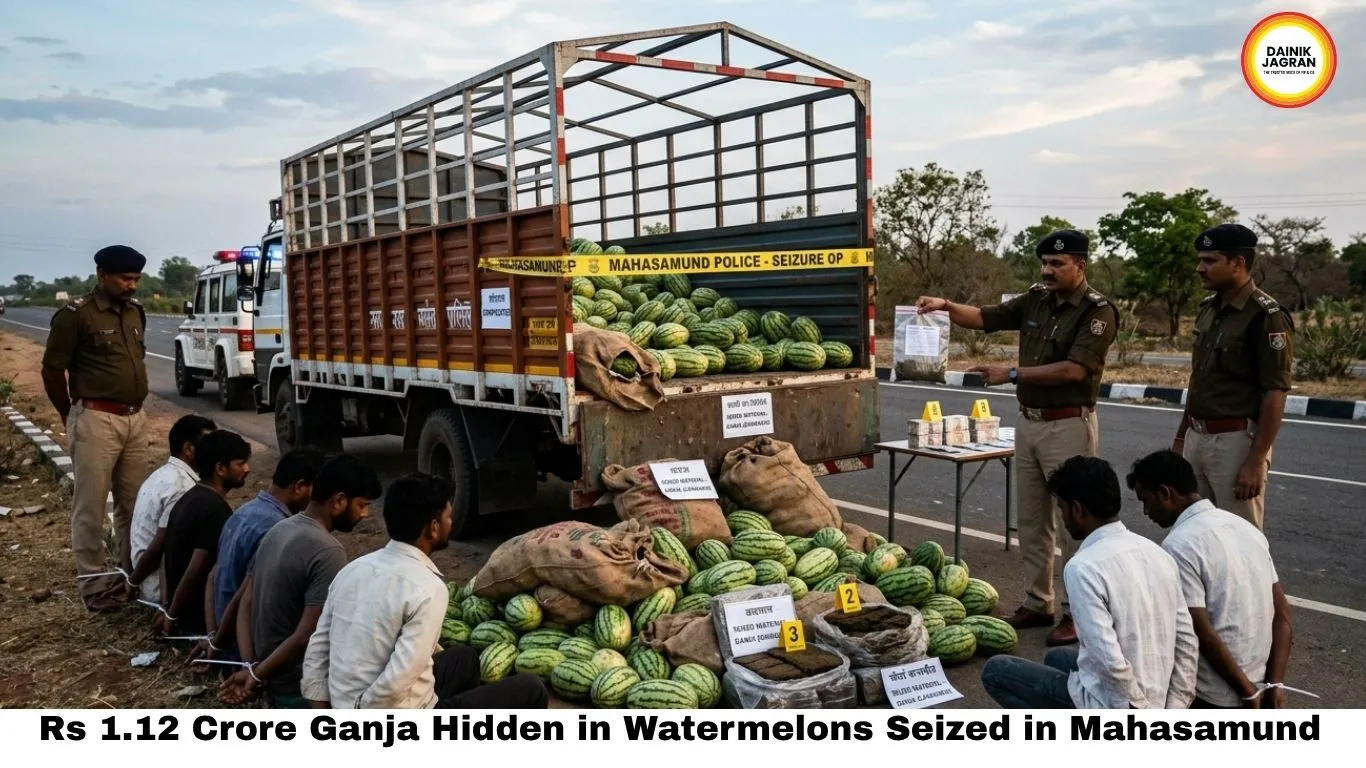
Mahasamund Police bust inter-state drug racket, seize Rs 1.12 crore ganja hidden under watermelons in a UP-bound pickup. Six arrested — two from MP, four from Uttar Pradesh.
In a sharp intelligence-driven operation, Mahasamund Police in Chhattisgarh have seized cannabis worth Rs 1.12 crore that was being smuggled from Odisha concealed beneath a load of watermelons in a pickup vehicle. Six individuals have been arrested in connection with the haul — two residents of Madhya Pradesh and four from Uttar Pradesh — in what police are describing as a significant strike against an inter-state drug trafficking network that was using the summer fruit season as cover for its operations.
The Watermelon Trick
The concealment method chosen by the smugglers was as brazen as it was calculated. A pickup vehicle loaded with watermelons — entirely unremarkable during the ongoing summer season when such vehicles move freely across state highways — was used to transport the contraband. The ganja was packed and placed beneath the layer of watermelons, designed to pass casual inspection without raising suspicion.
The vehicle was heading towards Uttar Pradesh when Mahasamund Police, acting on specific intelligence inputs about a suspicious consignment moving through the district, intercepted it. A thorough search of the vehicle revealed the concealed cannabis stash beneath the fruit — and the operation unravelled completely.
Six Arrested Across Two States
Six individuals travelling in or associated with the vehicle have been taken into custody. Of these, two are residents of Madhya Pradesh and four belong to Uttar Pradesh. Their arrest indicates that this was not a localised or opportunistic smuggling attempt — it was an organised, multi-state operation involving individuals from at least three states: Odisha as the source, Chhattisgarh as the transit corridor, and Uttar Pradesh as the intended destination market.
Police have registered a case under the relevant provisions of the Narcotic Drugs and Psychotropic Substances Act and have commenced interrogation of all six accused to map the full extent of the network behind the consignment.
Odisha-Chhattisgarh Drug Corridor
This seizure is the latest in a sustained and escalating series of anti-narcotics operations in Chhattisgarh, many of which have traced their supply chains back to Odisha. The Odisha-Chhattisgarh border has long been identified by law enforcement agencies as one of the most active cannabis trafficking corridors in central India. Odisha's forested and remote regions produce significant quantities of cannabis, and traffickers have consistently exploited Chhattisgarh's road network as a transit route to push the contraband northward — into Madhya Pradesh, Uttar Pradesh, and beyond.
Chhattisgarh Police and Odisha authorities have been coordinating more intensively in 2026 to counter this supply chain, with Odisha undertaking large-scale destruction of cannabis cultivation across tens of thousands of acres while Chhattisgarh has simultaneously stepped up seizures at border entry points and along interior transit routes. The Mahasamund haul fits squarely within this broader enforcement push.
Scale of the Crackdown in Chhattisgarh
The context behind this seizure underlines how significant the drug trafficking challenge has become for the state. Between January 2025 and January 2026 alone, Chhattisgarh Police registered over 1,400 drug cases, arrested nearly 2,600 accused, and seized upwards of 20,000 kilograms of ganja along with heroin, opium, and psychotropic substances. The state government has sanctioned 100 new posts specifically for Anti-Narcotics Task Force units across ten districts to intensify the campaign further.
The Mahasamund seizure — with a street value exceeding Rs 1.12 crore — represents one of the larger single hauls in the district's recent enforcement history and underscores both the scale of the trafficking problem and the increasingly sophisticated methods being used by smugglers to avoid detection.
Interrogation to Map the Network
With six accused now in custody, investigators are expected to focus their interrogation on three critical questions. First, who were the source contacts in Odisha — the individuals who procured and supplied the cannabis to the network? Second, who were the receiving parties in Uttar Pradesh — the buyers or distributors waiting for the consignment? Third, how many similar consignments had this network successfully moved before this interception?
Mobile phone data recovered from the accused is expected to provide a map of communication channels within the supply chain. Financial investigation is also likely, examining money transfers that may establish how payments were routed between the source, the carriers, and the buyers across state lines.
A Timely Warning to Traffickers
The use of seasonal agricultural produce — watermelons in this case — as a cover for drug smuggling is not unique to this operation. Across India, law enforcement agencies have documented traffickers concealing contraband in sacks of grain, vegetable loads, and fruit consignments precisely because these vehicles move in high volumes during peak seasons and typically attract less scrutiny at checkposts.
Mahasamund Police's success in intercepting this particular vehicle is a reminder that intelligence-based policing — acting on specific tip-offs rather than relying solely on routine checks — remains the most effective tool against organised drug smuggling networks operating across state boundaries.
--------
🚨 Beat the News Rush – Join Now!
Get breaking alerts, hot exclusives, and game-changing stories instantly on your phone. No delays, no fluff – just the edge you need. ⚡
Tap to join:
🟢 WhatsApp Channel: Dainik Jagran MP CG
Crave more?
🅕 Facebook: Dainik Jagran MP CG English
🅧 Twitter (X): Dainik Jagran MP CG
🅘 Instagram: Dainik Jagran MP CG
Share the fire – keep your crew ahead! 🗞️🔥
Rs 1.12 Crore Ganja Hidden in Watermelons Seized in Mahasamund
Digital Desk
In a sharp intelligence-driven operation, Mahasamund Police in Chhattisgarh have seized cannabis worth Rs 1.12 crore that was being smuggled from Odisha concealed beneath a load of watermelons in a pickup vehicle. Six individuals have been arrested in connection with the haul — two residents of Madhya Pradesh and four from Uttar Pradesh — in what police are describing as a significant strike against an inter-state drug trafficking network that was using the summer fruit season as cover for its operations.
The Watermelon Trick
The concealment method chosen by the smugglers was as brazen as it was calculated. A pickup vehicle loaded with watermelons — entirely unremarkable during the ongoing summer season when such vehicles move freely across state highways — was used to transport the contraband. The ganja was packed and placed beneath the layer of watermelons, designed to pass casual inspection without raising suspicion.
The vehicle was heading towards Uttar Pradesh when Mahasamund Police, acting on specific intelligence inputs about a suspicious consignment moving through the district, intercepted it. A thorough search of the vehicle revealed the concealed cannabis stash beneath the fruit — and the operation unravelled completely.
Six Arrested Across Two States
Six individuals travelling in or associated with the vehicle have been taken into custody. Of these, two are residents of Madhya Pradesh and four belong to Uttar Pradesh. Their arrest indicates that this was not a localised or opportunistic smuggling attempt — it was an organised, multi-state operation involving individuals from at least three states: Odisha as the source, Chhattisgarh as the transit corridor, and Uttar Pradesh as the intended destination market.
Police have registered a case under the relevant provisions of the Narcotic Drugs and Psychotropic Substances Act and have commenced interrogation of all six accused to map the full extent of the network behind the consignment.
Odisha-Chhattisgarh Drug Corridor
This seizure is the latest in a sustained and escalating series of anti-narcotics operations in Chhattisgarh, many of which have traced their supply chains back to Odisha. The Odisha-Chhattisgarh border has long been identified by law enforcement agencies as one of the most active cannabis trafficking corridors in central India. Odisha's forested and remote regions produce significant quantities of cannabis, and traffickers have consistently exploited Chhattisgarh's road network as a transit route to push the contraband northward — into Madhya Pradesh, Uttar Pradesh, and beyond.
Chhattisgarh Police and Odisha authorities have been coordinating more intensively in 2026 to counter this supply chain, with Odisha undertaking large-scale destruction of cannabis cultivation across tens of thousands of acres while Chhattisgarh has simultaneously stepped up seizures at border entry points and along interior transit routes. The Mahasamund haul fits squarely within this broader enforcement push.
Scale of the Crackdown in Chhattisgarh
The context behind this seizure underlines how significant the drug trafficking challenge has become for the state. Between January 2025 and January 2026 alone, Chhattisgarh Police registered over 1,400 drug cases, arrested nearly 2,600 accused, and seized upwards of 20,000 kilograms of ganja along with heroin, opium, and psychotropic substances. The state government has sanctioned 100 new posts specifically for Anti-Narcotics Task Force units across ten districts to intensify the campaign further.
The Mahasamund seizure — with a street value exceeding Rs 1.12 crore — represents one of the larger single hauls in the district's recent enforcement history and underscores both the scale of the trafficking problem and the increasingly sophisticated methods being used by smugglers to avoid detection.
Interrogation to Map the Network
With six accused now in custody, investigators are expected to focus their interrogation on three critical questions. First, who were the source contacts in Odisha — the individuals who procured and supplied the cannabis to the network? Second, who were the receiving parties in Uttar Pradesh — the buyers or distributors waiting for the consignment? Third, how many similar consignments had this network successfully moved before this interception?
Mobile phone data recovered from the accused is expected to provide a map of communication channels within the supply chain. Financial investigation is also likely, examining money transfers that may establish how payments were routed between the source, the carriers, and the buyers across state lines.
A Timely Warning to Traffickers
The use of seasonal agricultural produce — watermelons in this case — as a cover for drug smuggling is not unique to this operation. Across India, law enforcement agencies have documented traffickers concealing contraband in sacks of grain, vegetable loads, and fruit consignments precisely because these vehicles move in high volumes during peak seasons and typically attract less scrutiny at checkposts.
Mahasamund Police's success in intercepting this particular vehicle is a reminder that intelligence-based policing — acting on specific tip-offs rather than relying solely on routine checks — remains the most effective tool against organised drug smuggling networks operating across state boundaries.


