

Bhopal Municipal Corporation Opens New 8-Storey Headquarters Building
Digital Desk
Bhopal's new municipal headquarters, Atal Bhavan, consolidates civic services under one roof. Chief Minister inaugurates Rs 73-crore building with 10.5 MW solar project in Neemuch.
Bhopal Civic Chief Shifts to 8-Storey Hub in Tulsi Nagar
New municipal headquarters consolidates fragmented offices; 10.5 MW solar project goes live
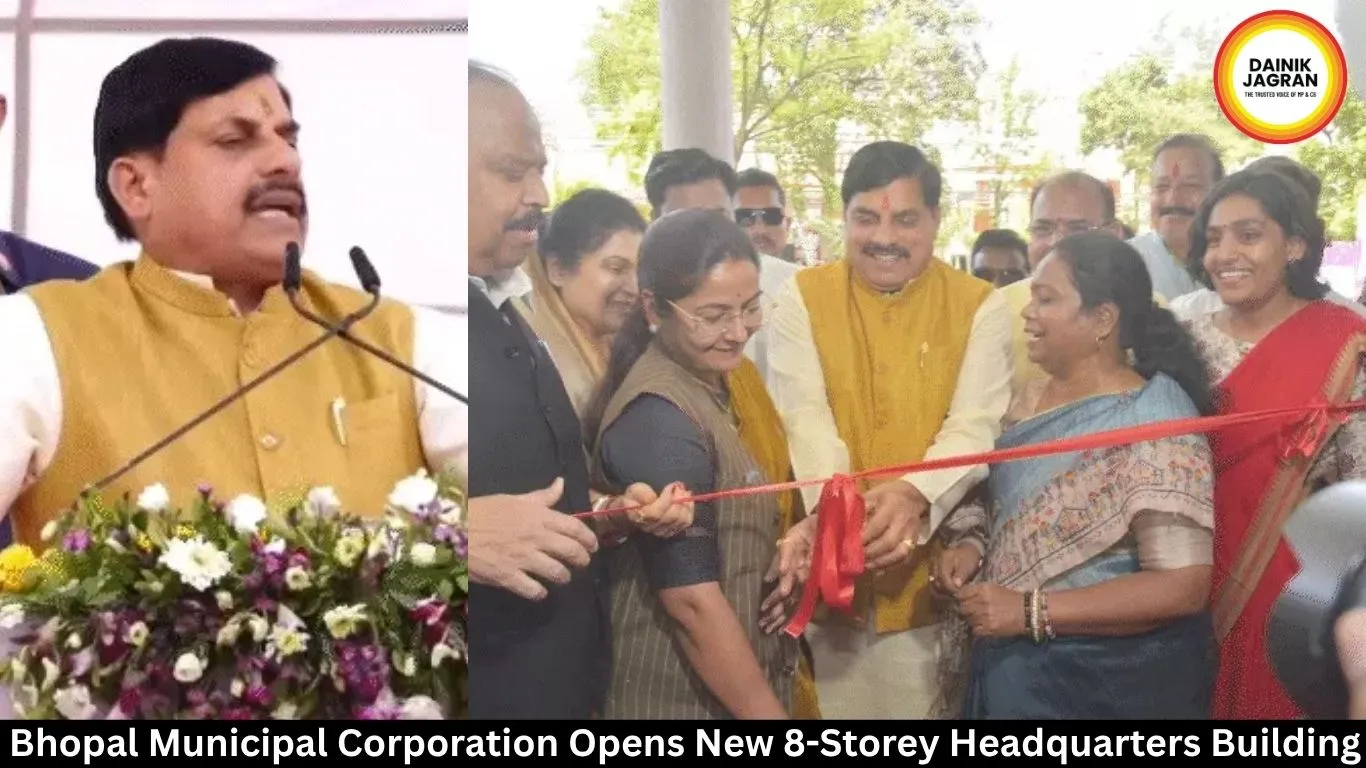
Bhopal's civic administration got a major operational overhaul on Thursday as Chief Minister Mohan Yadav inaugurated the Bhopal Municipal Corporation's new integrated headquarters—christened Atal Bhavan—on Tulsi Nagar's Second Stop area. The eight-storey structure, built at Rs 73 crore, marks the state's first municipal office equipped with geothermal technology and rooftop solar installations.
For residents accustomed to shuttling across the city for permits, registrations, and tax submissions, the consolidation promises immediate relief. All departments—from building permits to sewerage management—will now operate under one roof.
Departments converge under single building
The ground floor opens directly into a citizen facilitation centre. Tax counters, public relations, marriage registrations, and a dedicated play zone for children occupy the entry level. Floors one through four house the mayor's office, municipal corporation members, building approvals, water works, sewerage, and revenue departments. The upper levels accommodate planning cells, IT operations, smart city projects, health services, and parks management.
The corporation had already begun shifting operations two months before the formal inauguration. Central workshop facilities, housing-for-all programmes, civil works, electricity divisions, and cleanliness missions relocated to the new address. Previously, these branches sprawled across multiple locations—ISBT, Mata Mandir, Shahpura, and Fatehgarh—forcing citizens to navigate the sprawling city for routine administrative tasks.
Green building design with solar backbone
The five-acre facility incorporates green building principles, with solar panels installed across the parking structure expected to generate 300 kilowatts of power. Simultaneously, officials commissioned a 10.5-megawatt solar power project in Neemuch district under the corporation's setup.
Yet the infrastructure choice raises efficiency concerns. The panels face north-south orientation, a configuration that specialists suggest could compromise power generation efficiency despite the technology's promise.
Cost revision raises accountability questions
The project's financial trajectory drew public attention Thursday. Earlier municipal meetings pegged construction costs at Rs 43 crore. At the inauguration, Mayor Malti Ray announced the final figure as Rs 73 crore—a 70 percent cost escalation with no public clarification. The discrepancy, unexplained during the ceremony, has already sparked scrutiny regarding project management and fund allocation transparency.
Design shortcomings emerge post-inauguration
The newly minted headquarters revealed planning gaps even as Chief Minister Yadav cut the ribbon. A major oversight surfaced: the building lacks a dedicated meeting hall—a critical administrative space. Mayor Ray seized the inauguration moment to request additional land from the chief minister specifically to address this omission.
The structure underwent construction oversight through three different commissioners. K.V.S. Chowdhary Kolesani designed the building and oversaw roughly half the work; Harendra Narayan managed subsequent phases; and Sanskriti Jain presided over the final commissioning.
What officials envision
The building consolidation addresses a persistent administrative fragmentation that plagued Bhopal's civic operations. Earlier, citizens seeking multiple services faced a Byzantine journey across the city. The medical emergency room provisioned on-site caters to staff and visitor health needs, while the play zone and recreational spaces reflect an attempt at public-friendly municipal design.
Officials project operational efficiency gains once all departments sync their systems within the unified headquarters. However, the missing meeting hall and solar orientation issues suggest the building's operational maturity remains incomplete. The corporation must resolve these functional shortcomings to maximize the investment's intended benefits.
--------
🚨 Beat the News Rush – Join Now!
Get breaking alerts, hot exclusives, and game-changing stories instantly on your phone. No delays, no fluff – just the edge you need. ⚡
Tap to join:
🟢 WhatsApp Channel: Dainik Jagran MP CG
Crave more?
🅕 Facebook: Dainik Jagran MP CG English
🅧 Twitter (X): Dainik Jagran MP CG
🅘 Instagram: Dainik Jagran MP CG
Share the fire – keep your crew ahead! 🗞️🔥
Bhopal Municipal Corporation Opens New 8-Storey Headquarters Building
Digital Desk
Bhopal Civic Chief Shifts to 8-Storey Hub in Tulsi Nagar
New municipal headquarters consolidates fragmented offices; 10.5 MW solar project goes live
Bhopal's civic administration got a major operational overhaul on Thursday as Chief Minister Mohan Yadav inaugurated the Bhopal Municipal Corporation's new integrated headquarters—christened Atal Bhavan—on Tulsi Nagar's Second Stop area. The eight-storey structure, built at Rs 73 crore, marks the state's first municipal office equipped with geothermal technology and rooftop solar installations.
For residents accustomed to shuttling across the city for permits, registrations, and tax submissions, the consolidation promises immediate relief. All departments—from building permits to sewerage management—will now operate under one roof.
Departments converge under single building
The ground floor opens directly into a citizen facilitation centre. Tax counters, public relations, marriage registrations, and a dedicated play zone for children occupy the entry level. Floors one through four house the mayor's office, municipal corporation members, building approvals, water works, sewerage, and revenue departments. The upper levels accommodate planning cells, IT operations, smart city projects, health services, and parks management.
The corporation had already begun shifting operations two months before the formal inauguration. Central workshop facilities, housing-for-all programmes, civil works, electricity divisions, and cleanliness missions relocated to the new address. Previously, these branches sprawled across multiple locations—ISBT, Mata Mandir, Shahpura, and Fatehgarh—forcing citizens to navigate the sprawling city for routine administrative tasks.
Green building design with solar backbone
The five-acre facility incorporates green building principles, with solar panels installed across the parking structure expected to generate 300 kilowatts of power. Simultaneously, officials commissioned a 10.5-megawatt solar power project in Neemuch district under the corporation's setup.
Yet the infrastructure choice raises efficiency concerns. The panels face north-south orientation, a configuration that specialists suggest could compromise power generation efficiency despite the technology's promise.
Cost revision raises accountability questions
The project's financial trajectory drew public attention Thursday. Earlier municipal meetings pegged construction costs at Rs 43 crore. At the inauguration, Mayor Malti Ray announced the final figure as Rs 73 crore—a 70 percent cost escalation with no public clarification. The discrepancy, unexplained during the ceremony, has already sparked scrutiny regarding project management and fund allocation transparency.
Design shortcomings emerge post-inauguration
The newly minted headquarters revealed planning gaps even as Chief Minister Yadav cut the ribbon. A major oversight surfaced: the building lacks a dedicated meeting hall—a critical administrative space. Mayor Ray seized the inauguration moment to request additional land from the chief minister specifically to address this omission.
The structure underwent construction oversight through three different commissioners. K.V.S. Chowdhary Kolesani designed the building and oversaw roughly half the work; Harendra Narayan managed subsequent phases; and Sanskriti Jain presided over the final commissioning.
What officials envision
The building consolidation addresses a persistent administrative fragmentation that plagued Bhopal's civic operations. Earlier, citizens seeking multiple services faced a Byzantine journey across the city. The medical emergency room provisioned on-site caters to staff and visitor health needs, while the play zone and recreational spaces reflect an attempt at public-friendly municipal design.
Officials project operational efficiency gains once all departments sync their systems within the unified headquarters. However, the missing meeting hall and solar orientation issues suggest the building's operational maturity remains incomplete. The corporation must resolve these functional shortcomings to maximize the investment's intended benefits.


