

Climate Change Disrupts Migratory Bird Arrival at Bhopal Wetlands, Numbers Stall at 50–60%

Digital Desk

Climate Change Disrupts Migratory Bird Arrival at Bhopal Wetlands, Numbers Stall at 50–60%

The impact of climate change is increasingly evident across Bhopal’s major wetlands, where erratic weather patterns and altered water conditions have disrupted migratory bird movement this winter. Experts say bird arrivals at the Bhoj Wetland have stalled at just 50–60% of last year’s levels, raising concerns about long-term biodiversity and wetland health.

The slowdown has been observed across key water bodies, including Upper Lake (Bada Talab), Lower Lake (Chhota Talab), Kaliyasot Dam and Karwa Dam. Ornithologists attribute the decline to unstable winter conditions marked by sudden cold spells followed by rapid temperature increases, a pattern linked to climate change.

Bird expert Mohammad Khalik said the migration trend this season remains significantly below expectations. “Migration has reached only about 50–60% of last year’s numbers. While there is no sharp drop at the moment, the absence of a normal increase is worrying,” he said.

According to experts, fluctuating temperatures along traditional migratory routes are altering bird behaviour. Many species that usually travel through or settle in central India are now halting in colder northern regions or bypassing areas with inconsistent winter conditions. This has reduced the number of birds reaching Bhopal during the peak migration period.

High water levels in the city’s wetlands have compounded the problem. Due to good monsoon rainfall, incomplete drainage and continuous inflow, water levels remain higher than normal. This has particularly affected diving duck species, which rely on shallow waters to forage. Excess depth pushes food sources beyond reach, increasing stress and reducing habitat suitability.

These trends were reflected during the Bhoj Wetland Winter Bird Count 2025–26, conducted on Saturday. The annual survey was organised jointly by Bhopal Birds, the Madhya Pradesh State Wetland Authority (EPCO), Bhopal Forest Division and VNS Nature Savers.

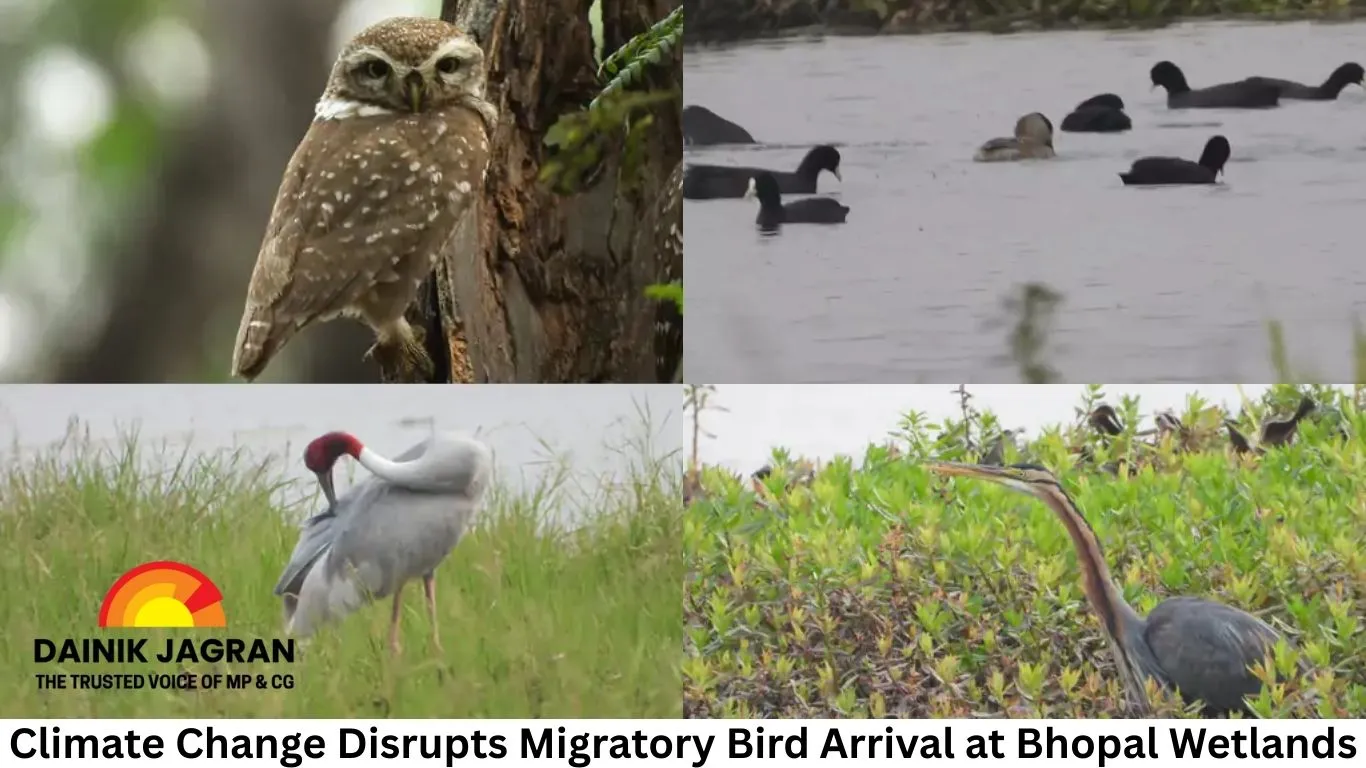
Beginning at 6 am, around 80 participants surveyed three zones of Bhoj Tal—Bishankhedi, Bamhori and Beel Kheda. The exercise recorded around 110 bird species, including Red-crested Pochard, Common Pochard, Common Coot, Brahminy Shelduck, Painted Stork, Purple Heron, Steppe Eagle, Black Redstart and Eurasian Wryneck. Zone-wise counts stood at 64 species in Bishankhedi, 55 in Bamhori and 45 in Beel Kheda.

Experts noted that while species diversity remains intact, overall numbers are lower than normal. Some hope remains, as several duck species traditionally arrive until late February. A reduction in water levels over the coming weeks could still improve conditions.

The event concluded with experts stressing that climate change has made continuous monitoring and wetland conservation more critical than ever. Without adaptive management and scientific intervention, they warned, migratory patterns and ecological balance in Bhopal’s wetlands could face lasting disruption.

--------

🚨 Beat the News Rush – Join Now!

Get breaking alerts, hot exclusives, and game-changing stories instantly on your phone. No delays, no fluff – just the edge you need. ⚡

Tap to join: 

🟢 WhatsApp Channel: Dainik Jagran MP CG

Crave more?

🅕 Facebook: Dainik Jagran MP CG English

🅧 Twitter (X): Dainik Jagran MP CG

🅘 Instagram: Dainik Jagran MP CG

Share the fire – keep your crew ahead! 🗞️🔥

english.dainikjagranmpcg.com
02 Feb 2026 By Nitin Trivedi

Climate Change Disrupts Migratory Bird Arrival at Bhopal Wetlands, Numbers Stall at 50–60%

Digital Desk

The slowdown has been observed across key water bodies, including Upper Lake (Bada Talab), Lower Lake (Chhota Talab), Kaliyasot Dam and Karwa Dam. Ornithologists attribute the decline to unstable winter conditions marked by sudden cold spells followed by rapid temperature increases, a pattern linked to climate change.

Bird expert Mohammad Khalik said the migration trend this season remains significantly below expectations. “Migration has reached only about 50–60% of last year’s numbers. While there is no sharp drop at the moment, the absence of a normal increase is worrying,” he said.

According to experts, fluctuating temperatures along traditional migratory routes are altering bird behaviour. Many species that usually travel through or settle in central India are now halting in colder northern regions or bypassing areas with inconsistent winter conditions. This has reduced the number of birds reaching Bhopal during the peak migration period.

High water levels in the city’s wetlands have compounded the problem. Due to good monsoon rainfall, incomplete drainage and continuous inflow, water levels remain higher than normal. This has particularly affected diving duck species, which rely on shallow waters to forage. Excess depth pushes food sources beyond reach, increasing stress and reducing habitat suitability.

These trends were reflected during the Bhoj Wetland Winter Bird Count 2025–26, conducted on Saturday. The annual survey was organised jointly by Bhopal Birds, the Madhya Pradesh State Wetland Authority (EPCO), Bhopal Forest Division and VNS Nature Savers.

Beginning at 6 am, around 80 participants surveyed three zones of Bhoj Tal—Bishankhedi, Bamhori and Beel Kheda. The exercise recorded around 110 bird species, including Red-crested Pochard, Common Pochard, Common Coot, Brahminy Shelduck, Painted Stork, Purple Heron, Steppe Eagle, Black Redstart and Eurasian Wryneck. Zone-wise counts stood at 64 species in Bishankhedi, 55 in Bamhori and 45 in Beel Kheda.

Experts noted that while species diversity remains intact, overall numbers are lower than normal. Some hope remains, as several duck species traditionally arrive until late February. A reduction in water levels over the coming weeks could still improve conditions.

The event concluded with experts stressing that climate change has made continuous monitoring and wetland conservation more critical than ever. Without adaptive management and scientific intervention, they warned, migratory patterns and ecological balance in Bhopal’s wetlands could face lasting disruption.

https://english.dainikjagranmpcg.com/states/madhya-pradesh/climate-change-disrupts-migratory-bird-arrival-at-bhopal-wetlands-numbers/article-13534

Related Posts

Latest News


