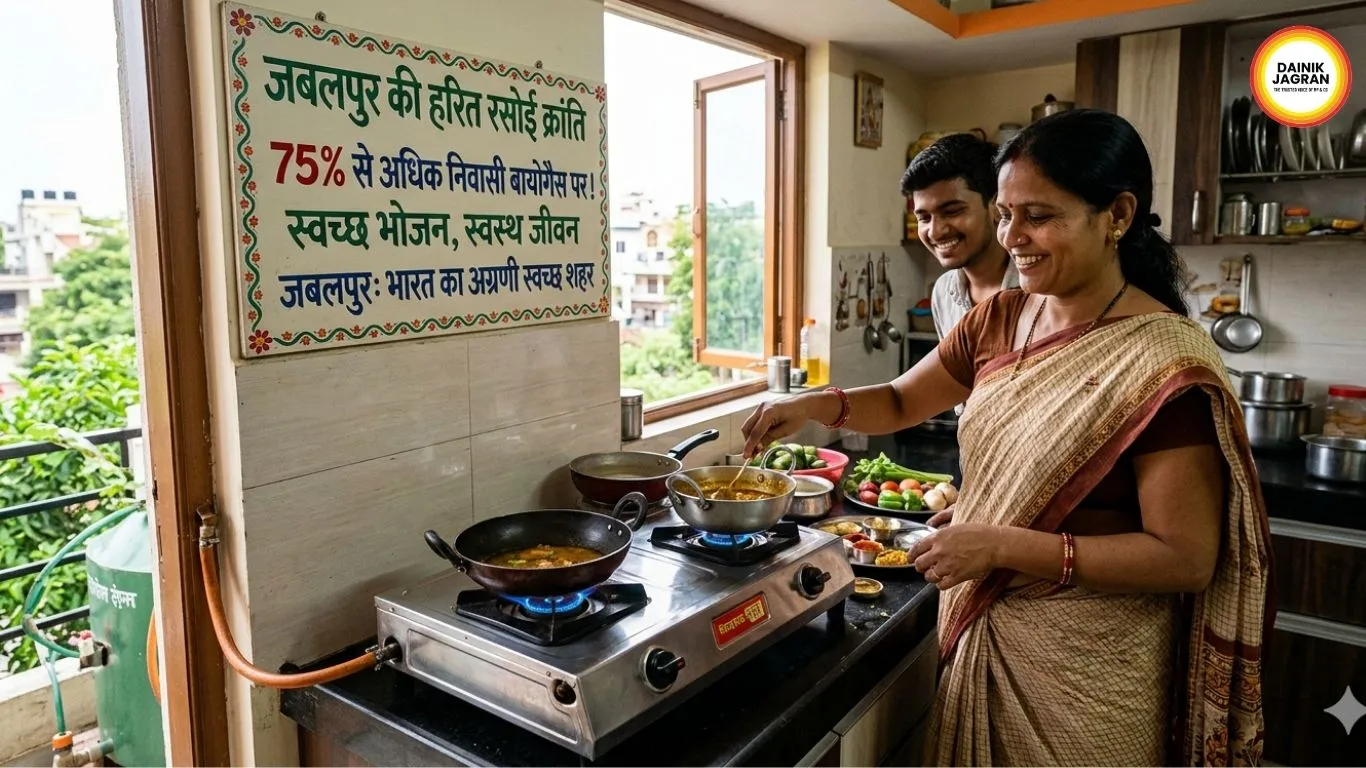
Jabalpur's Green Kitchen Revolution: How 75% of the City Is Cooking With Biogas and Why It Matters for India
Digital Desk
While India's big cities debate electric vehicles and solar panels, a quieter but more powerful green revolution is already happening in Jabalpur. In this Madhya Pradesh city, an extraordinary 75 percent of residents have switched to biogas as their primary cooking fuel — a figure that puts Jabalpur far ahead of most urban centres in India's clean energy transition.
This is not a government pilot project. This is a community-led shift that has quietly transformed how thousands of Jabalpur families cook their daily meals — and it carries lessons for every city in the country.
What Is Driving Jabalpur's Biogas Boom
Biogas is produced naturally when organic waste — cattle dung, kitchen waste, agricultural residue — breaks down without oxygen. The resulting gas is rich in methane and burns cleanly, just like LPG, without the smoke, soot, or imported fuel dependency that comes with conventional cooking fuels.
For Jabalpur's households, the advantages are immediate and practical. Biogas plants produce fuel from waste that is already available in homes and farms. There is no cylinder to book, no price hike to worry about, and no delivery to wait for. The fuel is local, renewable, and largely free once the plant is set up.
India currently has around 4.31 million family-type biogas plants installed nationwide — but Jabalpur's 75 percent adoption rate suggests the city has achieved something that national policy has struggled to replicate at scale elsewhere.
Why This Matters Right Now
India's clean cooking story in 2026 is at a crossroads. A major new report by the International Institute for Sustainable Development released in February 2026 found that decentralised biogas can work at scale across India — but only if supported by targeted finance, services, and policy. The report also noted that households adopting biogas have reduced firewood use by roughly 70 percent annually, with significant improvements in health and household air quality.
Despite over 33 crore LPG connections across India, 37 percent of Indian households still rely primarily on solid fuels for cooking. The affordability gap is real. LPG prices fluctuate with global markets, and low-income households — particularly in smaller cities and rural belts — bear the heaviest burden.
Jabalpur's model offers a direct answer to this problem.
The National Push Behind Biogas
The timing could not be better. The Indian government's National Bioenergy Programme, running through 2025–26, has allocated Rs 100 crore specifically to support small and medium biogas plant installations across the country. The Ministry of New and Renewable Energy provides direct financial assistance and subsidies to households setting up biogas plants, with additional support for SC/ST households, hilly states, and North-East India.
India's biogas sector is also attracting serious industrial investment. The Indian Biogas Association projects that the sector will draw over Rs 5,000 crore in investments in 2026–27 alone, with the industry expected to reach a valuation of USD 3–4 billion by the end of 2026 and nearly USD 5 billion by 2030.
Jabalpur's community-level success story — built from the ground up — now aligns perfectly with this national momentum.
What Jabalpur Is Getting Right
Three things stand out in Jabalpur's approach that other cities can learn from directly.
Local ownership over dependency. When households manage their own biogas plants, they are not dependent on supply chains or government subsidies to keep their kitchens running. Energy sovereignty at the household level is a powerful motivator.
Waste becomes fuel. Kitchen and cattle waste — which would otherwise pollute water bodies or generate methane emissions uncontrolled — becomes a clean cooking resource. The city reduces its waste burden while also solving its energy gap.
Women benefit most. Biogas eliminates the need to collect firewood and removes indoor smoke pollution — two burdens that fall disproportionately on women and children. In Jabalpur's homes, clean cooking is also a public health and gender equality achievement.
The Road Ahead
Jabalpur's 75 percent adoption figure is remarkable — but the work is not done. Sustaining and maintaining biogas infrastructure requires trained technicians, accessible spare parts, and continued community awareness. As the city grows and its population diversifies, ensuring that newer residents and urban migrants are included in the biogas ecosystem will be the next challenge.
At the national level, policymakers would do well to study Jabalpur closely. India has the organic waste, the livestock density, the rural infrastructure, and now the policy funding to replicate this model in hundreds of cities.
The green kitchen revolution does not always start with a new technology or a big government scheme. Sometimes, it starts with a city of ordinary people making an extraordinary choice — one biogas plant at a time.
Jabalpur has made that choice. The question now is: which city is next?