

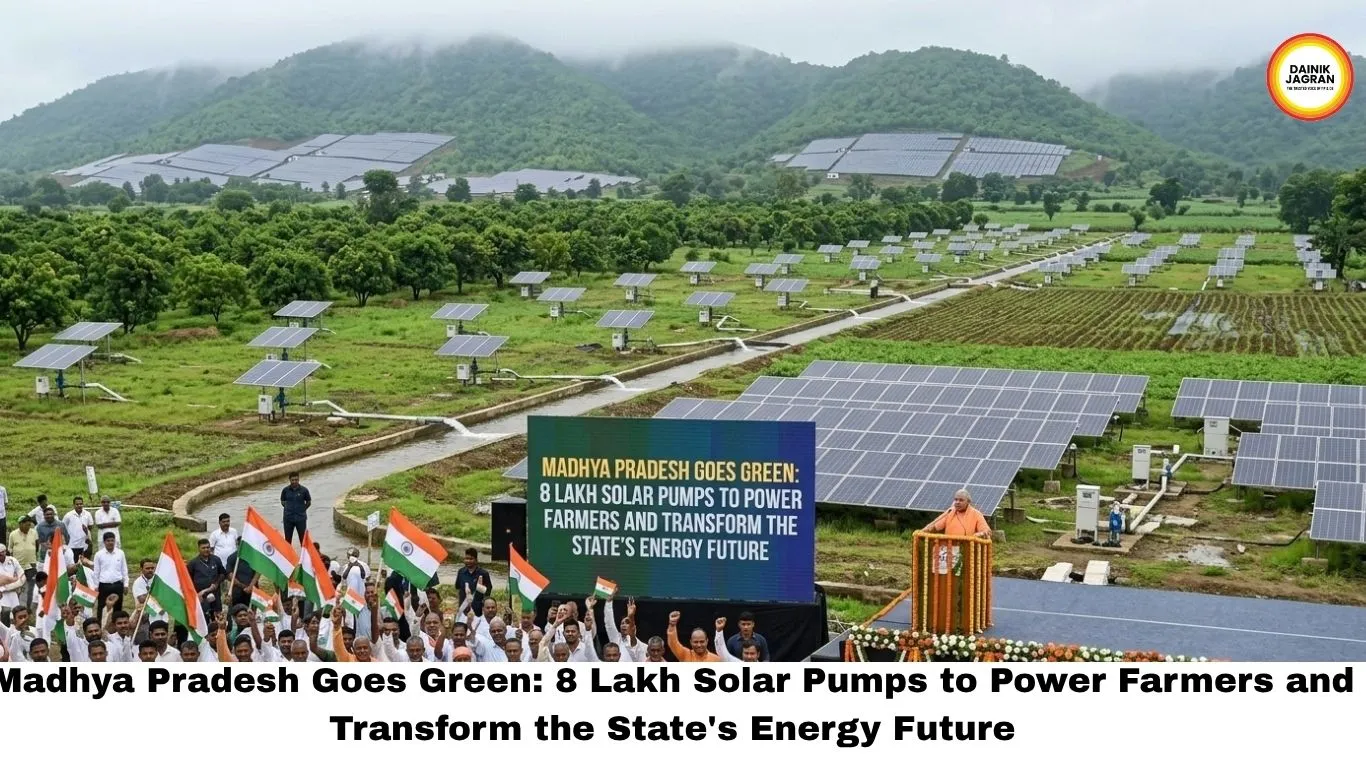
Madhya Pradesh Goes Green: 8 Lakh Solar Pumps to Power Farmers and Transform the State's Energy Future

Digital Desk

Madhya Pradesh Goes Green: 8 Lakh Solar Pumps to Power Farmers and Transform the State's Energy Future

Madhya Pradesh targets 8 lakh solar pumps for farmers under PM KUSUM and state schemes. Here's how MP is turning green with ₹3,000 crore investment.

Madhya Pradesh Goes Green: 8 Lakh Solar Pumps to Power Farmers and Transform the State's Energy Future

In a move that could permanently change how Madhya Pradesh's farmers grow their crops and how the state powers its future, the Mohan Yadav government has committed to putting 8 lakh solar-powered irrigation pumps in the hands of farmers — eliminating diesel costs, cutting electricity bills, and making MP one of India's greenest agricultural states in the process.

This is not a distant promise. It is a funded, phased, and already-moving mission — and the numbers behind it are impossible to ignore.

Where MP Stands Today — And Where It Is Headed

Madhya Pradesh already has over 6 lakh farmers who have received solar pumps under various central and state schemes. The state government has now announced that this number will be pushed to 8 lakh and beyond, with a fresh allocation of ₹3,000 crore in the MP Budget 2026 specifically for the solar pump scheme to strengthen irrigation infrastructure across the state.

Finance Minister Jagdish Devda, while presenting the budget in the Madhya Pradesh Assembly, made the government's intent crystal clear: the solar pump mission is not slowing down — it is accelerating. Farmers who have already received pumps are producing results. The government wants every remaining farmer dependent on diesel or erratic grid electricity to make the shift to clean, free solar power as quickly as possible.

What the Solar Pump Mission Means for an MP Farmer

For a farmer in Narsinghpur, Sehore, or Hoshangabad, a solar pump is not just an environmental choice — it is an economic lifeline. Diesel-powered pumps are expensive to run and dependent on fuel supply chains that can break down during sowing or harvesting season. Grid electricity in rural MP is often available only at night, forcing farmers to irrigate crops in darkness, risking both safety and efficiency.

A solar pump changes everything. It runs during daylight hours when sunlight is strongest and irrigation need is highest. It has no fuel cost. It requires minimal maintenance. And under the PM KUSUM scheme — the central government's Pradhan Mantri Kisan Urja Suraksha evam Utthaan Mahabhiyan — farmers can receive up to 60 percent subsidy on the purchase cost, with additional state top-up subsidies bringing the farmer's out-of-pocket contribution down further still.

Under MP's own scheme — the Pradhan Mantri Krishak Mitra Surya Yojana — ₹447 crore has been specifically allocated this fiscal year to replace existing agricultural connections with solar-powered systems, building on the central KUSUM framework with state-level urgency.

The Bigger Green Picture: MP's Renewable Energy Ambition

The solar pump mission sits inside a much larger transformation happening across Madhya Pradesh's energy sector. The state currently has over 10,366 MW of installed renewable energy capacity, with solar power leading at more than 5,000 MW. Chief Minister Mohan Yadav has set an ambitious target — 50 percent of MP's electricity needs to come from solar energy by 2030.

To reach that target, the state is not just installing pumps on farms. It is developing large-scale solar parks, pursuing floating solar installations on reservoirs — including the Omkareshwar reservoir — and attracting massive industrial investment. NTPC has committed a ₹2 trillion investment in MP's renewable energy sector, covering solar, wind, and pumped hydro storage projects. Shakti Pumps, one of India's leading pump manufacturers based in MP's own Pithampur industrial corridor, has simultaneously invested in a new 2.20 GW solar manufacturing plant — creating a full ecosystem of solar production, installation, and use within the state's own borders.

Why 8 Lakh Pumps Is a Transformational Number

Eight lakh solar pumps, running across MP's agricultural districts, represent an extraordinary volume of decentralised clean energy. Each pump eliminates the equivalent of thousands of litres of diesel per year from the state's agricultural carbon footprint. Each pump saves a farmer between ₹30,000 and ₹70,000 annually in fuel and electricity costs depending on their land size and crop cycle. Multiply that saving across 8 lakh farms and you have a rural economic stimulus worth thousands of crores — money that stays in farmers' hands rather than flowing to fuel dealers.

There is also a water management dimension. Solar pumps operating during daytime hours allow for more disciplined irrigation schedules, better water conservation, and reduced over-extraction from groundwater. In a state where agriculture depends heavily on groundwater, this is a meaningful environmental benefit alongside the economic one.

The Road Ahead: Challenges MP Must Solve

No mission of this scale is without its hurdles. Solar pump installation requires trained technicians for maintenance, a supply chain for replacement parts, and a clear grievance mechanism when equipment fails. Rural MP's terrain — from the Vindhya hills to the Narmada plains to the Bundelkhand plateau — presents logistical complexity. The government will need to ensure that the subsidy pipeline reaches small and marginal farmers first, not just those with the resources to navigate bureaucratic processes.

But the direction is clear, the budget is allocated, and the momentum is real.

Madhya Pradesh is writing a green story that deserves far more national attention than it currently receives. Eight lakh solar pumps for farmers is not a slogan — it is a structural transformation of how the heartland of India grows its food and generates its energy. With ₹3,000 crore committed in the budget, more than 6 lakh pumps already delivered, and a state government that has made renewable energy a defining policy priority, MP is no longer just the soybean capital of India. It is fast becoming the solar capital too. And for the farmers of this state, the sun has never looked more promising.

english.dainikjagranmpcg.com
26 Mar 2026 By Jiya.S

Madhya Pradesh Goes Green: 8 Lakh Solar Pumps to Power Farmers and Transform the State's Energy Future

Digital Desk

Madhya Pradesh Goes Green: 8 Lakh Solar Pumps to Power Farmers and Transform the State's Energy Future

In a move that could permanently change how Madhya Pradesh's farmers grow their crops and how the state powers its future, the Mohan Yadav government has committed to putting 8 lakh solar-powered irrigation pumps in the hands of farmers — eliminating diesel costs, cutting electricity bills, and making MP one of India's greenest agricultural states in the process.

This is not a distant promise. It is a funded, phased, and already-moving mission — and the numbers behind it are impossible to ignore.

Where MP Stands Today — And Where It Is Headed

Madhya Pradesh already has over 6 lakh farmers who have received solar pumps under various central and state schemes. The state government has now announced that this number will be pushed to 8 lakh and beyond, with a fresh allocation of ₹3,000 crore in the MP Budget 2026 specifically for the solar pump scheme to strengthen irrigation infrastructure across the state.

Finance Minister Jagdish Devda, while presenting the budget in the Madhya Pradesh Assembly, made the government's intent crystal clear: the solar pump mission is not slowing down — it is accelerating. Farmers who have already received pumps are producing results. The government wants every remaining farmer dependent on diesel or erratic grid electricity to make the shift to clean, free solar power as quickly as possible.

What the Solar Pump Mission Means for an MP Farmer

For a farmer in Narsinghpur, Sehore, or Hoshangabad, a solar pump is not just an environmental choice — it is an economic lifeline. Diesel-powered pumps are expensive to run and dependent on fuel supply chains that can break down during sowing or harvesting season. Grid electricity in rural MP is often available only at night, forcing farmers to irrigate crops in darkness, risking both safety and efficiency.

A solar pump changes everything. It runs during daylight hours when sunlight is strongest and irrigation need is highest. It has no fuel cost. It requires minimal maintenance. And under the PM KUSUM scheme — the central government's Pradhan Mantri Kisan Urja Suraksha evam Utthaan Mahabhiyan — farmers can receive up to 60 percent subsidy on the purchase cost, with additional state top-up subsidies bringing the farmer's out-of-pocket contribution down further still.

Under MP's own scheme — the Pradhan Mantri Krishak Mitra Surya Yojana — ₹447 crore has been specifically allocated this fiscal year to replace existing agricultural connections with solar-powered systems, building on the central KUSUM framework with state-level urgency.

The Bigger Green Picture: MP's Renewable Energy Ambition

The solar pump mission sits inside a much larger transformation happening across Madhya Pradesh's energy sector. The state currently has over 10,366 MW of installed renewable energy capacity, with solar power leading at more than 5,000 MW. Chief Minister Mohan Yadav has set an ambitious target — 50 percent of MP's electricity needs to come from solar energy by 2030.

To reach that target, the state is not just installing pumps on farms. It is developing large-scale solar parks, pursuing floating solar installations on reservoirs — including the Omkareshwar reservoir — and attracting massive industrial investment. NTPC has committed a ₹2 trillion investment in MP's renewable energy sector, covering solar, wind, and pumped hydro storage projects. Shakti Pumps, one of India's leading pump manufacturers based in MP's own Pithampur industrial corridor, has simultaneously invested in a new 2.20 GW solar manufacturing plant — creating a full ecosystem of solar production, installation, and use within the state's own borders.

Why 8 Lakh Pumps Is a Transformational Number

Eight lakh solar pumps, running across MP's agricultural districts, represent an extraordinary volume of decentralised clean energy. Each pump eliminates the equivalent of thousands of litres of diesel per year from the state's agricultural carbon footprint. Each pump saves a farmer between ₹30,000 and ₹70,000 annually in fuel and electricity costs depending on their land size and crop cycle. Multiply that saving across 8 lakh farms and you have a rural economic stimulus worth thousands of crores — money that stays in farmers' hands rather than flowing to fuel dealers.

There is also a water management dimension. Solar pumps operating during daytime hours allow for more disciplined irrigation schedules, better water conservation, and reduced over-extraction from groundwater. In a state where agriculture depends heavily on groundwater, this is a meaningful environmental benefit alongside the economic one.

The Road Ahead: Challenges MP Must Solve

No mission of this scale is without its hurdles. Solar pump installation requires trained technicians for maintenance, a supply chain for replacement parts, and a clear grievance mechanism when equipment fails. Rural MP's terrain — from the Vindhya hills to the Narmada plains to the Bundelkhand plateau — presents logistical complexity. The government will need to ensure that the subsidy pipeline reaches small and marginal farmers first, not just those with the resources to navigate bureaucratic processes.

But the direction is clear, the budget is allocated, and the momentum is real.

Madhya Pradesh is writing a green story that deserves far more national attention than it currently receives. Eight lakh solar pumps for farmers is not a slogan — it is a structural transformation of how the heartland of India grows its food and generates its energy. With ₹3,000 crore committed in the budget, more than 6 lakh pumps already delivered, and a state government that has made renewable energy a defining policy priority, MP is no longer just the soybean capital of India. It is fast becoming the solar capital too. And for the farmers of this state, the sun has never looked more promising.

https://english.dainikjagranmpcg.com/states/madhya-pradesh/madhya-pradesh-goes-green-8-lakh-solar-pumps-to-power/article-16039

Related Posts

Advertisement

Latest News


