

Tractors Seized in Baghnadi — But Balaghat's Sand Mafia Is Still Winning

Digital Desk

Tractors Seized in Baghnadi — But Balaghat's Sand Mafia Is Still Winning

Tractor seized in Baghnadi, Balaghat for illegal sand transport. But MP's sand mafia runs deep — rivers dying, officials attacked, crackdowns ignored.

One Tractor. One Seizure. One Day's News.

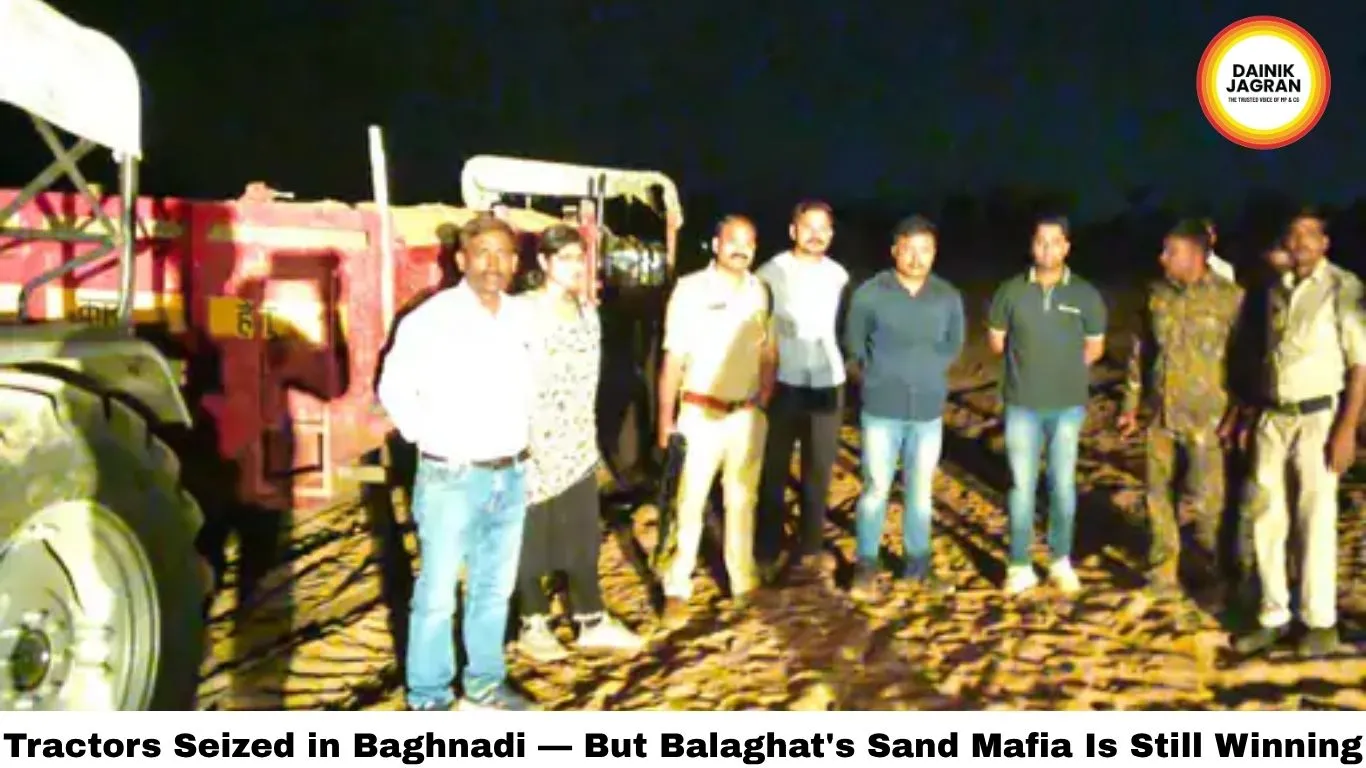
A tractor carrying illegally transported sand was seized in Baghnadi, Balaghat district. The driver was detained. The vehicle was impounded. An FIR was registered under the Mines and Minerals Development and Regulation Act.

By tomorrow, another tractor will be on the same road.

This is the exhausting, repetitive reality of illegal sand mining in Balaghat — one of Madhya Pradesh's most resource-rich and most exploited districts. Seizures happen. FIRs are filed. And then, almost without pause, the trucks roll again. Because the tractor that gets caught is never the problem. The system that puts it on the road is.


Why Balaghat Is Ground Zero for Sand Mafia

Balaghat sits at the confluence of several rivers that sand mafia operators consider a goldmine — literally. The Wainganga, the Bawanthadi and the Bagh rivers all flow through or near the district, carrying the high-quality riverbed sand that India's construction industry cannot get enough of.

What makes Balaghat uniquely vulnerable is its geography. It sits on the Madhya Pradesh-Maharashtra border. And that border is where the money is made.

MP's government royalty on sand stands at roughly ₹362 per brass. Maharashtra charges ₹2,000 per brass for the same material. That staggering difference — over five times the MP rate — is the economic engine of the entire illegal sand trade in this region. Sand mined illegally in Balaghat's rivers is loaded onto tractors and dumpers, driven across the border into Gondia district of Maharashtra, and sold at Maharashtra prices — generating enormous profits on material that cost the mafia next to nothing to extract.

Every tractor seized in Baghnadi today is the visible tip of an invisible operation that has been running for years and generating crores in illegal profits every single month.


A Pattern of Raids That Changes Nothing

The Balaghat district administration has been conducting raids on illegal sand mining for years. The record is not one of inaction — it is one of action without consequence.

In December 2025, a joint team of the Tehsildar, Revenue Department and Mining Department conducted operations at the Wainganga River in Gaykhuri village. A temporary bridge that had been secretly constructed across the river — specifically to enable illegal sand mining and transportation — was demolished using a JCB. The approach road was blocked. Officials declared the crackdown a success.

Within weeks, operations resumed at adjacent locations.

In October 2025, the National Green Tribunal stepped in directly. The NGT issued orders to the Balaghat District Magistrate and Superintendent of Police to ensure no illegal mining takes place at the Bawanthadi River in Chicholi village, Kharlanji tehsil. The NGT noted that sand mafia operators had been mining using heavy Poklane machines, digging pits 20 to 25 feet deep — far beyond any permitted depth — and operating well outside their licensed lease boundaries.

The NGT had to intervene because local enforcement had not stopped it.


The Violence Nobody Talks About

Here is the part of the Balaghat sand mafia story that rarely makes headlines outside the district — but that defines the true scale of the problem.

Officials who try to stop the sand mafia in this region face violence. Not isolated incidents. Systematic, organised violence designed to intimidate enforcement personnel into backing off. Revenue officials have been attacked. Police personnel have been threatened. In one documented episode, while revenue officials were asking police to act against attackers, the police themselves were seen standing down — allegedly because the mafia operated with political protection.

The Bombay High Court took suo motu cognisance of attacks on government officials conducting anti-sand-mining enforcement in the Balaghat-Gondia border region after multiple incidents of violence went unaddressed. When a High Court has to step in to protect government officials doing their jobs, the message about who actually controls the territory is not subtle.


The Rivers Are Paying the Price

Beyond the economics and the politics, there is an environmental catastrophe unfolding in Balaghat's rivers — quietly, steadily, and almost entirely unreported.

Illegal sand mining at the scale and depth being conducted on the Wainganga and Bawanthadi is not just removing sand. It is fundamentally altering river morphology. When pits 20 to 25 feet deep are dug in a riverbed, the natural flow dynamics of the river change permanently. Water tables drop. Riverbeds destabilise. Fish populations collapse. The agricultural communities that depend on river water for irrigation find their access drying up as the water table falls.

Bridges and causeways near illegal mining sites are at structural risk — the removal of sand from under and around foundations is the engineering equivalent of pulling the ground out from under a building. Several bridges in the Balaghat-Gondia border region have already been flagged as potentially compromised by the sustained mining activity around them.

And once a riverbed is damaged at this depth and scale, recovery is not a matter of months. It takes decades — if it happens at all.


The Royalty Loophole That Funds Everything

To understand why this problem persists despite raids, NGT orders, High Court interventions and district administration crackdowns, you need to understand the fundamental economic incentive structure.

The ₹362 vs ₹2,000 royalty differential between MP and Maharashtra is not a minor pricing quirk. It is a structural policy gap that makes illegal cross-border sand trade one of the most profitable criminal enterprises in central India. Every unit of sand that crosses the border illegally generates a profit margin that easily absorbs the occasional cost of a seized tractor, a paid-off fine or a brief operational pause during a crackdown period.

Until that differential is addressed — either by raising MP's royalty rate to reduce the arbitrage, or by creating a joint enforcement mechanism between the two state governments that targets cross-border transport rather than just point-of-extraction seizures — the economics of the trade will always outrun the enforcement.


What a Real Crackdown Actually Looks Like

Bihar offers the most instructive recent comparison. In December 2025, the Bihar government launched a month-long state-wide enforcement campaign against illegal sand mining that was genuinely different in scale and structure from what Balaghat has seen. Over 4,500 raids. 574 vehicles seized. 248 FIRs registered. A Special Task Force created specifically to investigate and dismantle the financial networks of sand mafias — not just seize their vehicles.

The result: Bihar's Mines Department surpassed its annual revenue target for the first time in years — proof that dismantling illegal operations does not just protect the environment, it restores government revenue that the mafia was stealing.

The key difference in Bihar's approach was financial investigation. By targeting the money — the bank accounts, the property, the hidden assets — rather than just the tractors, Bihar hit the mafia where it actually hurts. Seizing a tractor costs the mafia one tractor. Seizing the profits from six months of operations costs the mafia its business model.


Three Things That Must Happen in Balaghat

One: Joint MP-Maharashtra enforcement. The cross-border sand trade cannot be dismantled by one state acting alone. A permanent joint enforcement mechanism — with shared intelligence, coordinated raids and mutual recognition of legal actions — is the only way to close the border arbitrage that funds the entire operation.

Two: Financial investigation, not just vehicle seizure. Every tractor seized in Baghnadi should trigger an automatic financial investigation into who owns the vehicle, who arranged the transport contract and where the money flows. Tractors are replaceable. Bank accounts are traceable.

Three: NGT orders must have teeth. The NGT issued clear orders to the Balaghat DM and SP in October 2025. The fact that illegal mining continued after those orders is not just a local enforcement failure — it is contempt of a court order. The NGT must follow up with compliance hearings, and officials who failed to enforce its directions must face accountability.


The Bottom Line

The tractor seized in Baghnadi today is one tractor. It represents one arrest, one FIR and one news story. By next week it will be forgotten — and the sand will still be moving.

Balaghat's rivers have been mined illegally for years. They have been defended by officials who faced violence for trying to do their jobs. They have been the subject of NGT orders, High Court interventions and district administration crackdowns. And the sand mafia is still operating.

That is not a story about one tractor on one road in Baghnadi. It is a story about a system that has learned to absorb enforcement without changing behaviour — because the profits are too large, the political connections too deep and the consequences too thin.

Until that changes, the rivers of Balaghat will keep getting poorer. And the mafia will keep getting richer.

--------

🚨 Beat the News Rush – Join Now!

Get breaking alerts, hot exclusives, and game-changing stories instantly on your phone. No delays, no fluff – just the edge you need. ⚡

Tap to join: 

🟢 WhatsApp Channel: Dainik Jagran MP CG

Crave more?

🅕 Facebook: Dainik Jagran MP CG English

🅧 Twitter (X): Dainik Jagran MP CG

🅘 Instagram: Dainik Jagran MP CG

Share the fire – keep your crew ahead! 🗞️🔥

english.dainikjagranmpcg.com
26 Mar 2026 By Nitin Trivedi

Tractors Seized in Baghnadi — But Balaghat's Sand Mafia Is Still Winning

Digital Desk

One Tractor. One Seizure. One Day's News.

A tractor carrying illegally transported sand was seized in Baghnadi, Balaghat district. The driver was detained. The vehicle was impounded. An FIR was registered under the Mines and Minerals Development and Regulation Act.

By tomorrow, another tractor will be on the same road.

This is the exhausting, repetitive reality of illegal sand mining in Balaghat — one of Madhya Pradesh's most resource-rich and most exploited districts. Seizures happen. FIRs are filed. And then, almost without pause, the trucks roll again. Because the tractor that gets caught is never the problem. The system that puts it on the road is.


Why Balaghat Is Ground Zero for Sand Mafia

Balaghat sits at the confluence of several rivers that sand mafia operators consider a goldmine — literally. The Wainganga, the Bawanthadi and the Bagh rivers all flow through or near the district, carrying the high-quality riverbed sand that India's construction industry cannot get enough of.

What makes Balaghat uniquely vulnerable is its geography. It sits on the Madhya Pradesh-Maharashtra border. And that border is where the money is made.

MP's government royalty on sand stands at roughly ₹362 per brass. Maharashtra charges ₹2,000 per brass for the same material. That staggering difference — over five times the MP rate — is the economic engine of the entire illegal sand trade in this region. Sand mined illegally in Balaghat's rivers is loaded onto tractors and dumpers, driven across the border into Gondia district of Maharashtra, and sold at Maharashtra prices — generating enormous profits on material that cost the mafia next to nothing to extract.

Every tractor seized in Baghnadi today is the visible tip of an invisible operation that has been running for years and generating crores in illegal profits every single month.


A Pattern of Raids That Changes Nothing

The Balaghat district administration has been conducting raids on illegal sand mining for years. The record is not one of inaction — it is one of action without consequence.

In December 2025, a joint team of the Tehsildar, Revenue Department and Mining Department conducted operations at the Wainganga River in Gaykhuri village. A temporary bridge that had been secretly constructed across the river — specifically to enable illegal sand mining and transportation — was demolished using a JCB. The approach road was blocked. Officials declared the crackdown a success.

Within weeks, operations resumed at adjacent locations.

In October 2025, the National Green Tribunal stepped in directly. The NGT issued orders to the Balaghat District Magistrate and Superintendent of Police to ensure no illegal mining takes place at the Bawanthadi River in Chicholi village, Kharlanji tehsil. The NGT noted that sand mafia operators had been mining using heavy Poklane machines, digging pits 20 to 25 feet deep — far beyond any permitted depth — and operating well outside their licensed lease boundaries.

The NGT had to intervene because local enforcement had not stopped it.


The Violence Nobody Talks About

Here is the part of the Balaghat sand mafia story that rarely makes headlines outside the district — but that defines the true scale of the problem.

Officials who try to stop the sand mafia in this region face violence. Not isolated incidents. Systematic, organised violence designed to intimidate enforcement personnel into backing off. Revenue officials have been attacked. Police personnel have been threatened. In one documented episode, while revenue officials were asking police to act against attackers, the police themselves were seen standing down — allegedly because the mafia operated with political protection.

The Bombay High Court took suo motu cognisance of attacks on government officials conducting anti-sand-mining enforcement in the Balaghat-Gondia border region after multiple incidents of violence went unaddressed. When a High Court has to step in to protect government officials doing their jobs, the message about who actually controls the territory is not subtle.


The Rivers Are Paying the Price

Beyond the economics and the politics, there is an environmental catastrophe unfolding in Balaghat's rivers — quietly, steadily, and almost entirely unreported.

Illegal sand mining at the scale and depth being conducted on the Wainganga and Bawanthadi is not just removing sand. It is fundamentally altering river morphology. When pits 20 to 25 feet deep are dug in a riverbed, the natural flow dynamics of the river change permanently. Water tables drop. Riverbeds destabilise. Fish populations collapse. The agricultural communities that depend on river water for irrigation find their access drying up as the water table falls.

Bridges and causeways near illegal mining sites are at structural risk — the removal of sand from under and around foundations is the engineering equivalent of pulling the ground out from under a building. Several bridges in the Balaghat-Gondia border region have already been flagged as potentially compromised by the sustained mining activity around them.

And once a riverbed is damaged at this depth and scale, recovery is not a matter of months. It takes decades — if it happens at all.


The Royalty Loophole That Funds Everything

To understand why this problem persists despite raids, NGT orders, High Court interventions and district administration crackdowns, you need to understand the fundamental economic incentive structure.

The ₹362 vs ₹2,000 royalty differential between MP and Maharashtra is not a minor pricing quirk. It is a structural policy gap that makes illegal cross-border sand trade one of the most profitable criminal enterprises in central India. Every unit of sand that crosses the border illegally generates a profit margin that easily absorbs the occasional cost of a seized tractor, a paid-off fine or a brief operational pause during a crackdown period.

Until that differential is addressed — either by raising MP's royalty rate to reduce the arbitrage, or by creating a joint enforcement mechanism between the two state governments that targets cross-border transport rather than just point-of-extraction seizures — the economics of the trade will always outrun the enforcement.


What a Real Crackdown Actually Looks Like

Bihar offers the most instructive recent comparison. In December 2025, the Bihar government launched a month-long state-wide enforcement campaign against illegal sand mining that was genuinely different in scale and structure from what Balaghat has seen. Over 4,500 raids. 574 vehicles seized. 248 FIRs registered. A Special Task Force created specifically to investigate and dismantle the financial networks of sand mafias — not just seize their vehicles.

The result: Bihar's Mines Department surpassed its annual revenue target for the first time in years — proof that dismantling illegal operations does not just protect the environment, it restores government revenue that the mafia was stealing.

The key difference in Bihar's approach was financial investigation. By targeting the money — the bank accounts, the property, the hidden assets — rather than just the tractors, Bihar hit the mafia where it actually hurts. Seizing a tractor costs the mafia one tractor. Seizing the profits from six months of operations costs the mafia its business model.


Three Things That Must Happen in Balaghat

One: Joint MP-Maharashtra enforcement. The cross-border sand trade cannot be dismantled by one state acting alone. A permanent joint enforcement mechanism — with shared intelligence, coordinated raids and mutual recognition of legal actions — is the only way to close the border arbitrage that funds the entire operation.

Two: Financial investigation, not just vehicle seizure. Every tractor seized in Baghnadi should trigger an automatic financial investigation into who owns the vehicle, who arranged the transport contract and where the money flows. Tractors are replaceable. Bank accounts are traceable.

Three: NGT orders must have teeth. The NGT issued clear orders to the Balaghat DM and SP in October 2025. The fact that illegal mining continued after those orders is not just a local enforcement failure — it is contempt of a court order. The NGT must follow up with compliance hearings, and officials who failed to enforce its directions must face accountability.


The Bottom Line

The tractor seized in Baghnadi today is one tractor. It represents one arrest, one FIR and one news story. By next week it will be forgotten — and the sand will still be moving.

Balaghat's rivers have been mined illegally for years. They have been defended by officials who faced violence for trying to do their jobs. They have been the subject of NGT orders, High Court interventions and district administration crackdowns. And the sand mafia is still operating.

That is not a story about one tractor on one road in Baghnadi. It is a story about a system that has learned to absorb enforcement without changing behaviour — because the profits are too large, the political connections too deep and the consequences too thin.

Until that changes, the rivers of Balaghat will keep getting poorer. And the mafia will keep getting richer.

https://english.dainikjagranmpcg.com/states/madhya-pradesh/tractors-seized-in-baghnadi-%E2%80%94-but-balaghats-sand-mafia-is/article-15997

Related Posts

Latest News


