Rescue operations continued in Nepal on Tuesday, nearly two weeks after catastrophic flash floods and a glacier-related collapse devastated the Nepal-Tibet border region, leaving thousands dead or missing and causing extensive damage to hydropower infrastructure.
Search teams are concentrating on three major hydropower projects where workers may still be trapped inside tunnels, particularly the Chilime, Upper Trishuli 3A and Upper Trishuli 3B facilities. Rescue authorities say blocked tunnel entrances, deep mud, debris and difficult Himalayan terrain are making the operation exceptionally challenging.
According to the latest figures reported from Nepal, 1,356 people have died and nearly 5,000 remain missing. The disaster has also affected foreign nationals, while neighbouring Tibet has reported additional deaths and missing people. Reuters reported that the combined death toll in Nepal and Tibet had reached at least 1,399, with more than 5,400 people missing.
Rescue Teams Search Seven Hydropower Projects
The search has expanded across several hydropower installations affected by the August 26 disaster.
Operations are continuing at Langtang, Chilime, Upper Trishuli-1, Melung Khola, Trishuli-3A and Trishuli-3B, among other affected facilities. The focus has increasingly shifted towards tunnels because workers may have taken shelter inside them as floodwaters and debris swept through the surrounding areas.
At Chilime, Nepali and Indian rescue personnel are working together to clear access routes and reach sections of the tunnel where workers are believed to be trapped.
Reuters reported that authorities estimate about 121 of roughly 900 people reported missing from hydropower projects could have been inside tunnels when the disaster struck.
Six Workers Feared Trapped at Chilime
The Chilime Hydropower Project has emerged as one of the main priorities for rescuers.
According to the latest information cited in the source material, six workers are believed to remain trapped there. A 35-member Indian Army rescue team is assisting Nepalese authorities along with other specialist teams.
Rescuers have been advancing through a tunnel approximately 250 metres long. The operation has been slowed by mud, damaged infrastructure and difficult access.
Indian tunnel-rescue specialists have been working alongside Nepalese authorities since the disaster. Earlier operations involved creating temporary access routes so that heavy equipment could be moved closer to the affected sections.
Survivors Found After Days Inside Tunnels
Recent rescues have provided some hope to families still waiting for information.
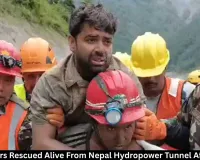
Two hydropower workers were rescued alive from the Upper Trishuli 3A tunnel after surviving for nine days inside a confined section of the underground network. Their rescue demonstrated that people may survive for extended periods in isolated sections of the tunnels if they have access to air and limited water or shelter.
Rescuers have also recovered other survivors from affected areas in recent days, reinforcing the decision to continue searching the tunnels despite the increasingly difficult conditions.
Roads, Bridges and Power Infrastructure Devastated
The flood has caused widespread destruction beyond the immediate loss of life.
The Associated Press reported that around 7,500 homes were destroyed, another 20,000 require rebuilding and at least 12 hydropower projects were damaged. Preliminary damage estimates have reached approximately $2.56 billion, placing an enormous financial burden on Nepal.
Mountain roads and bridges have also been washed away or buried beneath debris, complicating the movement of rescue equipment and personnel.
The difficult terrain has forced rescue teams to combine heavy machinery, helicopters, specialist tunnel equipment and technical expertise to reach isolated locations.
India Assists Nepal in Rescue Operations
India has been providing specialised assistance to Nepal since the disaster.
Indian tunnel rescue teams have been deployed to the Chilime area, while Indian medical personnel have also supported humanitarian operations. Earlier, India's Ministry of External Affairs said 163 Indian nationals had been rescued in Nepal following the disaster.
The Indian teams have faced particularly difficult conditions inside the tunnels, including muddy floors and restricted access. Special equipment and improvised techniques have been used to move deeper into blocked sections.
Nepal Seeks $20 Million in Climate Compensation
The disaster has also triggered a wider debate over climate change and the vulnerability of Himalayan nations.
Nepal has sought $20 million in climate compensation from the UN's loss-and-damage mechanism. Foreign Minister Shisir Khanal has argued that Nepal contributes less than 0.1% of global greenhouse-gas emissions but faces disproportionately severe consequences from climate change.
Nepal's glaciers have also experienced substantial ice loss over recent decades. The government has linked the latest disaster to broader climate risks affecting the Himalayan region, although the precise contribution of climate change to individual extreme events remains a matter for scientific assessment.
Rescue Mission Continues Despite Difficult Conditions
For families of the missing, the search remains a race against time.
Authorities continue to prioritise tunnels where there is a possibility of survivors, while drones, heavy machinery, technical teams and specialist rescue personnel are being used to search damaged facilities.
The latest operation reflects the scale of the disaster: Nepal is simultaneously dealing with a mass search for missing people, damaged hydropower infrastructure, destroyed settlements and a massive reconstruction challenge.
For now, rescuers remain focused on the possibility that more people could still be found alive inside the tunnels.





.jpg)
.jpg)
.jpg)
.jpg)