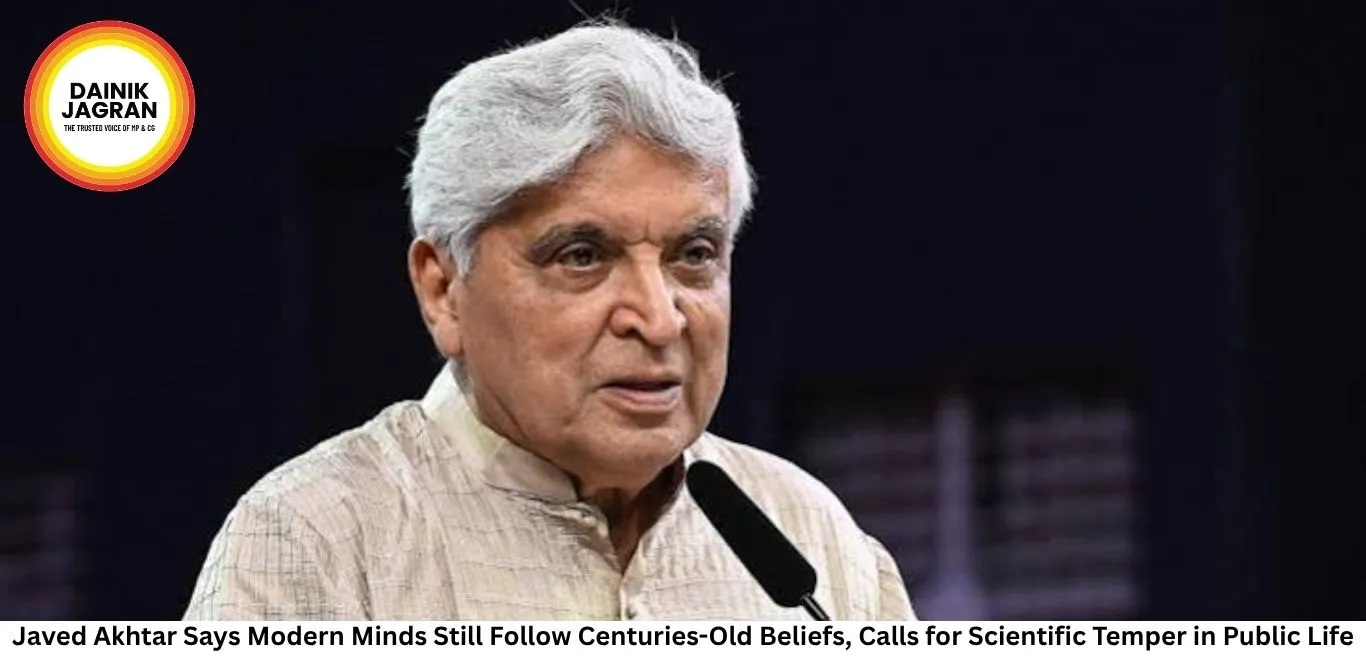
Javed Akhtar Says Modern Minds Still Follow Centuries-Old Beliefs, Calls for Scientific Temper in Public Life
Digital desk
Veteran lyricist, screenwriter and public intellectual Javed Akhtar has argued that while humanity has achieved unprecedented scientific and technological progress, society's thinking often remains rooted in centuries-old beliefs, creating what he described as one of the biggest contradictions of the modern age.
In a recent column, Akhtar reflected on the rapid advancements made by humankind over the last two centuries and questioned whether human thought has evolved at the same pace as technology. According to him, modern individuals often live between two parallel worlds — one guided by science, evidence and experimentation, and another shaped by inherited traditions, symbols and long-held beliefs.
Akhtar pointed out that humanity has explored the depths of the oceans, reached the Moon, decoded the human genome and developed machines capable of learning and making decisions. Yet, he argued, many people continue to rely on ideas formed during eras when scientific explanations for natural phenomena were unavailable.
He said this contradiction becomes particularly visible when people place faith in supernatural explanations while simultaneously benefiting from scientific achievements. Referring to space exploration, Akhtar noted that scientists spend years calculating trajectories and conducting experiments to ensure spacecraft reach distant destinations with precision. In such situations, he questioned the need to attribute outcomes to unseen forces rather than the scientific processes responsible for them.
According to Akhtar, this coexistence of scientific knowledge and unquestioned belief represents a major intellectual conflict of the 21st century. He suggested that information and faith often exist side by side within the same individual but rarely challenge one another.
Discussing the origins of religion, Akhtar said religious systems emerged during periods when human beings lacked scientific understanding of natural events such as lightning, earthquakes, epidemics and eclipses. People, he said, created explanations based on their limited knowledge and imagination, which was natural for their time.
However, he argued that knowledge is constantly evolving and every new discovery requires societies to reassess older assumptions. In his view, problems arise when people eagerly embrace the benefits of modern science but hesitate to adopt its most fundamental principle — the willingness to question claims and examine them through reason, evidence and testing.
Akhtar said this creates a divided existence in which modern technology becomes a part of everyday life while aspects of thinking remain tied to medieval ideas. Technology, he wrote, can make life modern, but only a scientific outlook can create a genuinely modern mindset.
The writer also touched upon the relationship between religion and morality. He argued that religious belief alone does not guarantee peaceful societies and suggested that ethical progress depends on broader social and intellectual development rather than faith alone.
A significant part of his commentary focused on the importance of questioning inherited ideas. According to Akhtar, civilizations survive not merely by preserving their past but by critically examining it. Respecting tradition, he said, should not mean accepting every historical belief without scrutiny.
He maintained that ideas capable of withstanding reason, experience and evidence do not require special protection because they remain relevant on their own. Continuing to accept a belief solely because it is old, he argued, risks turning heritage into a burden rather than a source of wisdom.
Akhtar also spoke openly about his personal beliefs, reiterating that he is an atheist and does not follow any religion. He clarified, however, that he has no objection to individual faith as long as it remains a personal matter.
His concern, he said, begins when private beliefs start influencing decisions related to education, healthcare, law, governance or public policy. In such areas, he argued, decisions should be based on evidence, rationality and verifiable knowledge rather than faith.
On spirituality, Akhtar offered a nuanced perspective. He said introspection, self-awareness and understanding one’s strengths and weaknesses are valuable pursuits. Likewise, he supported ideas that encourage people to rise above divisions of religion, caste and race in favour of universal human values.
At the same time, he criticized what he described as the commercialization of spirituality. Drawing a contrast between historical spiritual figures and some contemporary gurus, he remarked that while Gautama Buddha left a palace in search of truth, many modern spiritual leaders appear to move in the opposite direction.

--------
🚨 Beat the News Rush – Join Now!
Get breaking alerts, hot exclusives, and game-changing stories instantly on your phone. No delays, no fluff – just the edge you need. ⚡
Tap to join:
🟢 WhatsApp Channel: Dainik Jagran MP CG
Crave more?
🅕 Facebook: Dainik Jagran MP CG English
🅧 Twitter (X): Dainik Jagran MP CG
🅘 Instagram: Dainik Jagran MP CG
Share the fire – keep your crew ahead! 🗞️🔥
Javed Akhtar Says Modern Minds Still Follow Centuries-Old Beliefs, Calls for Scientific Temper in Public Life
Digital desk
In a recent column, Akhtar reflected on the rapid advancements made by humankind over the last two centuries and questioned whether human thought has evolved at the same pace as technology. According to him, modern individuals often live between two parallel worlds — one guided by science, evidence and experimentation, and another shaped by inherited traditions, symbols and long-held beliefs.
Akhtar pointed out that humanity has explored the depths of the oceans, reached the Moon, decoded the human genome and developed machines capable of learning and making decisions. Yet, he argued, many people continue to rely on ideas formed during eras when scientific explanations for natural phenomena were unavailable.
He said this contradiction becomes particularly visible when people place faith in supernatural explanations while simultaneously benefiting from scientific achievements. Referring to space exploration, Akhtar noted that scientists spend years calculating trajectories and conducting experiments to ensure spacecraft reach distant destinations with precision. In such situations, he questioned the need to attribute outcomes to unseen forces rather than the scientific processes responsible for them.
According to Akhtar, this coexistence of scientific knowledge and unquestioned belief represents a major intellectual conflict of the 21st century. He suggested that information and faith often exist side by side within the same individual but rarely challenge one another.
Discussing the origins of religion, Akhtar said religious systems emerged during periods when human beings lacked scientific understanding of natural events such as lightning, earthquakes, epidemics and eclipses. People, he said, created explanations based on their limited knowledge and imagination, which was natural for their time.
However, he argued that knowledge is constantly evolving and every new discovery requires societies to reassess older assumptions. In his view, problems arise when people eagerly embrace the benefits of modern science but hesitate to adopt its most fundamental principle — the willingness to question claims and examine them through reason, evidence and testing.
Akhtar said this creates a divided existence in which modern technology becomes a part of everyday life while aspects of thinking remain tied to medieval ideas. Technology, he wrote, can make life modern, but only a scientific outlook can create a genuinely modern mindset.
The writer also touched upon the relationship between religion and morality. He argued that religious belief alone does not guarantee peaceful societies and suggested that ethical progress depends on broader social and intellectual development rather than faith alone.
A significant part of his commentary focused on the importance of questioning inherited ideas. According to Akhtar, civilizations survive not merely by preserving their past but by critically examining it. Respecting tradition, he said, should not mean accepting every historical belief without scrutiny.
He maintained that ideas capable of withstanding reason, experience and evidence do not require special protection because they remain relevant on their own. Continuing to accept a belief solely because it is old, he argued, risks turning heritage into a burden rather than a source of wisdom.
Akhtar also spoke openly about his personal beliefs, reiterating that he is an atheist and does not follow any religion. He clarified, however, that he has no objection to individual faith as long as it remains a personal matter.
His concern, he said, begins when private beliefs start influencing decisions related to education, healthcare, law, governance or public policy. In such areas, he argued, decisions should be based on evidence, rationality and verifiable knowledge rather than faith.
On spirituality, Akhtar offered a nuanced perspective. He said introspection, self-awareness and understanding one’s strengths and weaknesses are valuable pursuits. Likewise, he supported ideas that encourage people to rise above divisions of religion, caste and race in favour of universal human values.
At the same time, he criticized what he described as the commercialization of spirituality. Drawing a contrast between historical spiritual figures and some contemporary gurus, he remarked that while Gautama Buddha left a palace in search of truth, many modern spiritual leaders appear to move in the opposite direction.