


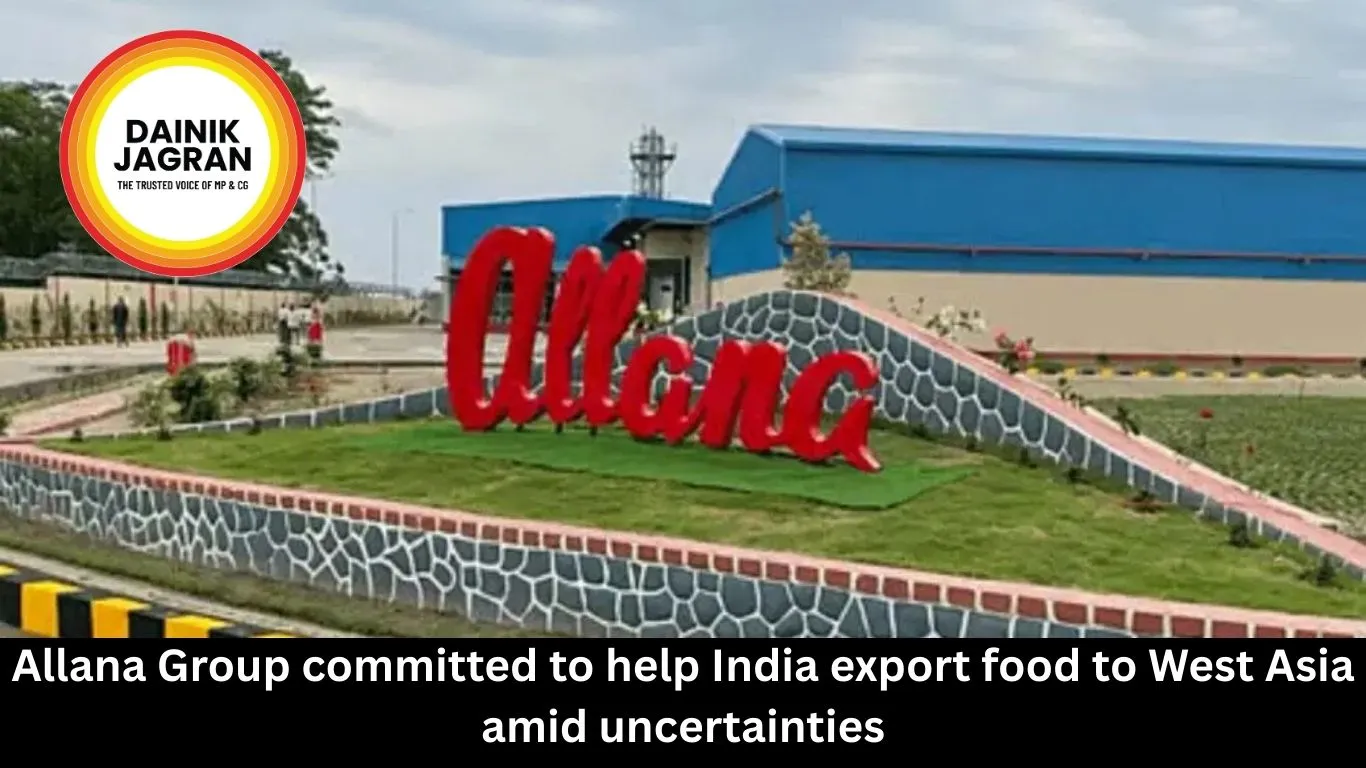
Allana Group committed to help India export food to West Asia amid uncertainties
Digital Desk
The stakes are particularly high for the six-member Gulf Cooperation Council, which includes the UAE, Saudi Arabia, Oman, Kuwait, Qatar and Bahrain. The countries’ structural limitations on agriculture mean they are heavily dependent on global food markets to meet basic consumption needs. Across the bloc, 75-90% of food consumption is imported, including roughly 93% of cereals, 56% of vegetables and about 62% of meat. Collectively, GCC countries spend close to $50billion annually on food imports, making stable supply corridors vital for their economic needs.
India has increasingly stepped into that role.
With one of the world’s largest agricultural bases and a rapidly expanding food-processing sector, the country has become a key supplier of staples ranging from rice and wheat to processed foods, fruits and beverages for markets across West Asia. As the raging war strains logistics and swells shipping risks in the region, such long-standing trade links, especially the one with India, are gaining new strategic significance.
The scale of India’s agricultural exports has expanded sharply in recent years. Shipments grew from around $6.6billion in FY2022-23 to $7.2billion in FY2023-24.
Rice continues to dominate India’s export basket. In 2024, India exported rice worth $4.08 billion to West Asia.
Total shipments reached about 20.1mn tonnes valued at around $12.9billion in FY2024-25, followed by processed food exports worth $7.89billion. Fresh produce from India has also gained ground, with fruits and vegetables alone contributing around $1.82billion in export value during the same period.
Within this expanding trade network, the Allana Group has emerged as a major pillar of India’s food export ecosystem. Operating in nearly 70 countries, the Mumbai-headquartered conglomerate counts West Asia as one of its most important global markets and today supplies roughly $1billion worth of food products annually to the region.
The company’s export portfolio somewhat reflects the diversity of India’s agricultural output. It ships a wide range of washed and unwashed Arabica, Robusta and monsooned- coffees, with annual exports estimated at 24,000–30,000 tonnes. The group also produces aseptic and frozen fruit pulps including mango and guava with an annual capacity of about 50,000 metric tonnes, alongside exports of wheat, other agricultural commodities, frozen meat and potato-based products.
Over the past few years, the company has put in significant efforts in building up large capabilities to ensure continuity of food supply during periods of acute disruption or sudden spikes in demand. In fact, at any given time, Allana Group holds around 40,000 tonnes of food products ready for immediate dispatch to West Asian markets. These stocks typically include staples such as wheat, fruits, vegetables and coffee.
Besides, Allana has invested significantly in expanding regional logistics infrastructure to strengthen supply flexibility. The company operates several value-addition and distribution facilities across West Asia, which is further supported by large, advanced grain storage facilities in the UAE, with their warehouse capacity estimated at around 80,000 tonnes. These facilities are meant to ensure food supply continuity during periods of uncertainty.
Such safeguards are possibly becoming increasingly important as tensions around the critical Iran-controlled Strait of Hormuz threaten to disrupt global trade routes. While the narrow waterway is widely known for carrying a significant portion of the world’s oil shipments, it is equally vital for food imports entering the West Asia markets.
Against this volatile backdrop, India’s long-standing commercial ties with West Asia are helping provide stability to regional food markets. Exporters from India such as the Allana Group with established supply chains, advanced storage capacity and diversified food portfolios are playing a crucial role in keeping essential commodities moving even as geopolitical uncertainties rise.
For West Asia economies that depend heavily on imported food, the India–West Asia food corridor is becoming an increasingly strategic economic lifeline. Within that system, companies like Allana are acting as a vital bridge between India’s vast agricultural output and the millions of consumers across war-hit West Asia who rely on those supplies every day.




.jpg)




