


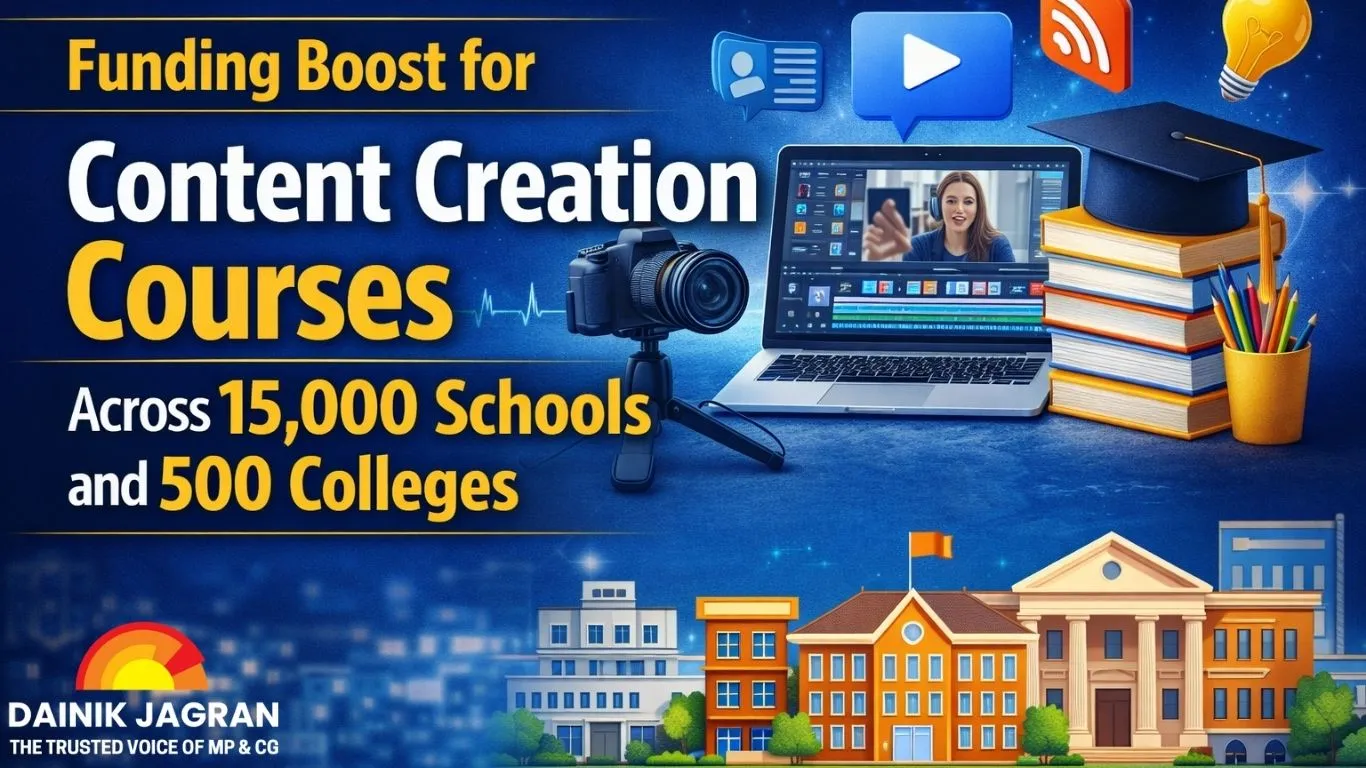
Funding Boost for Content Creation Courses Across 15,000 Schools and 500 Colleges
Digital Desk
The initiative will be rolled out from the upcoming academic year and will be implemented through a coordinated ffort involving the Ministry of Education, the Ministry of Electronics and Information Technology, and state education departments. Officials said the focus will be on integrating content creation into existing curricula rather than treating it as a standalone or extracurricular activity.
According to government sources, the funding will be used to develop age-appropriate course material, train teachers, set up basic production infrastructure such as media labs, and partner with industry professionals for mentorship and certification. Schools covered under the programme will primarily include government and government-aided institutions, while the selected colleges will focus on undergraduate-level courses and vocational programmes.
The move reflects the government’s assessment that digital content creation has emerged as a mainstream economic activity, generating employment across advertising, entertainment, education, journalism and e-commerce. Policymakers believe early exposure to these skills will help students adapt to evolving job markets and encourage entrepreneurship at a young age.
A senior official in the education ministry said the courses would emphasise both creative and technical aspects. “Students will learn not only how to create digital content, but also how to do it responsibly—understanding copyright, misinformation, data privacy and ethical communication,” the official said. The curriculum is expected to be modular, allowing schools and colleges to adopt components based on local needs and infrastructure.
At the school level, content creation modules will be introduced from the upper primary stage onwards, gradually advancing in complexity at the secondary and higher secondary levels. In colleges, the focus will be on professional-grade skills, including scripting, editing software, analytics, platform monetisation models and audience engagement strategies.
Teacher training will be a critical component of the programme. Funds have been earmarked for short-term certification courses and workshops to upskill existing teachers, along with the appointment of visiting faculty from the media and technology sectors. Digital platforms will also be used to provide continuous learning support to educators in remote and underserved regions.
Education experts have broadly welcomed the initiative, noting that it formalises skills that many young people are already acquiring informally. “This recognises content creation as a legitimate skill set, not just a hobby,” said an academic specialising in digital education. “If implemented well, it can bridge the gap between education and employability.”
However, some experts cautioned that infrastructure gaps and uneven internet access could affect implementation, particularly in rural areas. Officials said the programme would be aligned with ongoing investments in digital connectivity and school infrastructure to ensure equitable access.
The government also sees the initiative as a way to promote regional languages and local narratives in the digital space. By training students in content creation across different linguistic and cultural contexts, policymakers hope to diversify India’s online ecosystem and reduce overdependence on a few dominant languages and platforms.
In the long term, the programme is expected to feed into higher skilling and startup initiatives, with pathways for advanced training, incubation and industry collaboration. Officials indicated that outcomes such as student participation, skill certification and employment linkage would be monitored to assess the programme’s impact.
With digital media continuing to reshape communication, commerce and culture, the government’s decision to invest in content creation education marks a strategic shift in how creative and technological skills are positioned within the formal education system.
.jpg)




