


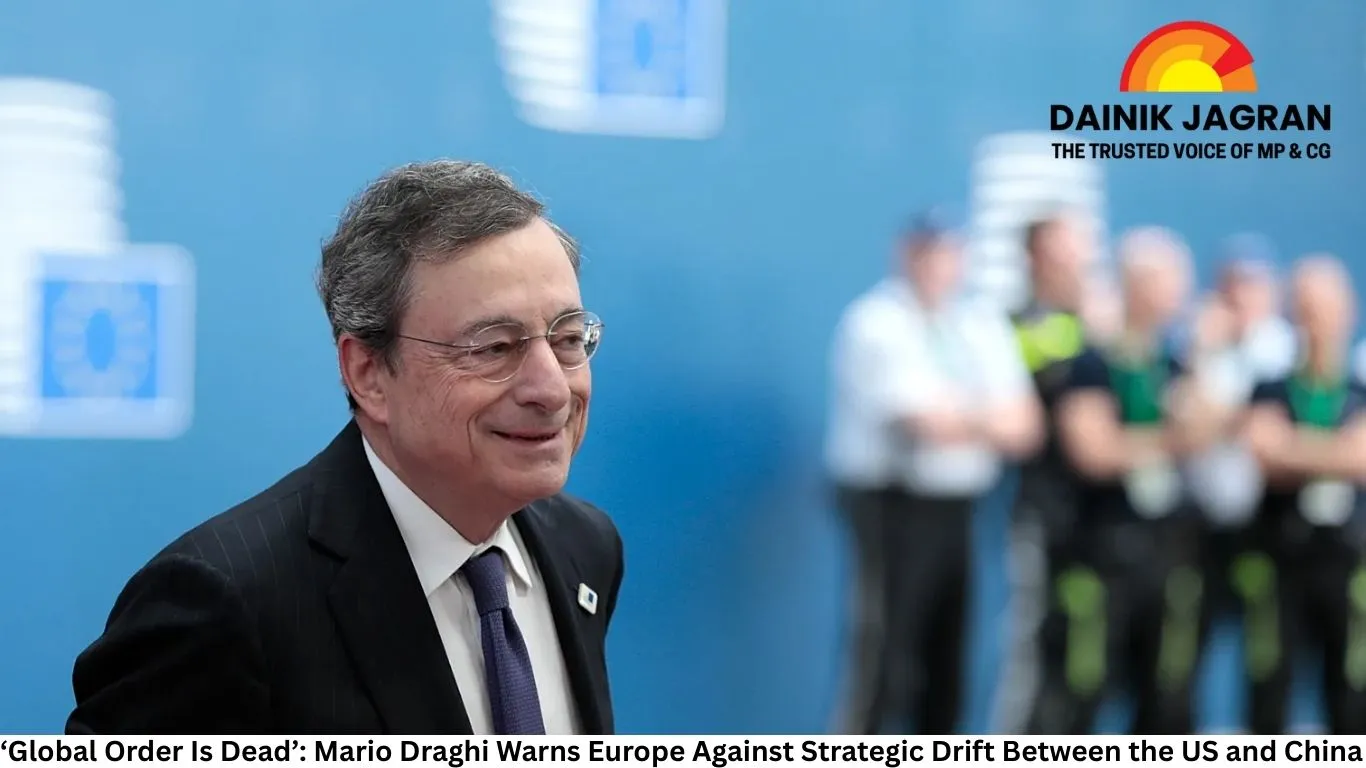
‘Global Order Is Dead’: Mario Draghi Warns Europe Against Strategic Drift Between the US and China
Digital Desk
Draghi said concerns about the breakdown of the global order are well-founded. However, he cautioned that the greater danger lies not in the collapse itself, but in what replaces it. His remarks come at a time of heightened geopolitical uncertainty, trade tensions, and shifting power equations across the world.
“The global order as we knew it is dead,” Draghi said, arguing that Europe now confronts two competing pressures: an America that believes it has paid too much for global leadership, and a China that uses its dominance over supply chains to export economic stress to other countries.
Europe caught between Washington and Beijing
Draghi said the United States increasingly “counts costs” without acknowledging the strategic and economic benefits it has long derived from its leadership role. He warned that this shift in American thinking has direct consequences for Europe, particularly in trade and security.
At the same time, he accused China of exploiting its control over key segments of global supply chains. According to Draghi, Beijing uses this leverage to flood international markets with cheap goods, restrict access to critical materials, and shift the burden of its domestic economic disruptions onto other economies.
“Competition among countries is intensifying, and trade policy is no longer separate from security,” Draghi said, calling on the European Union to urgently reassess its economic and strategic priorities.
Call for deeper European unity
A central theme of Draghi’s address was Europe’s internal fragmentation. He argued that while the EU has demonstrated strength when acting collectively on trade, competition policy, markets, and monetary integration, it appears weak and divided in areas such as defence, industrial strategy, and foreign policy.
“Where Europe acts together, it is strong. Where it acts separately, it is seen as a collection of small, vulnerable states,” Draghi said.
He warned that this imbalance allows Europe’s economic strength to be exploited against its security weaknesses. In a world where trade, technology, and defence are increasingly intertwined, Draghi said, such divisions make the continent strategically fragile.
“If Europe remains united in money and trade but divided in security and military matters, it risks losing both,” he said.
Supply chains and industrial resilience
Draghi urged the EU to move quickly to secure its position in essential supply chains, arguing that dependence on external powers for critical goods exposes Europe to economic coercion. He called for a more assertive industrial policy to protect key sectors and reduce vulnerabilities.
According to Draghi, Europe must stop behaving like a loose coalition and start acting as a single strategic entity. He stressed that unity is no longer an ideological choice but a necessity for survival in an era of shifting global power.
Greenland tensions underline security concerns
Draghi’s remarks resonated amid renewed concerns over transatlantic relations, particularly following statements from Greenlandic leaders about fears of US intentions toward the territory. Greenland’s Prime Minister, Jens Frederik-Nielsen, has warned that talk of American “occupation” has created anxiety among the local population and raised broader questions about NATO, Western security, and democratic norms.
Draghi suggested that direct and firm responses to such threats are more effective than diplomatic formalities, underscoring his view that Europe must project strength to deter external pressure.
Trust deficit with the US under Trump
European unease has been compounded by former US President Donald Trump’s recent rhetoric and policy positions. According to reports cited by The Guardian, Trump’s repeated questioning of NATO’s value, interest in Greenland, and aggressive trade posture have eroded trust among European allies.
Trump’s proposed tariffs—ranging from 10% to 25% globally—have created widespread uncertainty. European economies, particularly Germany and France, have expressed concern that a 15% tariff regime could push the region toward recession. Trump had also threatened additional tariffs against European countries opposing US actions related to Greenland, though those threats were later withdrawn.
At the World Economic Forum in Davos last month, Trump told European leaders they should emulate the US economic model, further reinforcing perceptions of a widening transatlantic divide.
A warning with long-term implications
Draghi’s intervention is widely seen as a call to action for European policymakers ahead of critical decisions on defence integration, industrial policy, and trade strategy. His warning suggests that Europe’s future influence will depend less on individual national policies and more on its ability to act cohesively in a fractured global landscape.
As geopolitical competition intensifies, Draghi argued, Europe must decide whether it wants to shape the emerging order—or be shaped by it.
.jpg)




