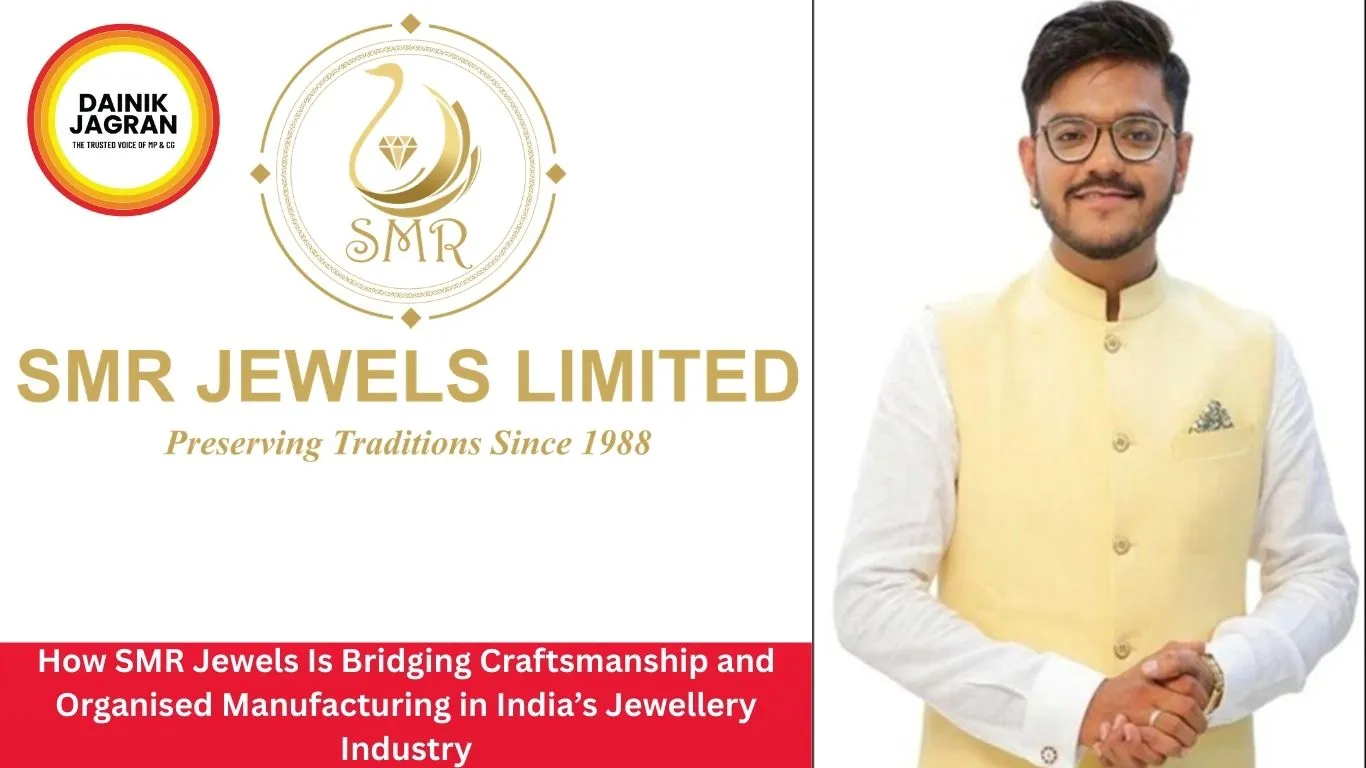
How SMR Jewels Is Bridging Craftsmanship and Organised Manufacturing in India’s Jewellery Industry
Digital Desk
That shift is not a rejection of tradition. If anything, it is creating fresh pressure to preserve artisanal value while building systems that can support a more formal retail ecosystem. This transition is framed as part of a wider evolution in the industry, driven by hallmarking, documentation, policy reforms, better access to finance, jewellery parks and the expansion of large retail chains into Tier II and Tier III markets. The result is a sector that still depends on heritage, but increasingly operates through more organised supply structures.
For SMR Jewels, that changing landscape appears less like disruption and more like an opportunity to modernise around its strengths. “Traditional craftsmanship continues to remain the core of our heritage and designer jewellery,” says Vismay Soni, Managing Director, SMR Jewels. “While advanced technology like CAD and AutoCAD are used to refine proportions, strengthen structural integrity and achieve superior finish, the human touch in our creations remains non-negotiable and uncompromised.” That balance is central to the company’s positioning: technology is used to support precision, but the final character of the jewellery still comes from skilled hands.
This is becoming increasingly important because retailers today expect more from manufacturing partners than they once did. The market is no longer satisfied with good design alone. Delivery timelines, production clarity and product consistency now matter just as much, especially for retailers planning around wedding and festive demand cycles. This makes it clear: as jewellery retail becomes more organised, reliability has become a commercial necessity.
SMR Jewels says it has responded by making its workflow more structured. “Our organised manufacturing process allows for better planning, smoother execution, and far less uncertainty, which helps us commit to clear timelines and maintain consistency across orders,” Vismay says. He notes that each order is assigned a unique production code and moves through defined stages such as stone setting, bandhai, finishing and quality checks, all with pre-planned timelines. That kind of process discipline is increasingly what allows handcrafted work to function within a modern retail framework.
The company’s manufacturing model is also distinctive in another way. Rather than relying on a centralised factory structure, it works through long-standing relationships with a network of artisans and craftsmen. That could easily have become a weakness in an increasingly organised market, but SMR Jewels appears to treat it as an advantage, provided the network is supported with the right systems. “Our artisans not only have in-depth expertise in goldsmithing, stone-setting and fine detailing, they are also very adept in using modern machinery to achieve precision, durability and high-quality finishing,” Vismay says. “As the business scales, we have built a system that also empowers our artisans to upgrade their skills, and further boost efficiency, without any compromises.”
Design, too, has become more strategic in this environment. In a crowded manufacturing landscape, differentiation cannot rest on execution alone. Manufacturers are increasingly expected to bring design intelligence, originality and cultural relevance to the table. SMR Jewels describes its process as research-driven and design-led, with concepts developed in-house before being translated into finished pieces in collaboration with artisans. “From hand sketching to CAD modelling to prototype creation, every design is subjected to meticulous detailing before the artisans transform them into exquisite and exclusive jewellery pieces,” Vismay says.
Alongside design and production, compliance has become one of the clearest markers of how the industry is evolving. Jewellery has historically been a trust-led business, but trust now increasingly needs the support of systems. Hallmarking, documentation, audit readiness and process accountability are no longer peripheral. They are part of how manufacturers prove their credibility to both retailers and end customers. “Unlike the years gone by, when relationships and trust were the backbone of the industry, the business today has evolved in keeping with the policies and compliances,” Vismay says. “Today, transparency, documentation and system-driven operations are leading the way.”
That organised approach has direct implications for retail strategy. Manufacturers who can deliver predictably and reproduce successful designs without variation become more valuable to retailers managing inventory during high-demand periods. “Organised manufacturing allows retailers to plan their inventory with greater confidence, especially during wedding and festive seasons when demand rises sharply,” Vismay says. “Consistency in design and manufacturing also ensures that best-selling pieces can be reproduced without variation.” In practical terms, that shifts the manufacturer’s role from supplier to planning partner.
The same logic underpins SMR Jewels’ B2B relationships. The company’s response sheet repeatedly positions these partnerships as central to long-term growth, supported by timely delivery, consistent quality and personalised engagement. By suggesting that the next phase of jewellery manufacturing will be defined by companies that can combine design innovation, structured supply and dependable execution in one model.
Vismay appears to see that shift clearly. “As India’s jewellery retail sector becomes more organised, the role of manufacturers like SMR Jewels will evolve from being only product suppliers to becoming strategic partners for retailers,” he says. “The future lies in combining traditional craftsmanship with modern technology and organised production systems, allowing us to create designs that are both commercially viable and relevant to changing consumer preferences.”
That may be the most important change underway in India’s jewellery industry. The sector is not moving away from craftsmanship. It is learning how to build structure around it. For companies like SMR Jewels, the opportunity lies in proving that heritage and efficiency do not have to exist in tension. When brought together thoughtfully, they can make each other stronger.