

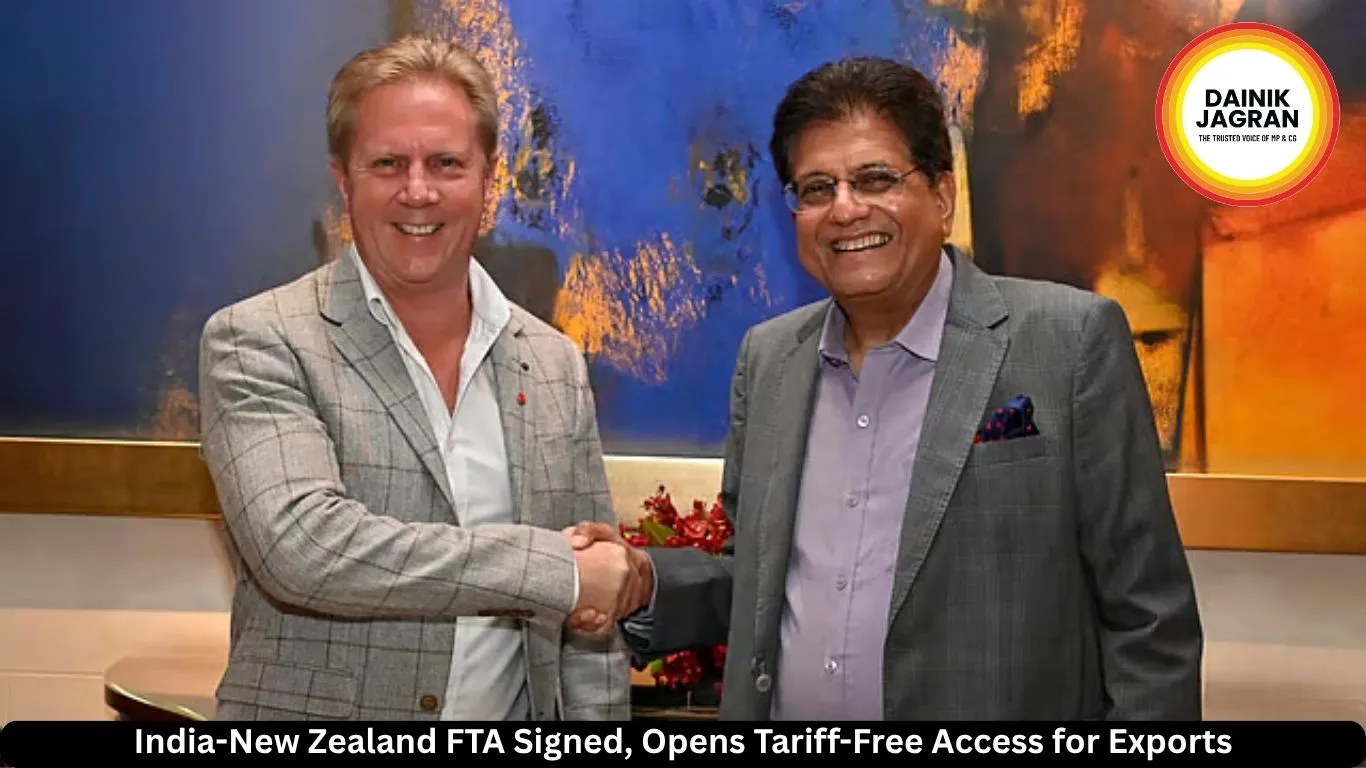
India-New Zealand FTA Signed, Opens Tariff-Free Access for Exports

Business Desk

India-New Zealand FTA Signed, Opens Tariff-Free Access for Exports

India-New Zealand FTA signed on Monday gives Indian exports tariff-free access, protects sensitive sectors and aims to boost trade and investment ties.

India and New Zealand on Monday signed a bilateral free trade agreement (FTA), marking a major step in efforts to deepen economic ties and expand two-way trade and investment. The India-New Zealand FTA was signed in the presence of Union Commerce and Industry Minister Piyush Goyal and New Zealand Trade and Investment Minister Todd McClay, according to officials.

The agreement gives Indian exporters tariff-free access to the New Zealand market across all tariff lines, covering 100 per cent of India’s exports to the country. Officials said the deal is expected to strengthen trade in labour-intensive sectors and improve India’s export competitiveness in a key overseas market.

Duty-Free Market Access

Under the pact, Indian goods will now enter New Zealand without import duties across all product categories. This is expected to benefit sectors such as textiles, garments, leather, footwear, gems and jewellery, engineering goods and processed food.

Officials said the removal of tariffs would help Indian products compete more effectively with goods from other countries in the New Zealand market. Earlier, New Zealand imposed tariffs of up to 10 per cent on several Indian products, including ceramics, carpets, motor vehicles and auto components.

The agreement is expected to support micro, small and medium enterprises (MSMEs), which form a large part of India’s export base, and generate employment in labour-driven sectors.

India Protects Sensitive Sectors

India has offered tariff concessions on 70.03 per cent of tariff lines, which account for 95 per cent of bilateral trade by value. At the same time, 29.97 per cent of tariff lines have been kept outside the agreement to protect sensitive domestic sectors.

These excluded categories include dairy products such as milk, cream and cheese, several animal products, major farm items including onion, gram, peas, maize and almonds, sugar, artificial honey, oils and fats, arms and ammunition, selected gems and jewellery, and products linked to copper and aluminium.

According to officials, this calibrated approach seeks to balance trade liberalisation with domestic industry protection, particularly in politically and economically sensitive segments.

Tariff Relief For Imports

India will eliminate tariffs on nearly 30 per cent of New Zealand’s tariff lines, including products such as wood, wool, sheep meat and raw hides. Duties on another 35.60 per cent of tariff lines will be phased out over three, five, seven and 10 years.

These include petroleum oils, malt extract, vegetable oils and selected machinery. New Zealand products set to receive tariff concessions also include wine, pharmaceuticals, polymers, aluminium, and iron and steel goods.

Some products, including manuka honey, apples, kiwi fruit and albumin, will be covered under tariff rate quotas, allowing limited imports at lower duty rates.

Investment Clause Added

A key feature of the India-New Zealand FTA is a commitment to facilitate up to $20 billion in investment into India. Officials said the agreement also includes a rebalancing clause to maintain equilibrium if investment targets are not met.

The provision is seen as a safeguard aimed at ensuring that trade concessions remain aligned with investment outcomes. It also reflects India’s growing preference for linking market access with measurable capital commitments.

Trade Ties Expand

The agreement comes as both countries seek to expand a relatively modest trade relationship. In 2024, total bilateral trade in goods and services between India and New Zealand stood at $2.4 billion.

Trade officials have for years flagged untapped potential in sectors such as food processing, advanced manufacturing, clean energy and services. The latest move is expected to widen market access and create new channels for commercial engagement.

As per reports, both sides also see the agreement as part of a broader strategy to diversify trade partnerships amid shifting global supply chains and rising protectionism.

What Comes Next

The India-New Zealand FTA now moves to the implementation stage, where tariff schedules, customs procedures and compliance mechanisms will determine the pace of gains. Businesses in both countries are expected to closely track the rollout of sector-specific concessions.

For India, the agreement strengthens export access while shielding politically sensitive sectors. For New Zealand, it opens a large and growing market with phased entry across key product categories.

--------

🚨 Beat the News Rush – Join Now!

Get breaking alerts, hot exclusives, and game-changing stories instantly on your phone. No delays, no fluff – just the edge you need. ⚡

Tap to join: 

🟢 WhatsApp Channel: Dainik Jagran MP CG

Crave more?

🅕 Facebook: Dainik Jagran MP CG English

🅧 Twitter (X): Dainik Jagran MP CG

🅘 Instagram: Dainik Jagran MP CG

Share the fire – keep your crew ahead! 🗞️🔥

english.dainikjagranmpcg.com
27 Apr 2026 By ROHIT

India-New Zealand FTA Signed, Opens Tariff-Free Access for Exports

Business Desk

India and New Zealand on Monday signed a bilateral free trade agreement (FTA), marking a major step in efforts to deepen economic ties and expand two-way trade and investment. The India-New Zealand FTA was signed in the presence of Union Commerce and Industry Minister Piyush Goyal and New Zealand Trade and Investment Minister Todd McClay, according to officials.

The agreement gives Indian exporters tariff-free access to the New Zealand market across all tariff lines, covering 100 per cent of India’s exports to the country. Officials said the deal is expected to strengthen trade in labour-intensive sectors and improve India’s export competitiveness in a key overseas market.

Duty-Free Market Access

Under the pact, Indian goods will now enter New Zealand without import duties across all product categories. This is expected to benefit sectors such as textiles, garments, leather, footwear, gems and jewellery, engineering goods and processed food.

Officials said the removal of tariffs would help Indian products compete more effectively with goods from other countries in the New Zealand market. Earlier, New Zealand imposed tariffs of up to 10 per cent on several Indian products, including ceramics, carpets, motor vehicles and auto components.

The agreement is expected to support micro, small and medium enterprises (MSMEs), which form a large part of India’s export base, and generate employment in labour-driven sectors.

India Protects Sensitive Sectors

India has offered tariff concessions on 70.03 per cent of tariff lines, which account for 95 per cent of bilateral trade by value. At the same time, 29.97 per cent of tariff lines have been kept outside the agreement to protect sensitive domestic sectors.

These excluded categories include dairy products such as milk, cream and cheese, several animal products, major farm items including onion, gram, peas, maize and almonds, sugar, artificial honey, oils and fats, arms and ammunition, selected gems and jewellery, and products linked to copper and aluminium.

According to officials, this calibrated approach seeks to balance trade liberalisation with domestic industry protection, particularly in politically and economically sensitive segments.

Tariff Relief For Imports

India will eliminate tariffs on nearly 30 per cent of New Zealand’s tariff lines, including products such as wood, wool, sheep meat and raw hides. Duties on another 35.60 per cent of tariff lines will be phased out over three, five, seven and 10 years.

These include petroleum oils, malt extract, vegetable oils and selected machinery. New Zealand products set to receive tariff concessions also include wine, pharmaceuticals, polymers, aluminium, and iron and steel goods.

Some products, including manuka honey, apples, kiwi fruit and albumin, will be covered under tariff rate quotas, allowing limited imports at lower duty rates.

Investment Clause Added

A key feature of the India-New Zealand FTA is a commitment to facilitate up to $20 billion in investment into India. Officials said the agreement also includes a rebalancing clause to maintain equilibrium if investment targets are not met.

The provision is seen as a safeguard aimed at ensuring that trade concessions remain aligned with investment outcomes. It also reflects India’s growing preference for linking market access with measurable capital commitments.

Trade Ties Expand

The agreement comes as both countries seek to expand a relatively modest trade relationship. In 2024, total bilateral trade in goods and services between India and New Zealand stood at $2.4 billion.

Trade officials have for years flagged untapped potential in sectors such as food processing, advanced manufacturing, clean energy and services. The latest move is expected to widen market access and create new channels for commercial engagement.

As per reports, both sides also see the agreement as part of a broader strategy to diversify trade partnerships amid shifting global supply chains and rising protectionism.

What Comes Next

The India-New Zealand FTA now moves to the implementation stage, where tariff schedules, customs procedures and compliance mechanisms will determine the pace of gains. Businesses in both countries are expected to closely track the rollout of sector-specific concessions.

For India, the agreement strengthens export access while shielding politically sensitive sectors. For New Zealand, it opens a large and growing market with phased entry across key product categories.

https://english.dainikjagranmpcg.com/business/india-new-zealand-fta-signed-opens-tariff-free-access-for-exports/article-17461

Latest News


