Indian Oil Crude Stock: 1-Month Supply, Profit Up 81% to ₹15,176 Cr
Digital Desk
Indian Oil Corporation assures no crude shortage despite Hormuz disruptions. Q4 profit jumps 81% to ₹15,176 crore. LPG sourcing shifted to Indonesia, Nigeria. Dividend recommended.
Indian Oil Has One-Month Crude Stock, Profit Jumps 81% to ₹15,176 Crore
State-run refiner says no shortage despite ongoing Hormuz route disruptions; LPG sourcing shifted to Indonesia, Nigeria
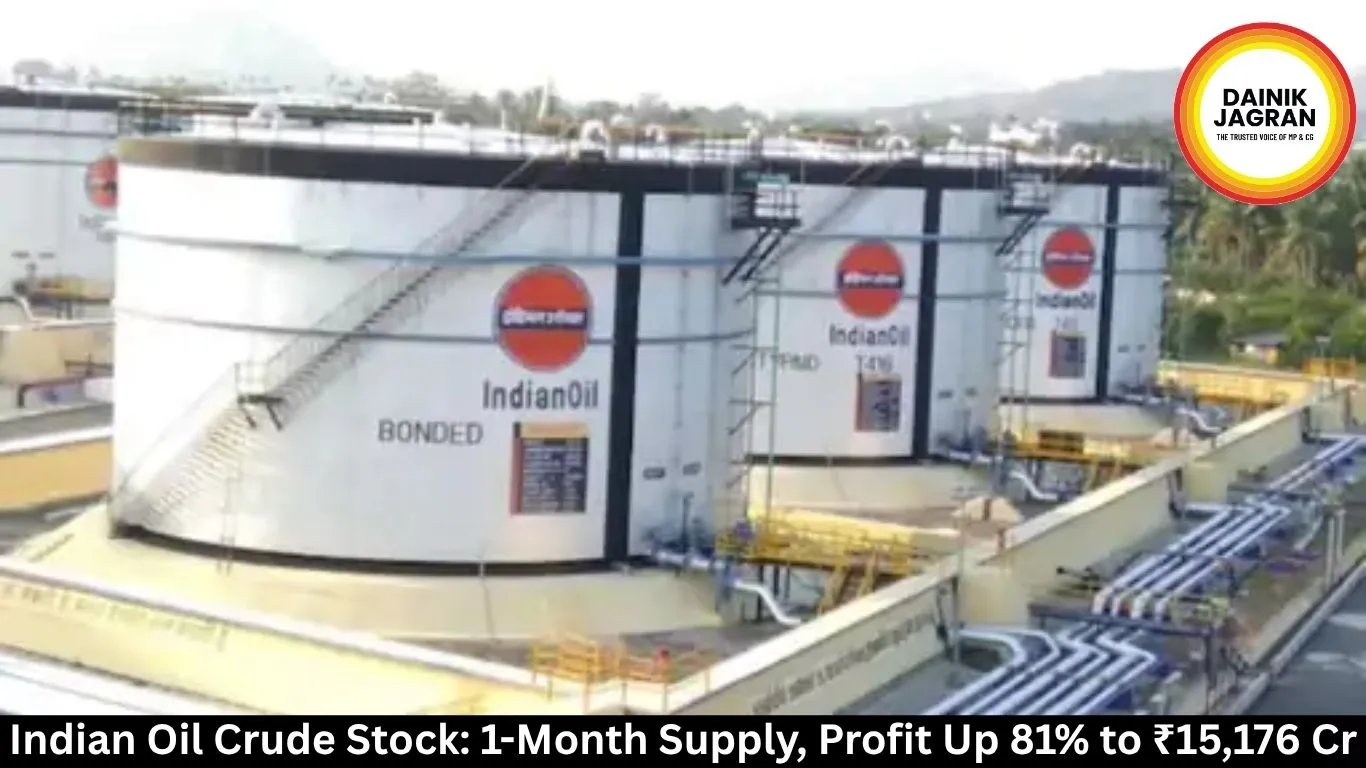
Indian Oil Corporation (IOCL) has built a crude oil stockpile sufficient for over a month, the company said on Tuesday, assuring that domestic supplies remain unaffected despite continued tensions between the United States and Iran. The assurance comes as the strategically vital Hormuz Strait – through which nearly half of India’s energy imports pass – remains partially disrupted.
The public sector oil major also reported an 81 per cent surge in consolidated net profit for the January-March quarter of fiscal year 2025-26, reaching ₹15,176.08 crore compared to ₹8,367.63 crore in the same period last year.
Crude Stock Adequate
According to IOCL officials, the company holds more than one month’s worth of crude oil inventory, enough to cushion any immediate supply shocks. “We have multiple sources for crude oil and other petroleum products,” said Anuj Jain, Director (Finance) at IOCL. “All our refineries have been operating at full capacity since the Middle East dispute began.”
The Gulf region remains India’s primary energy supplier, but the ongoing conflict near the Strait of Hormuz has forced refiners to explore alternative routes and suppliers.
Hormuz Disruptions Bite
The Hormuz Strait, located between the Gulf of Oman and the Persian Gulf, handles approximately 20 per cent of global crude oil trade. The waterway’s partial closure continues to affect worldwide crude supplies, with India feeling the pinch on its liquefied petroleum gas (LPG) imports.
Officials confirmed that nearly 50 per cent of India’s energy supply and 90 per cent of its LPG imports from Gulf nations typically transit through this choke point. “Initial reports indicate that LPG stock levels have seen a marginal dip,” a source familiar with the matter said. “But the situation is being managed across the country.”
LPG Sourcing Shifted
Acknowledging supply bottlenecks, IOCL has moved quickly to secure gas from alternative markets. Following disruptions in Gulf supplies, the company initiated spot procurement from Indonesia, Nigeria, Angola and Oman.
“There were some interruptions in LPG supply,” Jain admitted, “but we have changed our import sources.” Local authorities confirmed that retail LPG distribution has not faced major shortages in any state so far, though some dealers in coastal regions reported delayed tanker arrivals last week.
Profit Surges, Dividend on Table
The company’s board recommended a final dividend of 12.5 per cent for FY26, translating to ₹1.25 per equity share of face value ₹10. The payout, however, remains subject to shareholder approval at the upcoming annual general meeting.
IOCL’s strong quarterly performance comes despite volatile crude prices and geopolitical headwinds. Market analysts attribute the profit growth to robust refining margins and lower inventory losses compared to the previous year.
Refinery Expansion Plans Underway
For the current financial year 2026-27, IOCL has earmarked a capital expenditure of ₹32,700 crore – slightly up from ₹31,401 crore spent in FY26. The bulk of this investment is directed at expanding refining capacity across three key sites.
The Panipat refinery is being expanded from 15 million metric tonnes per annum (MMTPA) to 25 MMTPA, with completion targeted by December 2026. The Gujarat refinery will see capacity rise from 13.7 MMTPA to 18 MMTPA at an estimated cost of ₹19,000 crore. Meanwhile, the Barauni refinery is set to increase from 6 MMTPA to 9 MMTPA. All three projects are expected to be commissioned around the same timeline.
Ground-level work at these sites is progressing steadily, with officials stating that land acquisition and equipment orders are largely complete. The expanded capacities are expected to reduce India’s dependence on imported petroleum products in the medium term.
--------
🚨 Beat the News Rush – Join Now!
Get breaking alerts, hot exclusives, and game-changing stories instantly on your phone. No delays, no fluff – just the edge you need. ⚡
Tap to join:
🟢 WhatsApp Channel: Dainik Jagran MP CG
Crave more?
🅕 Facebook: Dainik Jagran MP CG English
🅧 Twitter (X): Dainik Jagran MP CG
🅘 Instagram: Dainik Jagran MP CG
Share the fire – keep your crew ahead! 🗞️🔥
Indian Oil Crude Stock: 1-Month Supply, Profit Up 81% to ₹15,176 Cr
Digital Desk
Indian Oil Has One-Month Crude Stock, Profit Jumps 81% to ₹15,176 Crore
State-run refiner says no shortage despite ongoing Hormuz route disruptions; LPG sourcing shifted to Indonesia, Nigeria
Indian Oil Corporation (IOCL) has built a crude oil stockpile sufficient for over a month, the company said on Tuesday, assuring that domestic supplies remain unaffected despite continued tensions between the United States and Iran. The assurance comes as the strategically vital Hormuz Strait – through which nearly half of India’s energy imports pass – remains partially disrupted.
The public sector oil major also reported an 81 per cent surge in consolidated net profit for the January-March quarter of fiscal year 2025-26, reaching ₹15,176.08 crore compared to ₹8,367.63 crore in the same period last year.
Crude Stock Adequate
According to IOCL officials, the company holds more than one month’s worth of crude oil inventory, enough to cushion any immediate supply shocks. “We have multiple sources for crude oil and other petroleum products,” said Anuj Jain, Director (Finance) at IOCL. “All our refineries have been operating at full capacity since the Middle East dispute began.”
The Gulf region remains India’s primary energy supplier, but the ongoing conflict near the Strait of Hormuz has forced refiners to explore alternative routes and suppliers.
Hormuz Disruptions Bite
The Hormuz Strait, located between the Gulf of Oman and the Persian Gulf, handles approximately 20 per cent of global crude oil trade. The waterway’s partial closure continues to affect worldwide crude supplies, with India feeling the pinch on its liquefied petroleum gas (LPG) imports.
Officials confirmed that nearly 50 per cent of India’s energy supply and 90 per cent of its LPG imports from Gulf nations typically transit through this choke point. “Initial reports indicate that LPG stock levels have seen a marginal dip,” a source familiar with the matter said. “But the situation is being managed across the country.”
LPG Sourcing Shifted
Acknowledging supply bottlenecks, IOCL has moved quickly to secure gas from alternative markets. Following disruptions in Gulf supplies, the company initiated spot procurement from Indonesia, Nigeria, Angola and Oman.
“There were some interruptions in LPG supply,” Jain admitted, “but we have changed our import sources.” Local authorities confirmed that retail LPG distribution has not faced major shortages in any state so far, though some dealers in coastal regions reported delayed tanker arrivals last week.
Profit Surges, Dividend on Table
The company’s board recommended a final dividend of 12.5 per cent for FY26, translating to ₹1.25 per equity share of face value ₹10. The payout, however, remains subject to shareholder approval at the upcoming annual general meeting.
IOCL’s strong quarterly performance comes despite volatile crude prices and geopolitical headwinds. Market analysts attribute the profit growth to robust refining margins and lower inventory losses compared to the previous year.
Refinery Expansion Plans Underway
For the current financial year 2026-27, IOCL has earmarked a capital expenditure of ₹32,700 crore – slightly up from ₹31,401 crore spent in FY26. The bulk of this investment is directed at expanding refining capacity across three key sites.
The Panipat refinery is being expanded from 15 million metric tonnes per annum (MMTPA) to 25 MMTPA, with completion targeted by December 2026. The Gujarat refinery will see capacity rise from 13.7 MMTPA to 18 MMTPA at an estimated cost of ₹19,000 crore. Meanwhile, the Barauni refinery is set to increase from 6 MMTPA to 9 MMTPA. All three projects are expected to be commissioned around the same timeline.
Ground-level work at these sites is progressing steadily, with officials stating that land acquisition and equipment orders are largely complete. The expanded capacities are expected to reduce India’s dependence on imported petroleum products in the medium term.