


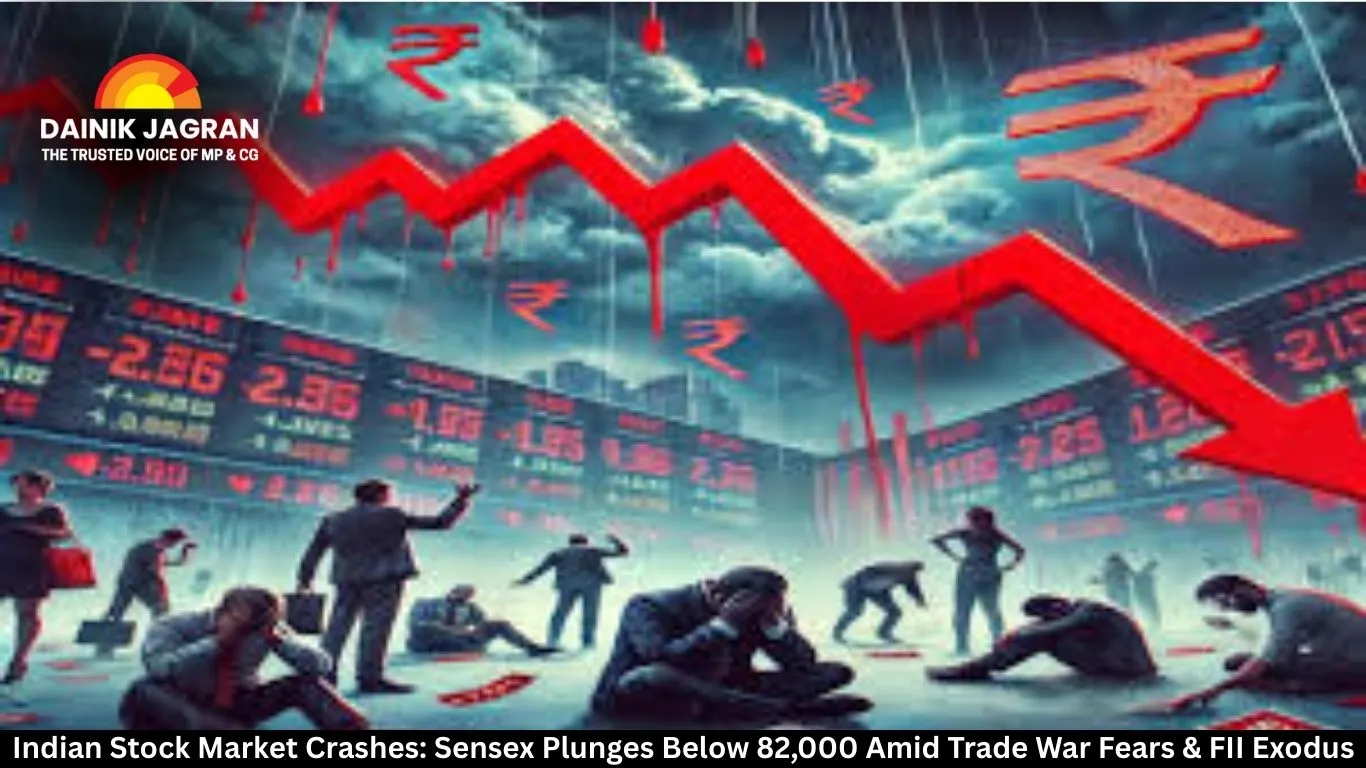
Indian Stock Market Crashes: Sensex Plunges Below 82,000 Amid Trade War Fears & FII Exodus
Digital Desk
Indian Markets Extend Losses: Sensex Crashes Below 82,000 as Global Storm Hits Dalal Street
In a brutal session that rattled investor confidence, India’s benchmark Sensex plunged below the psychologically crucial 82,000 mark for the first time in over three months, extending its losing streak to a third straight day. The index, after a wild roller-coaster ride that saw a dramatic 1,200-point recovery from the day’s low, finally surrendered to overwhelming selling pressure, closing deep in the red. The Nifty 50 followed suit, dropping 75 points to settle at 25,157.50.
The heavyweights that dragged the indices down were telling: ICICI Bankand Axis Bankfeatured among the top Nifty losers, shedding over 2% and 1.2% respectively, reflecting broad-based anxiety in the financial sector.
Why Are Markets Falling? 4 Key Reasons Explained
The Indian stock market declineisn't happening in isolation. It’s a perfect storm of global geopolitical shocks and domestic headwinds.
1. Geopolitical Tensions Spark Trade War Fears:The most significant trigger is an unexpected global flashpoint. Reports that former US President Donald Trump is pushing to acquire Greenland for its resources, facing fierce opposition from European allies, has ignited fresh tensions. Trump's retaliatory announcement of tariffs on imports from opposing nations has markets fearing a new US-Europe trade war. An emergency EU summit scheduled for Thursday has investors worldwide on edge.
2. US Supreme Court & The Tariff Threat:Adding fuel to the fire, the US Supreme Court recently heard arguments on the validity of Trump's aggressive tariff policies. Market readings suggest the Court may grant the administration wider leeway, increasing the risk of protectionist measures. This spells trouble for Indian IT and Pharma sectors, which derive substantial revenue from the US and saw heavy selling today.
3. Relentless FII Selling & a Record Weak Rupee:Foreign Institutional Investors (FIIs) continue their exit. With the Indian rupee hitting a historic low of ₹91.20 against the US dollar, their returns in dollar terms are eroded, accelerating the sell-off. Preliminary data shows FIIs have pulled out a staggering ₹29,000 crore+ already in January, with another ₹2,191 crore sold just on Tuesday.
4. Disappointing Corporate Results:The ongoing Q3 results season has failed to cheer the markets. Behemoth Reliance Industries (RIL) and several major private banks have reported weaker-than-expected margins, pressured by global supply chain issues. Their weight in the indices has magnified the market's fall.
Expert Take: A "Cautious Pause" Ahead
"Markets are pricing in a new era of uncertainty," says Simulated Market Analyst, Priya Sharma of Insight Capital. "The twin blows of potential trade wars and sustained FII outflow are forcing a deep revaluation. We are in a risk-off environment globally, and India is not immune. The key support for Nifty now is at the 25,000 level."
Global Markets & The Shadowfax IPO
The gloom is worldwide. Asian markets like Nikkei and KOSPI traded lower, following a sharp sell-off on Wall Street where the Dow Jones crashed nearly 1.8%. Meanwhile, amidst the turmoil, the Shadowfax Technologies IPOcontinued its subscription on day two, closing for bids on January 22—a test of retail investor appetite in volatile times.
Bottom Line: What Should Investors Do?
The break below 82,000 for the Sensexis a significant technical and psychological blow. While domestic institutional investors (DIIs) provided a cushion with net buying, they are struggling to counter the FII tidal wave. For now, analysts advise against aggressive bottom-fishing. The market's near-term direction hinges heavily on the evolving geopolitical narrative and the rupee's stability. Investors should brace for continued volatility and prioritize capital preservation over quick gains.




.jpg)




