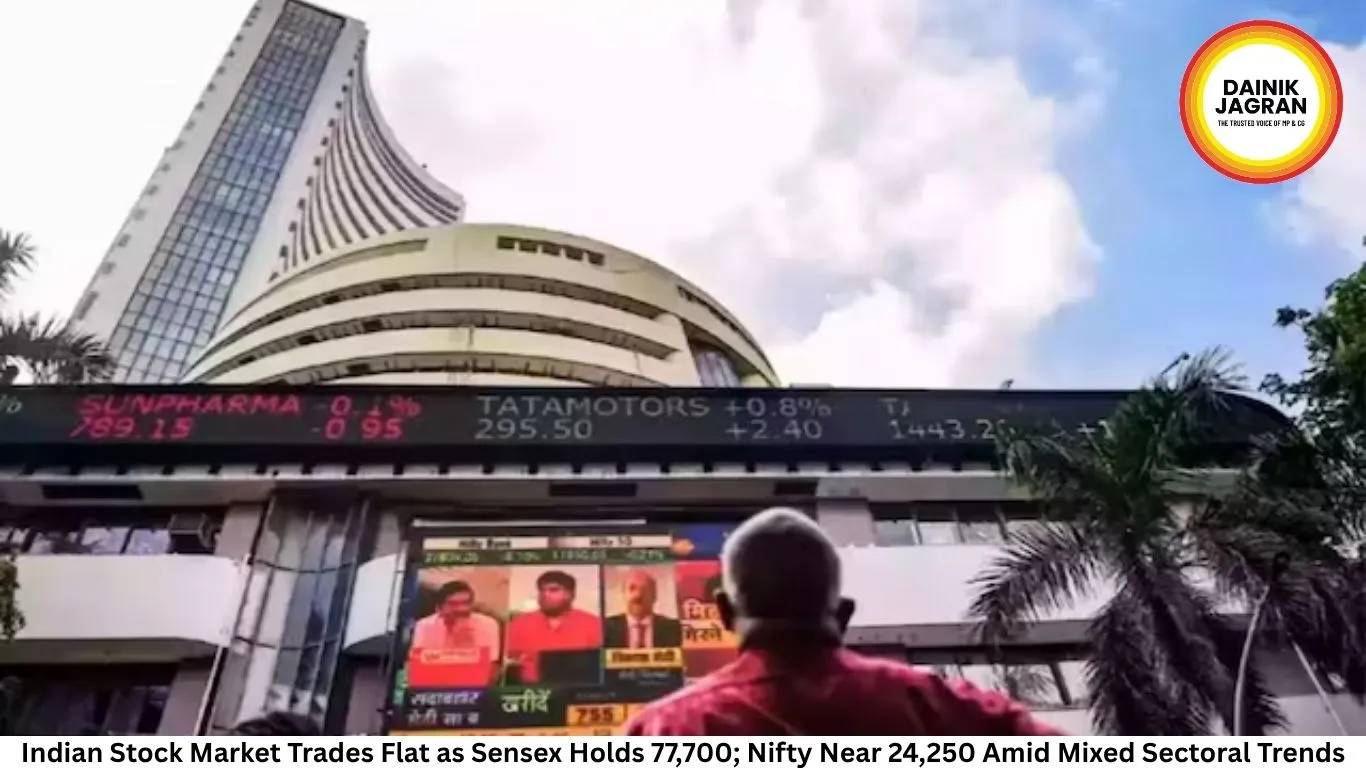
Indian Stock Market Trades Flat as Sensex Holds 77,700; Nifty Near 24,250 Amid Mixed Sectoral Trends

Digital Desk

Indian Stock Market Trades Flat as Sensex Holds 77,700; Nifty Near 24,250 Amid Mixed Sectoral Trends

Indian equity benchmarks traded largely flat on Tuesday, with the Sensex hovering around 77,700 and the Nifty near 24,250. Banking and FMCG stocks remained under pressure, while chemical stocks outperformed. Falling crude oil prices and mixed global cues kept investor sentiment cautious.

Indian benchmark equity indices traded in a narrow range on Tuesday as investors remained cautious amid mixed global market signals and sector-specific selling. The BSE Sensex hovered around 77,700, while the NSE Nifty 50 traded near 24,250, reflecting a lack of strong directional momentum after the previous session's decline.

Market participants closely tracked global developments, easing crude oil prices, institutional investment flows, and corporate earnings, all of which influenced trading sentiment during the session.

Banking and FMCG Stocks Under Pressure

The broader market witnessed selective buying, but heavy selling pressure in banking and FMCG stocks limited overall gains.

Sector-wise, the Nifty Chemicals Index emerged as the top performer, rising nearly 0.86%, while several other indices traded in the red.

Pharmaceuticals, PSU banks, consumer durables, real estate, and REIT-linked stocks also witnessed weakness, reflecting cautious investor positioning across defensive and rate-sensitive sectors.

Analysts said investors remained selective as they awaited fresh corporate earnings and additional domestic and global economic triggers.

Crude Oil Slips Below $90 Per Barrel

Global crude oil prices eased below the $90 per barrel mark, offering some relief to emerging markets, including India.

Oil prices had recently climbed amid renewed geopolitical tensions between the United States and Iran, raising concerns over supply disruptions. The latest decline helped improve sentiment for sectors dependent on imported crude, although investors continued to monitor geopolitical developments closely.

Lower crude prices are generally viewed positively for India's inflation outlook, fiscal balance, and corporate profitability.

Asian Markets Trade Mixed

Asian equity markets presented a mixed picture during Tuesday's trading session.

South Korea's KOSPI gained over 3%, while Japan's Nikkei advanced nearly 1.7%, supported by technology and export-oriented stocks.

In contrast, Hong Kong's Hang Seng Index traded marginally lower, reflecting continued caution among regional investors amid global economic uncertainties.

The mixed performance across Asia contributed to the subdued opening in Indian equities.

US Markets End Lower

Wall Street closed lower in the previous trading session.

The Dow Jones Industrial Average declined by over 300 points, while the Nasdaq Composite and S&P 500 also ended in negative territory as investors assessed corporate earnings, inflation concerns, and geopolitical risks.

Weakness in US markets added to the cautious mood among global investors.

Domestic Investors Continue to Support Markets

Despite foreign investor selling, domestic institutional investors (DIIs) continued to provide stability to Indian equities.

Over the past seven trading sessions:

  • DIIs purchased shares worth ₹6,021 crore
  • FIIs/FPI sold equities worth ₹6,439 crore

During the past month, domestic institutions have invested more than ₹43,000 crore, helping cushion the impact of continued foreign fund outflows.

Market experts believe sustained domestic buying has remained one of the key factors supporting Indian markets despite global volatility.

Rupee Weakens Against Dollar

The Indian rupee weakened by 6 paise against the US dollar to trade at 96.42, reflecting continued demand for the greenback and cautious foreign investor sentiment.

Currency movement will remain an important factor for sectors dependent on imports and exports in the coming sessions.

Previous Session Ended in Losses

Indian markets had ended Monday's session on a weak note.

The Sensex closed 443 points lower at 77,709, while the Nifty declined 96 points to settle at 24,239, as profit booking across heavyweight sectors dragged benchmark indices lower.

With quarterly earnings season gaining momentum, investors are expected to remain focused on company results, global market trends, crude oil prices, and foreign investment flows for further market direction.


--------

🚨 Beat the News Rush – Join Now!

Get breaking alerts, hot exclusives, and game-changing stories instantly on your phone. No delays, no fluff – just the edge you need. ⚡

Tap to join: 

🟢 WhatsApp Channel: Dainik Jagran MP CG

Crave more?

🅕 Facebook: Dainik Jagran MP CG English

🅧 Twitter (X): Dainik Jagran MP CG

🅘 Instagram: Dainik Jagran MP CG

Share the fire – keep your crew ahead! 🗞️🔥

english.dainikjagranmpcg.com
21 Jul 2026 By Rishita

Indian Stock Market Trades Flat as Sensex Holds 77,700; Nifty Near 24,250 Amid Mixed Sectoral Trends

Digital Desk

Indian benchmark equity indices traded in a narrow range on Tuesday as investors remained cautious amid mixed global market signals and sector-specific selling. The BSE Sensex hovered around 77,700, while the NSE Nifty 50 traded near 24,250, reflecting a lack of strong directional momentum after the previous session's decline.

Market participants closely tracked global developments, easing crude oil prices, institutional investment flows, and corporate earnings, all of which influenced trading sentiment during the session.

Banking and FMCG Stocks Under Pressure

The broader market witnessed selective buying, but heavy selling pressure in banking and FMCG stocks limited overall gains.

Sector-wise, the Nifty Chemicals Index emerged as the top performer, rising nearly 0.86%, while several other indices traded in the red.

Pharmaceuticals, PSU banks, consumer durables, real estate, and REIT-linked stocks also witnessed weakness, reflecting cautious investor positioning across defensive and rate-sensitive sectors.

Analysts said investors remained selective as they awaited fresh corporate earnings and additional domestic and global economic triggers.

Crude Oil Slips Below $90 Per Barrel

Global crude oil prices eased below the $90 per barrel mark, offering some relief to emerging markets, including India.

Oil prices had recently climbed amid renewed geopolitical tensions between the United States and Iran, raising concerns over supply disruptions. The latest decline helped improve sentiment for sectors dependent on imported crude, although investors continued to monitor geopolitical developments closely.

Lower crude prices are generally viewed positively for India's inflation outlook, fiscal balance, and corporate profitability.

Asian Markets Trade Mixed

Asian equity markets presented a mixed picture during Tuesday's trading session.

South Korea's KOSPI gained over 3%, while Japan's Nikkei advanced nearly 1.7%, supported by technology and export-oriented stocks.

In contrast, Hong Kong's Hang Seng Index traded marginally lower, reflecting continued caution among regional investors amid global economic uncertainties.

The mixed performance across Asia contributed to the subdued opening in Indian equities.

US Markets End Lower

Wall Street closed lower in the previous trading session.

The Dow Jones Industrial Average declined by over 300 points, while the Nasdaq Composite and S&P 500 also ended in negative territory as investors assessed corporate earnings, inflation concerns, and geopolitical risks.

Weakness in US markets added to the cautious mood among global investors.

Domestic Investors Continue to Support Markets

Despite foreign investor selling, domestic institutional investors (DIIs) continued to provide stability to Indian equities.

Over the past seven trading sessions:

  • DIIs purchased shares worth ₹6,021 crore
  • FIIs/FPI sold equities worth ₹6,439 crore

During the past month, domestic institutions have invested more than ₹43,000 crore, helping cushion the impact of continued foreign fund outflows.

Market experts believe sustained domestic buying has remained one of the key factors supporting Indian markets despite global volatility.

Rupee Weakens Against Dollar

The Indian rupee weakened by 6 paise against the US dollar to trade at 96.42, reflecting continued demand for the greenback and cautious foreign investor sentiment.

Currency movement will remain an important factor for sectors dependent on imports and exports in the coming sessions.

Previous Session Ended in Losses

Indian markets had ended Monday's session on a weak note.

The Sensex closed 443 points lower at 77,709, while the Nifty declined 96 points to settle at 24,239, as profit booking across heavyweight sectors dragged benchmark indices lower.

With quarterly earnings season gaining momentum, investors are expected to remain focused on company results, global market trends, crude oil prices, and foreign investment flows for further market direction.

https://english.dainikjagranmpcg.com/business/indian-stock-market-trades-flat-as-sensex-holds-77700-nifty/article-23025

Trending News