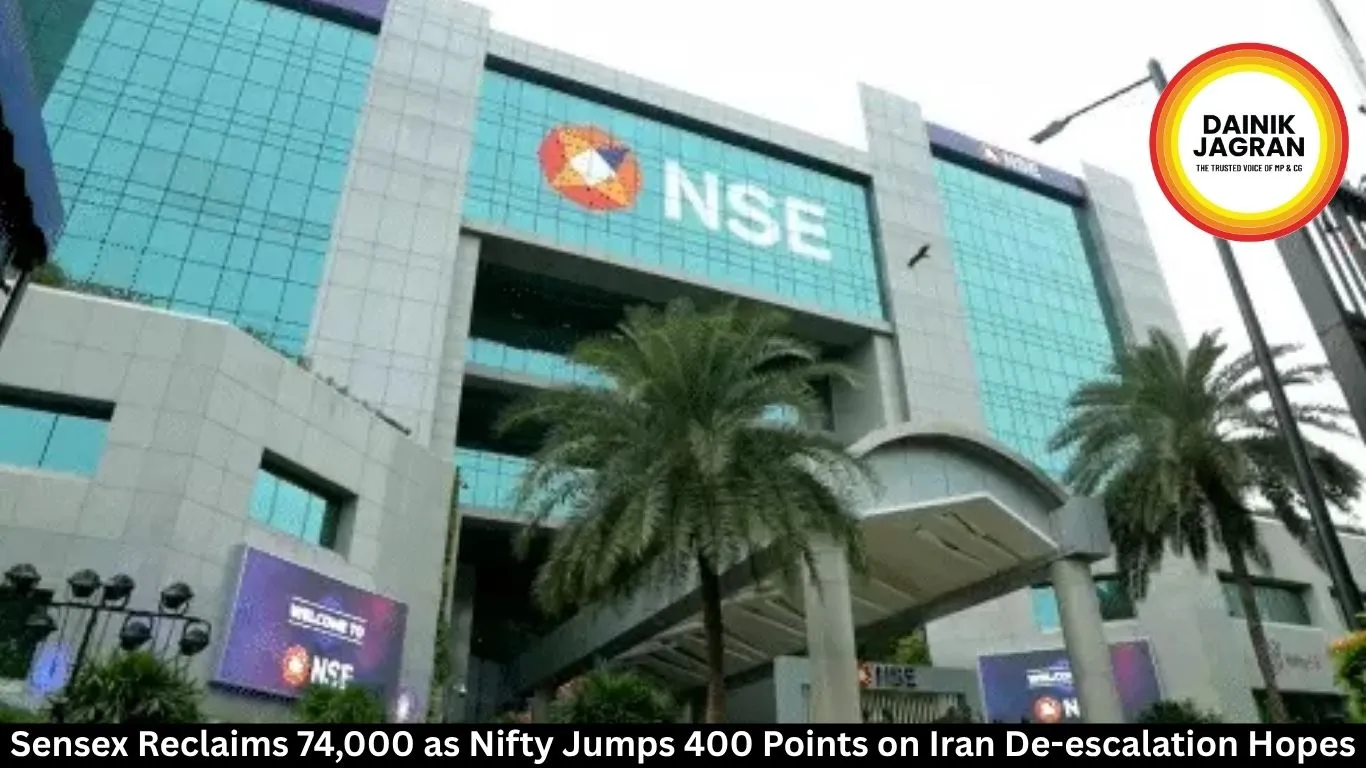
Sensex Reclaims 74,000 as Nifty Jumps 400 Points on Iran De-escalation Hopes
Digital Desk
Sensex surged 1,372 points to reclaim 74,000 and Nifty rose nearly 400 points on Tuesday as US President Trump postponed strikes on Iranian energy infrastructure for five days, easing oil price fears and boosting banking and auto stocks.
Indian equity benchmarks staged a sharp rebound on Tuesday, with the Sensex surging over 1,372 points to reclaim the 74,000 mark and the Nifty climbing nearly 400 points, driven by positive global cues after US President Donald Trump announced a five-day pause on planned military strikes against Iranian energy infrastructure.
The BSE Sensex closed at 74,068, up 1,372 points or 1.89 per cent from Monday’s close. The NSE Nifty settled at 22,958, gaining 445 points or 1.98 per cent. Banking and auto stocks led the buying, reflecting renewed investor confidence amid easing geopolitical tensions in the Middle East.
Strong Buying in Key Sectors
Banking shares witnessed robust demand as the Nifty Bank index rose sharply. Auto majors also posted solid gains, contributing significantly to the broader market rally. Market participants noted broad-based buying across most sectors, with only a few pockets of selling.
Traders attributed the bounceback to Trump’s announcement late on Monday that he had instructed a postponement of strikes on Iranian power plants and energy facilities following what he described as productive talks with Tehran. The development reduced immediate fears of supply disruptions in the global oil market.
Oil Prices Volatile Amid Pause
Crude oil prices remained in focus. Brent crude rose about 4 per cent to trade above $104 per barrel during the session, while the Indian crude oil basket hovered near elevated levels around $150 per barrel. Earlier, prices had eased sharply when Trump first signalled the delay, dropping from highs near $113, but they regained some ground on Tuesday.
Analysts said the five-day window for diplomacy offered temporary relief to energy-sensitive sectors in India, though long-term concerns over the India-Middle East conflict persist. Domestic fuel prices, however, remained unchanged despite the volatility in global benchmarks.
Rupee Gains Ground
The Indian rupee opened stronger, rising 34 paise to 93.64 against the US dollar from Monday’s close of 93.98. Currency traders pointed to a weaker dollar and improved risk appetite in emerging markets as key factors supporting the local unit.
Global Markets Turn Positive
Asian markets advanced in Tuesday’s trade. Japan’s Nikkei rose 0.77 per cent, South Korea’s Kospi gained 1.74 per cent, Hong Kong’s Hang Seng climbed 1.45 per cent, and China’s Shanghai Composite was up 0.95 per cent.
Overnight, US indices also closed higher. The Dow Jones added 631 points or 1.38 per cent, the Nasdaq Composite rose 1.38 per cent, and the S&P 500 gained 1.15 per cent, reflecting relief over the de-escalation signal from Washington.
Sharp Fall on Monday
The rally on Tuesday came after a bruising session on Monday, when the Sensex had tumbled 1,837 points or 2.46 per cent to close at 72,696, while the Nifty dropped 602 points or 2.60 per cent to 22,513. Banking, auto, metal and FMCG stocks bore the brunt of selling amid heightened worries over the US-Israel-Iran conflict and rising oil prices.
Impact on Indian Economy
The sharp recovery provided some breathing space to domestic investors, who had seen significant erosion in wealth in recent sessions. Lower volatility and a pause in escalation fears could support foreign institutional inflows in the near term. However, analysts cautioned that any breakdown in talks could quickly reverse the sentiment, given India’s heavy dependence on imported crude.
What Lies Ahead
Market watchers will closely track developments in the US-Iran dialogue over the next five days. Any concrete progress toward de-escalation could sustain the momentum in Indian equities. On the domestic front, participants await quarterly earnings from key companies and upcoming policy cues from the government and RBI.
Traders also remain wary of elevated oil prices and their potential pass-through effect on inflation and the current account. With global cues turning supportive for now, the coming sessions will test whether this rebound can hold or if Monday’s losses signal deeper concerns.
Sensex Reclaims 74,000 as Nifty Jumps 400 Points on Iran De-escalation Hopes
Digital Desk
Indian equity benchmarks staged a sharp rebound on Tuesday, with the Sensex surging over 1,372 points to reclaim the 74,000 mark and the Nifty climbing nearly 400 points, driven by positive global cues after US President Donald Trump announced a five-day pause on planned military strikes against Iranian energy infrastructure.
The BSE Sensex closed at 74,068, up 1,372 points or 1.89 per cent from Monday’s close. The NSE Nifty settled at 22,958, gaining 445 points or 1.98 per cent. Banking and auto stocks led the buying, reflecting renewed investor confidence amid easing geopolitical tensions in the Middle East.
Strong Buying in Key Sectors
Banking shares witnessed robust demand as the Nifty Bank index rose sharply. Auto majors also posted solid gains, contributing significantly to the broader market rally. Market participants noted broad-based buying across most sectors, with only a few pockets of selling.
Traders attributed the bounceback to Trump’s announcement late on Monday that he had instructed a postponement of strikes on Iranian power plants and energy facilities following what he described as productive talks with Tehran. The development reduced immediate fears of supply disruptions in the global oil market.
Oil Prices Volatile Amid Pause
Crude oil prices remained in focus. Brent crude rose about 4 per cent to trade above $104 per barrel during the session, while the Indian crude oil basket hovered near elevated levels around $150 per barrel. Earlier, prices had eased sharply when Trump first signalled the delay, dropping from highs near $113, but they regained some ground on Tuesday.
Analysts said the five-day window for diplomacy offered temporary relief to energy-sensitive sectors in India, though long-term concerns over the India-Middle East conflict persist. Domestic fuel prices, however, remained unchanged despite the volatility in global benchmarks.
Rupee Gains Ground
The Indian rupee opened stronger, rising 34 paise to 93.64 against the US dollar from Monday’s close of 93.98. Currency traders pointed to a weaker dollar and improved risk appetite in emerging markets as key factors supporting the local unit.
Global Markets Turn Positive
Asian markets advanced in Tuesday’s trade. Japan’s Nikkei rose 0.77 per cent, South Korea’s Kospi gained 1.74 per cent, Hong Kong’s Hang Seng climbed 1.45 per cent, and China’s Shanghai Composite was up 0.95 per cent.
Overnight, US indices also closed higher. The Dow Jones added 631 points or 1.38 per cent, the Nasdaq Composite rose 1.38 per cent, and the S&P 500 gained 1.15 per cent, reflecting relief over the de-escalation signal from Washington.
Sharp Fall on Monday
The rally on Tuesday came after a bruising session on Monday, when the Sensex had tumbled 1,837 points or 2.46 per cent to close at 72,696, while the Nifty dropped 602 points or 2.60 per cent to 22,513. Banking, auto, metal and FMCG stocks bore the brunt of selling amid heightened worries over the US-Israel-Iran conflict and rising oil prices.
Impact on Indian Economy
The sharp recovery provided some breathing space to domestic investors, who had seen significant erosion in wealth in recent sessions. Lower volatility and a pause in escalation fears could support foreign institutional inflows in the near term. However, analysts cautioned that any breakdown in talks could quickly reverse the sentiment, given India’s heavy dependence on imported crude.
What Lies Ahead
Market watchers will closely track developments in the US-Iran dialogue over the next five days. Any concrete progress toward de-escalation could sustain the momentum in Indian equities. On the domestic front, participants await quarterly earnings from key companies and upcoming policy cues from the government and RBI.
Traders also remain wary of elevated oil prices and their potential pass-through effect on inflation and the current account. With global cues turning supportive for now, the coming sessions will test whether this rebound can hold or if Monday’s losses signal deeper concerns.