How to Become a Railway Station Master: Eligibility, Selection Process and Salary Explained

Digital desk

How to Become a Railway Station Master: Eligibility, Selection Process and Salary Explained

Station Master is widely considered one of the most attractive postings within Indian Railways — a mix of responsibility, stability and a pay scale that sits at the top of the RRB NTPC ladder. Here's what the role actually involves and how to get there.

What does a Station Master do?
As the officer-in-charge of a railway station, the Station Master oversees train arrivals and departures, manages the signalling system, coordinates platform operations and staff duties, and takes charge during emergencies. Most stations run multiple Station Masters across shifts to maintain round-the-clock coverage — typically around four per station, depending on size and traffic.

Eligibility
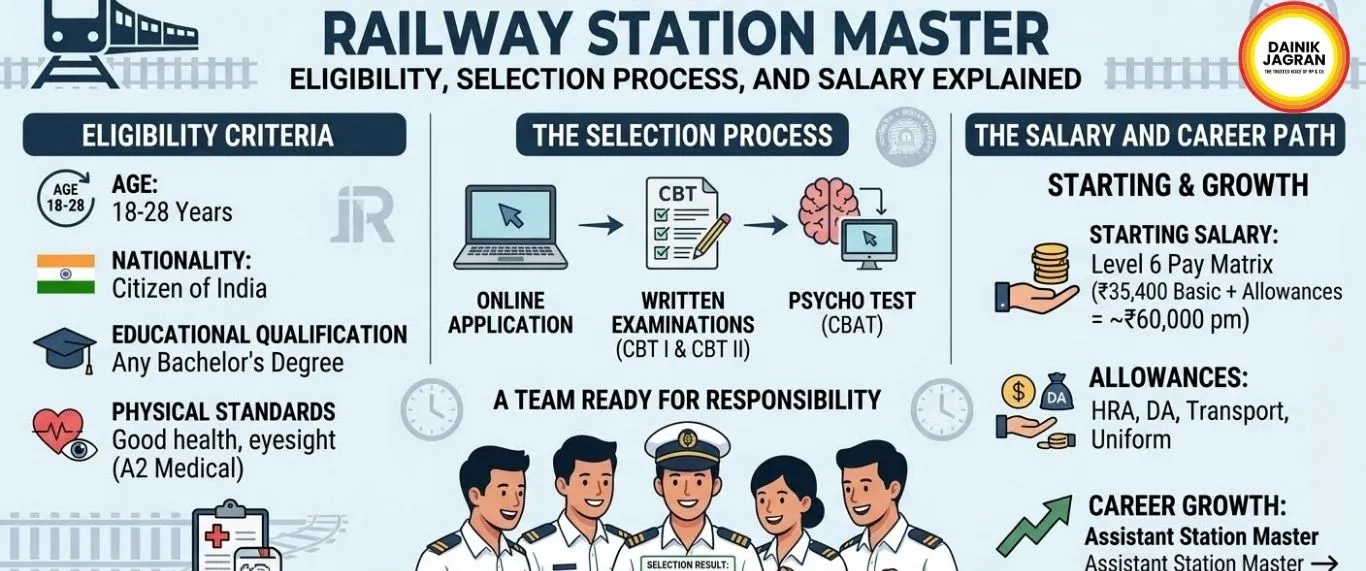
The role is filled through the RRB NTPC (Non-Technical Popular Categories) exam, conducted by the Railway Recruitment Board. Candidates need a graduation degree in any discipline from a recognised university — no specific stream is required. Age limits for graduate-level NTPC posts run from 18 to 36 years, with standard relaxations of 5 years for SC/ST candidates and 3 years for OBC candidates, along with further relaxation for PwBD applicants. Candidates also need to meet A-2 medical fitness standards, which include specific requirements around vision and general physical fitness given the operational nature of the job.

Selection process
The process runs in stages. First is CBT-1 (Computer Based Test), a qualifying-level exam that shortlists candidates — typically around 15 times the number of vacancies — for CBT-2. Marks from CBT-1 aren't carried forward into the final merit; they're used purely for shortlisting. CBT-2 is tougher and forms the primary basis for final selection.

Station Master aspirants have one additional hurdle beyond the standard NTPC process: the Computer-Based Aptitude Test (CBAT), a psychometric test assessing memory, perception and attention — skills considered directly relevant to the safety-critical nature of the job. Candidates need a minimum T-Score of 42 in each test battery within CBAT to qualify; unlike CBT-1 and CBT-2, this is qualifying only and isn't scored into the merit list. After CBAT, candidates go through document verification and a final medical examination before selection.

Salary and benefits
Station Master sits at Level 6 of the 7th Pay Commission pay matrix, with basic pay starting at ₹35,400 and going up to ₹1,12,400 as per the pay scale band — making it the highest-paying post within the broader NTPC category. With allowances like Dearness Allowance, House Rent Allowance and Transport Allowance factored in, in-hand salary typically works out to somewhere between ₹45,000 and ₹65,000 a month depending on the city of posting, with higher figures in metro and X-class cities. Beyond salary, the post comes with railway travel passes for the employee and family, medical coverage, and standard government retirement benefits including provident fund, gratuity and pension.

Career growth
Station Master isn't a gazetted post to start with, but it can become one through promotions over a career, with senior-level pay reaching ₹1.2–1.35 lakh a month at higher grades. Promotions depend on vacancies and performance rather than a fixed timeline, though employees who go without promotion for an extended period are generally entitled to a grade-pay increase under standard government service rules.

For anyone weighing RRB NTPC options, Station Master remains one of the more demanding routes in terms of the extra CBAT stage — but for many aspirants, the combination of top-tier NTPC pay and long-term stability makes it worth the additional test.

--------

🚨 Beat the News Rush – Join Now!

Get breaking alerts, hot exclusives, and game-changing stories instantly on your phone. No delays, no fluff – just the edge you need. ⚡

Tap to join: 

🟢 WhatsApp Channel: Dainik Jagran MP CG

Crave more?

🅕 Facebook: Dainik Jagran MP CG English

🅧 Twitter (X): Dainik Jagran MP CG

🅘 Instagram: Dainik Jagran MP CG

Share the fire – keep your crew ahead! 🗞️🔥

english.dainikjagranmpcg.com
13 Jul 2026 By Priyanshu.Jha

How to Become a Railway Station Master: Eligibility, Selection Process and Salary Explained

Digital desk

What does a Station Master do?
As the officer-in-charge of a railway station, the Station Master oversees train arrivals and departures, manages the signalling system, coordinates platform operations and staff duties, and takes charge during emergencies. Most stations run multiple Station Masters across shifts to maintain round-the-clock coverage — typically around four per station, depending on size and traffic.

Eligibility
The role is filled through the RRB NTPC (Non-Technical Popular Categories) exam, conducted by the Railway Recruitment Board. Candidates need a graduation degree in any discipline from a recognised university — no specific stream is required. Age limits for graduate-level NTPC posts run from 18 to 36 years, with standard relaxations of 5 years for SC/ST candidates and 3 years for OBC candidates, along with further relaxation for PwBD applicants. Candidates also need to meet A-2 medical fitness standards, which include specific requirements around vision and general physical fitness given the operational nature of the job.

Selection process
The process runs in stages. First is CBT-1 (Computer Based Test), a qualifying-level exam that shortlists candidates — typically around 15 times the number of vacancies — for CBT-2. Marks from CBT-1 aren't carried forward into the final merit; they're used purely for shortlisting. CBT-2 is tougher and forms the primary basis for final selection.

Station Master aspirants have one additional hurdle beyond the standard NTPC process: the Computer-Based Aptitude Test (CBAT), a psychometric test assessing memory, perception and attention — skills considered directly relevant to the safety-critical nature of the job. Candidates need a minimum T-Score of 42 in each test battery within CBAT to qualify; unlike CBT-1 and CBT-2, this is qualifying only and isn't scored into the merit list. After CBAT, candidates go through document verification and a final medical examination before selection.

Salary and benefits
Station Master sits at Level 6 of the 7th Pay Commission pay matrix, with basic pay starting at ₹35,400 and going up to ₹1,12,400 as per the pay scale band — making it the highest-paying post within the broader NTPC category. With allowances like Dearness Allowance, House Rent Allowance and Transport Allowance factored in, in-hand salary typically works out to somewhere between ₹45,000 and ₹65,000 a month depending on the city of posting, with higher figures in metro and X-class cities. Beyond salary, the post comes with railway travel passes for the employee and family, medical coverage, and standard government retirement benefits including provident fund, gratuity and pension.

Career growth
Station Master isn't a gazetted post to start with, but it can become one through promotions over a career, with senior-level pay reaching ₹1.2–1.35 lakh a month at higher grades. Promotions depend on vacancies and performance rather than a fixed timeline, though employees who go without promotion for an extended period are generally entitled to a grade-pay increase under standard government service rules.

For anyone weighing RRB NTPC options, Station Master remains one of the more demanding routes in terms of the extra CBAT stage — but for many aspirants, the combination of top-tier NTPC pay and long-term stability makes it worth the additional test.

https://english.dainikjagranmpcg.com/education/6a54a421d5a99/article-22000

Trending News