


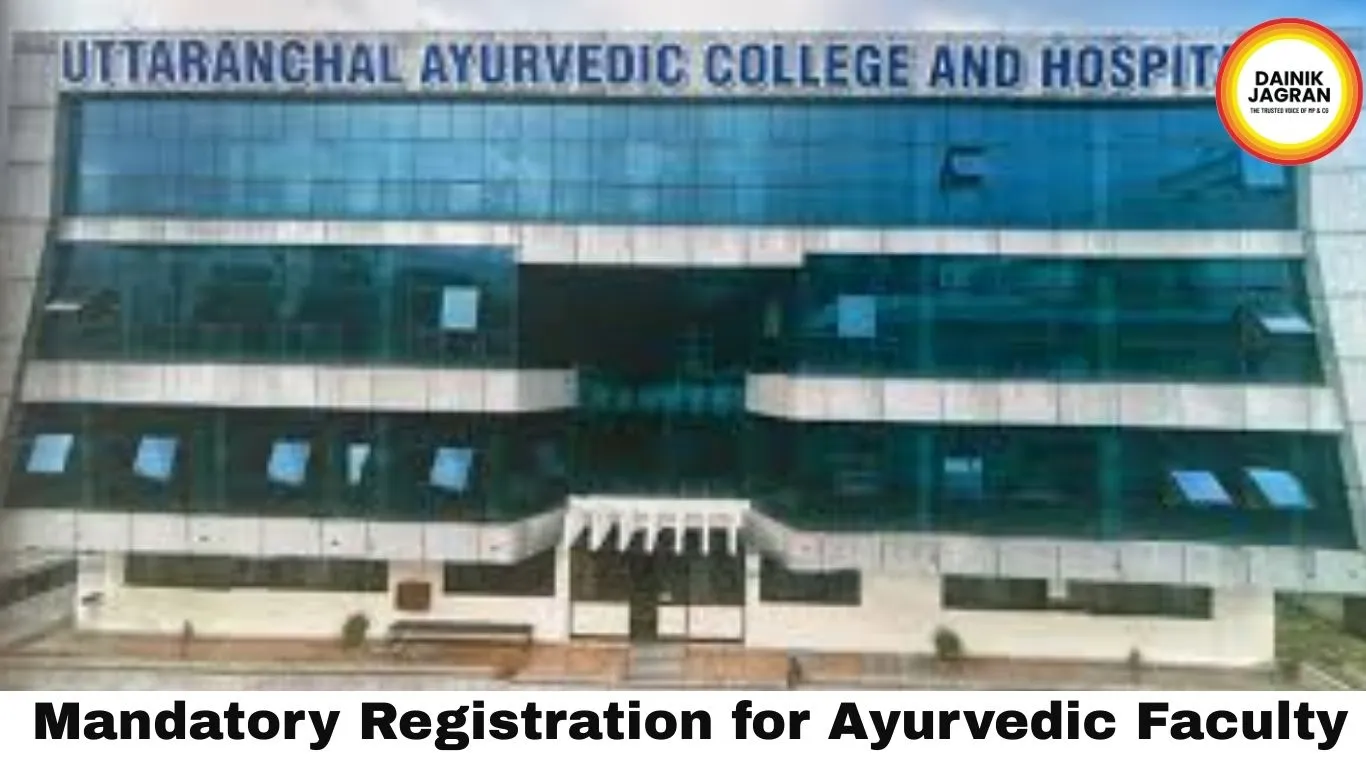
Mandatory Registration for Ayurvedic Faculty: New Rule Brings Big Shift in Ayurvedic Colleges
Mandatory Ayurvedic Faculty Registration Signals New Era for Ayurveda Education in India
India’s traditional medicine system is entering a decisive phase of transformation, as Ayurvedic faculty registration has now been made mandatory for educators in Ayurvedic colleges. The move, introduced under evolving regulatory norms, reflects a broader push to bring structure, accountability, and global credibility to Ayurveda education at a time when its relevance is expanding rapidly both within the country and abroad.
For decades, Ayurveda has remained one of India’s most valued knowledge systems, deeply rooted in cultural heritage and holistic healing practices. However, the academic framework supporting it has often faced criticism for uneven standards and lack of uniform regulatory enforcement. The introduction of mandatory registration for teaching faculty appears to be a direct response to these concerns, aiming to ensure that only qualified and verified professionals are entrusted with shaping future practitioners.
The timing of this reform is particularly significant. In recent years, Ayurveda has witnessed a renewed surge in popularity, driven by increasing awareness around natural healing, preventive healthcare, and wellness-based lifestyles. This rising demand has also led to a proliferation of Ayurvedic colleges and courses across India. While this expansion has created opportunities, it has simultaneously raised questions about the consistency and quality of education being delivered. In this context, Ayurvedic faculty registration is not merely an administrative step but a necessary intervention to safeguard academic integrity.
Under the new guidelines, faculty members are required to register with the relevant regulatory authority, most likely under the framework governed by the National Commission for Indian System of Medicine (NCISM). This registration is expected to act as a formal validation of their qualifications, teaching eligibility, and professional standing. Much like licensing systems in modern medical education, it introduces a mechanism of accountability that has long been considered essential but largely absent in traditional medicine teaching structures.
The implications of this reform are far-reaching. For Ayurvedic colleges, it marks a shift toward stricter compliance and more transparent hiring practices. Institutions will now have to ensure that every member of their teaching staff meets the prescribed criteria, which may involve revisiting existing appointments and strengthening internal verification processes. While this may pose short-term administrative challenges, it ultimately pushes institutions toward higher standards of academic excellence.
For students, the impact is expected to be overwhelmingly positive. Access to qualified and registered faculty members can significantly improve the quality of education, clinical training, and mentorship they receive. In a field like Ayurveda, where knowledge is both theoretical and practice-based, the role of a competent educator becomes even more critical. This reform, therefore, has the potential to directly influence the competence and confidence of future Ayurvedic professionals entering the healthcare system.
Experts in the field have largely welcomed the move, viewing it as a long-overdue step toward professionalization. Many believe that the absence of a robust regulatory mechanism for faculty has, in the past, allowed inconsistencies to persist. By mandating registration, authorities are effectively setting a benchmark that aligns Ayurveda education with global expectations. As one academic observer noted, such measures are essential if India aims to position Ayurveda as a credible and scientifically respected system on the international stage.
That said, the transition may not be entirely smooth. Concerns around implementation, particularly in smaller or rural institutions, are already being discussed. Some existing faculty members may face challenges in meeting updated requirements or completing registration processes within stipulated timelines. There is also the question of administrative efficiency, as regulatory bodies will need to handle a potentially large volume of applications without causing delays that could disrupt academic functioning.
Despite these challenges, the broader direction of the reform remains clear. The mandatory Ayurvedic faculty registration policy signals a commitment to strengthening the foundations of Ayurveda education rather than merely expanding its reach. It acknowledges that the future of this traditional system depends not just on its historical legacy, but on the quality and credibility of the professionals it produces.
In many ways, this move can be seen as part of a larger shift in how traditional knowledge systems are being integrated into modern frameworks. By introducing structured regulation without diluting the essence of Ayurveda, policymakers appear to be striking a balance between preservation and progress.
As Ayurveda continues to gain acceptance in global healthcare conversations, reforms like these will play a defining role in shaping its trajectory. The mandatory registration of faculty is more than a policy update; it is a statement of intent. It underscores the idea that for Ayurveda to thrive in the contemporary world, it must evolve with systems that ensure trust, transparency, and excellence at every level of education.




.jpg)




