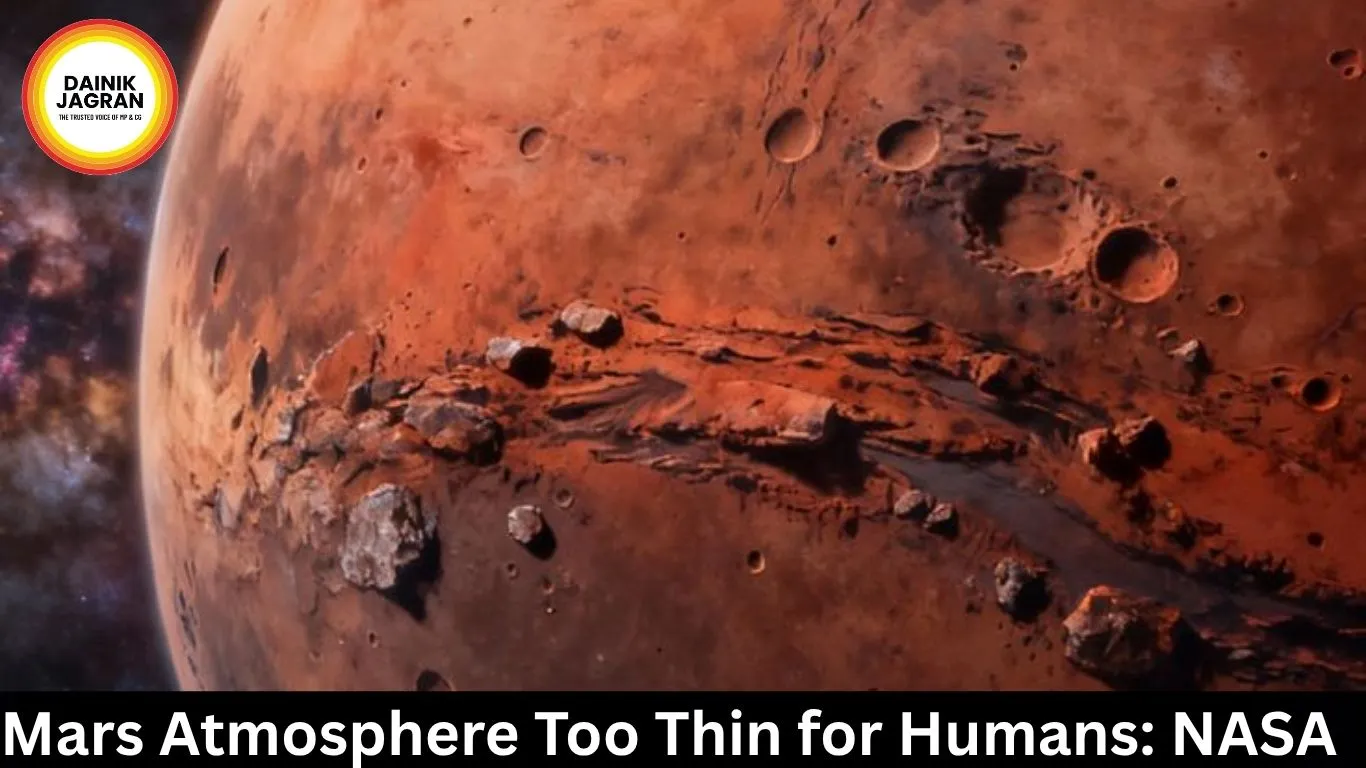
Mars Atmosphere Too Thin for Humans: NASA

Digital Desk

Mars Atmosphere Too Thin for Humans: NASA

 NASA's Perseverance data confirms Mars atmosphere—96% CO2, razor-thin pressure—is lethal within seconds for unprotected humans. MOXIE tech offers hope for oxygen production amid radiation and storm risks for 2030s missions.

Mars Atmosphere Confirmed Too Thin for Human Survival

NASA's latest analysis underscores why Red Planet's air—mostly CO2—poses instant lethal risk, even as oxygen tech advances for future missions.

NASA has long known Mars has an atmosphere, but fresh insights from ongoing missions hammer home a stark reality—it's far too thin and toxic for any human to survive even a few seconds unprotected.

The Red Planet's air pressure sits at just 1% of Earth's, dominated by 96% carbon dioxide with a mere 0.13% oxygen. Initial reports from Perseverance rover data, analyzed at NASA's Jet Propulsion Laboratory late last week, confirm what experts have warned: a single breath would trigger rapid ebullism—saliva and fluids boiling due to the vacuum-like conditions.

Thin Air's Deadly Toll

Without a suit, lungs would rupture almost immediately. Officials at NASA likened it to "stepping into space without a helmet." Ground-level readings from Jezero Crater, where Perseverance has been probing since 2021, show surface pressures hovering around 6-10 millibars—barely enough to sustain basic chemistry, let alone human biology.

Local time on Mars that morning? Around 8 AM sols (Martian days), when the rover logged yet another batch of hostile readings. "It's not just the lack of oxygen; the low pressure alone is fatal," a senior NASA atmospheric scientist noted in a briefing.

Echoes of a Lost Past

Billions of years ago, Mars likely boasted a thicker blanket of gases, warmer climes, and flowing rivers—clues etched in ancient rock layers Perseverance is sampling. Lower gravity let solar winds strip away most of that atmosphere over eons, leaving today's barren shell.

Sources familiar with the Curiosity mission's legacy data say early Mars might have teemed with microbial life. Today's cold (-60°C average) and dry expanse tells a different story, but those rock cores could rewrite history.

MOXIE's Oxygen Breakthrough

Enter MOXIE, the toaster-sized marvel aboard Perseverance. This experiment has churned out over 122 grams of oxygen so far—enough for a small dog to breathe for 10 hours—by zapping Martian CO2 into breathable O2.

Test runs peaked in late 2023, with efficiency holding steady even in dusty conditions. NASA engineers confirmed last month it's scalable; future habitats could pipe in site-made oxygen, slashing launch costs from Earth.

Radiation and Storms Loom Large

Oxygen's no silver bullet, though. Mars batters visitors with unfiltered cosmic rays—up to 700 times Earth's dose—plus planet-wide dust storms that blot out sunlight for weeks. Temps plunge to -125°C at poles. Pressurized domes and suits remain non-negotiable.

Public fascination spikes here in India, where ISRO eyes its own Mangalyaan-2 orbiter by 2026, potentially syncing with NASA's data haul.

Missions Inch Closer

Artemis program delays notwithstanding, NASA targets crewed Mars landings in the 2030s. SpaceX echoes that timeline with Starship tests. "We're learning to live off the land," one mission planner told reporters.

For now, Mars atmosphere stays a no-go zone. But as Perseverance drills deeper, the Red Planet feels less like sci-fi.


 

--------

🚨 Beat the News Rush – Join Now!

Get breaking alerts, hot exclusives, and game-changing stories instantly on your phone. No delays, no fluff – just the edge you need. ⚡

Tap to join: 

🟢 WhatsApp Channel: Dainik Jagran MP CG

Crave more?

🅕 Facebook: Dainik Jagran MP CG English

🅧 Twitter (X): Dainik Jagran MP CG

🅘 Instagram: Dainik Jagran MP CG

Share the fire – keep your crew ahead! 🗞️🔥

english.dainikjagranmpcg.com
30 Apr 2026 By Abhishek Joshi

Mars Atmosphere Too Thin for Humans: NASA

Digital Desk

Mars Atmosphere Confirmed Too Thin for Human Survival

NASA's latest analysis underscores why Red Planet's air—mostly CO2—poses instant lethal risk, even as oxygen tech advances for future missions.

NASA has long known Mars has an atmosphere, but fresh insights from ongoing missions hammer home a stark reality—it's far too thin and toxic for any human to survive even a few seconds unprotected.

The Red Planet's air pressure sits at just 1% of Earth's, dominated by 96% carbon dioxide with a mere 0.13% oxygen. Initial reports from Perseverance rover data, analyzed at NASA's Jet Propulsion Laboratory late last week, confirm what experts have warned: a single breath would trigger rapid ebullism—saliva and fluids boiling due to the vacuum-like conditions.

Thin Air's Deadly Toll

Without a suit, lungs would rupture almost immediately. Officials at NASA likened it to "stepping into space without a helmet." Ground-level readings from Jezero Crater, where Perseverance has been probing since 2021, show surface pressures hovering around 6-10 millibars—barely enough to sustain basic chemistry, let alone human biology.

Local time on Mars that morning? Around 8 AM sols (Martian days), when the rover logged yet another batch of hostile readings. "It's not just the lack of oxygen; the low pressure alone is fatal," a senior NASA atmospheric scientist noted in a briefing.

Echoes of a Lost Past

Billions of years ago, Mars likely boasted a thicker blanket of gases, warmer climes, and flowing rivers—clues etched in ancient rock layers Perseverance is sampling. Lower gravity let solar winds strip away most of that atmosphere over eons, leaving today's barren shell.

Sources familiar with the Curiosity mission's legacy data say early Mars might have teemed with microbial life. Today's cold (-60°C average) and dry expanse tells a different story, but those rock cores could rewrite history.

MOXIE's Oxygen Breakthrough

Enter MOXIE, the toaster-sized marvel aboard Perseverance. This experiment has churned out over 122 grams of oxygen so far—enough for a small dog to breathe for 10 hours—by zapping Martian CO2 into breathable O2.

Test runs peaked in late 2023, with efficiency holding steady even in dusty conditions. NASA engineers confirmed last month it's scalable; future habitats could pipe in site-made oxygen, slashing launch costs from Earth.

Radiation and Storms Loom Large

Oxygen's no silver bullet, though. Mars batters visitors with unfiltered cosmic rays—up to 700 times Earth's dose—plus planet-wide dust storms that blot out sunlight for weeks. Temps plunge to -125°C at poles. Pressurized domes and suits remain non-negotiable.

Public fascination spikes here in India, where ISRO eyes its own Mangalyaan-2 orbiter by 2026, potentially syncing with NASA's data haul.

Missions Inch Closer

Artemis program delays notwithstanding, NASA targets crewed Mars landings in the 2030s. SpaceX echoes that timeline with Starship tests. "We're learning to live off the land," one mission planner told reporters.

For now, Mars atmosphere stays a no-go zone. But as Perseverance drills deeper, the Red Planet feels less like sci-fi.

 

https://english.dainikjagranmpcg.com/special-news/mars-atmosphere-too-thin-for-humans-nasa/article-17611

Related Posts

Latest News