


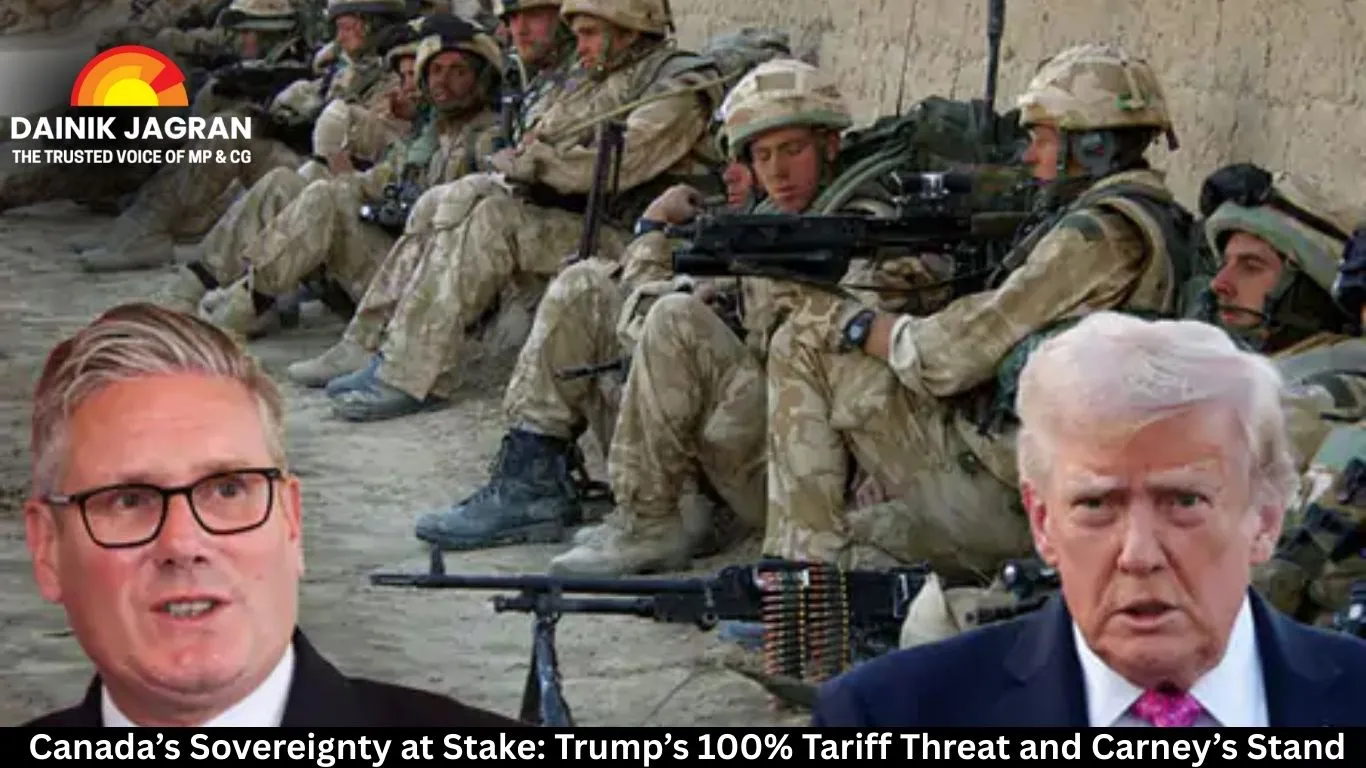
Canada’s Sovereignty at Stake: Trump’s 100% Tariff Threat and Carney’s Stand
Digital Desk
In a dramatic escalation of geopolitical tensions, former U.S. President Donald Trump has threatened to impose an immediate 100% tariff on all Canadian goods if the country proceeds with a new trade agreement with China. The threat, issued via social media on January 24, 2026, directly targets Canadian Prime Minister Mark Carney and challenges Canada’s economic sovereignty. This move marks a sharp reversal from Trump’s initial praise of the deal just days earlier and plunges vital North American trade relations into uncertainty.
The Tariff Threat and a "Drop Off Port" Warning
President Trump’s warning was explicit: if Prime Minister Carney “thinks he is going to make Canada a ‘Drop Off Port’ for China to send goods and products into the United States, he is sorely mistaken”. In his post, Trump argued that “China will eat Canada alive,” suggesting deeper concerns over Beijing’s influence.
The Canadian government swiftly clarified its position. Dominic LeBlanc, the minister responsible for U.S. trade, stated that “there is no pursuit of a free trade agreement with China” and reaffirmed the “remarkable partnership” with the United States. This distinction between resolving specific trade irritants and entering a comprehensive pact is central to Canada’s defense of its actions.
What’s in the Canada-China Agreement?
The agreement-in-principle, announced during Carney’s visit to Beijing earlier in January, is a targeted resolution of long-standing disputes rather than a broad free-trade deal. Its key components include:
Electric Vehicles: Canada will apply a Most-Favoured-Nation tariff rate of 6.1% to up to 49,000 Chinese EVs annually, down from 100%. A portion of this quota is reserved for more affordable models.
Agricultural Market Access: China will significantly lower tariffs on Canadian canola seed and remove punitive tariffs on products like lobster, peas, and crab, benefiting billions in Canadian exports.
Steel and Aluminum: Canada will extend tariff remissions on specific Chinese steel and aluminum products that are in short domestic supply.
The government frames this as a pragmatic effort to stabilize trade with its second-largest partner and secure key sectors like agriculture, while aiming to attract Chinese investment in domestic EV manufacturing.
A Feud Rooted in Sovereignty and Strategy
This trade threat is the latest flashpoint in a deteriorating personal and political relationship between the two leaders, rooted in fundamental disagreements over sovereignty and global strategy.
The “51st State” Provocation: Trump has repeatedly needled Canada over its sovereignty, including by posting an altered map showing Canada as part of the U.S. and referring to Carney as “Governor”—a dig at the idea of Canada becoming a U.S. state.
Clash of Worldviews at Davos: The friction peaked at the World Economic Forum in Davos. Trump stated that “Canada lives because of the United States,” to which Carney retorted, “Canada doesn’t live because of the United States. Canada thrives because we are Canadian”. Carney’s widely praised speech called for middle powers to unite, warning that “if you are not at the table, you are on the menu”.
Broader Strategic Divergence: Experts note Carney is positioning Canada as a leader for nations seeking to navigate between great powers. His government is actively diversifying trade partnerships across Europe and Asia, a strategy that directly challenges Trump’s pressure tactics.
The Stakes for a Deeply Interconnected Economy
The threat of a 100% tariff is not an abstract concern. The U.S.-Canada economic relationship is the most integrated in the world:
Nearly $2.7 billion in goods and services crosses the border daily.
Canada is the top export destination for 36 U.S. states.
Canada is the largest foreign supplier of steel, aluminum, and uranium to the U.S., and a critical source of electricity and crude oil.
While the existing Canada-U.S.-Mexico Agreement (CUSMA) currently provides some protection, it is up for review this year, adding another layer of vulnerability.
Carney’s Domestic Counter: “We’ll Buy Canadian”
Facing this external pressure, Prime Minister Carney has turned inward, urging a national economic mobilization. In a major speech in Quebec, he declared that with the economy “under threat from abroad,” Canadians must choose to “be our own best customers”. His “Buy Canadian” push is part of a broader domestic agenda to lower costs, boost defense spending, and fund nation-building projects, aiming to build what he calls “strategic autonomy”.
Analysis: A Defining Moment for Middle Powers
This confrontation transcends a simple trade spat. It represents a pivotal test of a middle power’s agency in an era of great power rivalry. Carney’s Canada is attempting a difficult balancing act: maintaining a vital relationship with its neighbor while pragmatically engaging with other major economies to avoid over-dependence. Trump’s tariff threat is a stark attempt to enforce alignment and limit that autonomy.
The coming weeks will reveal whether the threat is a negotiating tactic or a prelude to drastic action. The outcome will resonate far beyond North America, signaling to other nations the potential cost of pursuing an independent economic path in a fragmented world. As Carney himself has framed it, Canada’s choice is to build its strength at home and with diverse partners abroad—a path that now carries significant, immediate risk.




.jpg)




