

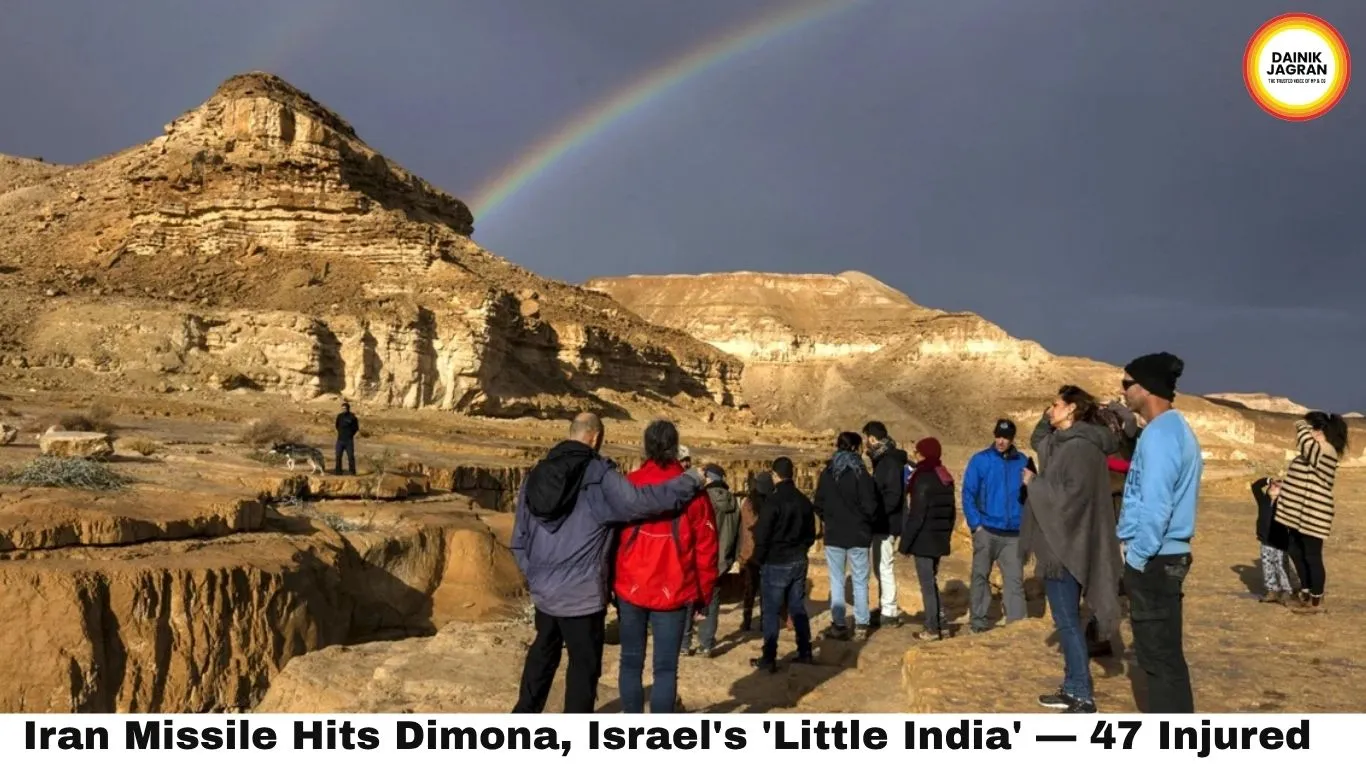
Iran Missile Hits Dimona, Israel's 'Little India' — 47 Injured

Digital Desk

 Iran Missile Hits Dimona, Israel's 'Little India' — 47 Injured

Iran's ballistic missile strikes Dimona — home to 7,500 Indian-origin Jews from Maharashtra — injuring 47 near Israel's nuclear facility. Air defence failure triggers global alarm.


War Came to 'Little India': How Iran's Missile Strike on Dimona Hit the Heart of Israel's Maharashtrian Community

 Dimona — home to 7,500 Indian-origin Jews from Maharashtra, where Marathi is spoken freely and bhelpuri is sold on street corners — was struck by an Iranian ballistic missile on Saturday evening, injuring 47 and raising global nuclear alarm.


A Town With Two Identities

To the world, Dimona is known for one thing: the dome-shaped structure that sits atop Israel's most secretive installation — the Negev Nuclear Research Centre, widely believed to house the Middle East's only undeclared nuclear arsenal. But to the 25,000 residents who call it home, Dimona is something else entirely. It is a town where Marathi flows as naturally as Hebrew. Where sonpapdi and gulab jamun sit on shop shelves. Where cricket is played in the evenings and Bollywood music drifts from apartment windows. They call it "Little India" — and on Saturday night, Iran's missile found it.


The Strike — What Happened

At approximately 8 pm local time on March 21, an Iranian ballistic missile penetrated Israel's multi-layered air defence system and struck a community building in a residential neighbourhood of Dimona. The Israel Defence Forces confirmed that air defence systems had engaged the missile — but the interceptors failed to bring it down. The building absorbed a direct hit. Nearby older houses, their walls weakened by decades of desert heat, collapsed under the impact. Windows shattered across the neighbourhood. Debris filled the streets.

At least 47 people were injured. Among them, a 12-year-old boy was taken to hospital in serious condition after being struck by shrapnel. A woman in her 30s suffered moderate injuries from glass shards. Thirty-one others sustained minor injuries from shrapnel or fell while rushing to shelters. Fourteen more were treated for acute anxiety at Soroka Hospital in Beersheba. A local resident told investigators that most people were already in shelters when the missile hit — the young boy had stayed outside moments too long.


Why the IDF's Air Defence Failed

The failure to intercept the Dimona missile has sent shockwaves through Israel's military establishment and its allies. Dimona is one of the most heavily protected areas in the country — surrounded by layers of radar systems, interceptor batteries, and close-in defence platforms specifically designed to protect the nuclear research centre. Iran's Parliamentary Speaker called the successful strike an operational sign of "entering a new phase of the battle" — suggesting that Tehran's missile forces have adapted their approach to defeat Israeli interception systems. The IDF said it was investigating the failure and would "learn from it." Israeli Prime Minister Benjamin Netanyahu described Saturday as "a very difficult evening" and vowed to continue striking Iran on all fronts.


The Indian-Jewish Community of Dimona

The story of Dimona's Indian connection goes back generations. The community traces its roots primarily to the Bene Israel Jews of Maharashtra — one of India's oldest Jewish communities, whose presence on the Konkan coast dates back nearly 2,000 years according to their oral tradition. Thousands emigrated to Israel in the decades following its founding in 1948, drawn by Zionist ideology and the promise of a Jewish homeland. Many settled in Dimona, drawn by affordable housing, community networks, and the desert landscape that reminded some of parts of Maharashtra's interiors.

Today, the Indian-origin community numbers approximately 7,500 — nearly 30 percent of Dimona's total population. It is a genuinely living, breathing cultural enclave. Indian shops line several streets. Marathi is heard everywhere — in markets, in parks, in conversations between elderly residents who have never lost the cadences of their mother tongue. Cricket remains the sport of choice for many young men. And the food — gulab jamun, bhelpuri, papri chaat, sonpapdi — is not nostalgic novelty but everyday reality, sold in multiple stores and prepared in home kitchens with spices carried over from India or sourced from community networks.


Dimona and the Nuclear Dimension

The strike's proximity to the Negev Nuclear Research Centre immediately triggered international alarm. The IAEA issued a statement saying it was aware of the incident and had received no indication of damage to the nuclear facility, adding that regional states had detected no abnormal radiation levels. IAEA Director General Rafael Grossi called for maximum military restraint — particularly in the vicinity of nuclear facilities.

Iran's IRGC framed the Dimona strike explicitly as retaliation for an earlier Israeli strike on Iran's Natanz nuclear enrichment facility. The IDF denied responsibility for the Natanz strike. The chain of claim and counter-claim — nuclear site for nuclear site — represents the most dangerous exchange of the current conflict and has brought the spectre of nuclear brinkmanship into sharp focus for the international community.


Arad — The Other Town Hit

Dimona was not the only target on Saturday night. The nearby town of Arad, approximately 35 kilometres north of the nuclear research centre, was struck simultaneously. A direct hit on a residential area caused widespread damage across at least ten apartment buildings — three of them badly damaged and in danger of collapse. At least 64 people were hospitalised. Mayor Yair Maayan confirmed that around 150 families had to be evacuated from the affected neighbourhood. Netanyahu spoke directly with the mayor, expressing prayers for the injured.


India Watches Closely

The Dimona strike has resonated with particular force in India. The Indian community there has maintained close ties with Maharashtra — through family visits, cultural exchanges, and a shared identity that decades of physical distance have not eroded. Community organisations in Mumbai and Pune have been in contact with relatives in Dimona since the strike. The Indian government is closely monitoring the welfare of Indian-origin nationals in Israel and has updated its travel advisory for Israeli territory as the conflict intensifies.


What Comes Next

The failure of Israel's air defences near Dimona has triggered a strategic reassessment. The IDF is expected to announce new measures to reinforce protection around critical infrastructure. Netanyahu has signalled that retaliatory strikes on Iran will intensify significantly in the coming week. The Dimona strike — the first successful Iranian missile hit near Israel's nuclear site — marks a threshold moment in this war. And for the 7,500 residents of Little India caught in its crossfire, it is a reminder that in a war of this scale, no town — however far from the frontlines it might feel — is truly safe.

english.dainikjagranmpcg.com
22 Mar 2026 By Jiya.S

Iran Missile Hits Dimona, Israel's 'Little India' — 47 Injured

Digital Desk


War Came to 'Little India': How Iran's Missile Strike on Dimona Hit the Heart of Israel's Maharashtrian Community

 Dimona — home to 7,500 Indian-origin Jews from Maharashtra, where Marathi is spoken freely and bhelpuri is sold on street corners — was struck by an Iranian ballistic missile on Saturday evening, injuring 47 and raising global nuclear alarm.


A Town With Two Identities

To the world, Dimona is known for one thing: the dome-shaped structure that sits atop Israel's most secretive installation — the Negev Nuclear Research Centre, widely believed to house the Middle East's only undeclared nuclear arsenal. But to the 25,000 residents who call it home, Dimona is something else entirely. It is a town where Marathi flows as naturally as Hebrew. Where sonpapdi and gulab jamun sit on shop shelves. Where cricket is played in the evenings and Bollywood music drifts from apartment windows. They call it "Little India" — and on Saturday night, Iran's missile found it.


The Strike — What Happened

At approximately 8 pm local time on March 21, an Iranian ballistic missile penetrated Israel's multi-layered air defence system and struck a community building in a residential neighbourhood of Dimona. The Israel Defence Forces confirmed that air defence systems had engaged the missile — but the interceptors failed to bring it down. The building absorbed a direct hit. Nearby older houses, their walls weakened by decades of desert heat, collapsed under the impact. Windows shattered across the neighbourhood. Debris filled the streets.

At least 47 people were injured. Among them, a 12-year-old boy was taken to hospital in serious condition after being struck by shrapnel. A woman in her 30s suffered moderate injuries from glass shards. Thirty-one others sustained minor injuries from shrapnel or fell while rushing to shelters. Fourteen more were treated for acute anxiety at Soroka Hospital in Beersheba. A local resident told investigators that most people were already in shelters when the missile hit — the young boy had stayed outside moments too long.


Why the IDF's Air Defence Failed

The failure to intercept the Dimona missile has sent shockwaves through Israel's military establishment and its allies. Dimona is one of the most heavily protected areas in the country — surrounded by layers of radar systems, interceptor batteries, and close-in defence platforms specifically designed to protect the nuclear research centre. Iran's Parliamentary Speaker called the successful strike an operational sign of "entering a new phase of the battle" — suggesting that Tehran's missile forces have adapted their approach to defeat Israeli interception systems. The IDF said it was investigating the failure and would "learn from it." Israeli Prime Minister Benjamin Netanyahu described Saturday as "a very difficult evening" and vowed to continue striking Iran on all fronts.


The Indian-Jewish Community of Dimona

The story of Dimona's Indian connection goes back generations. The community traces its roots primarily to the Bene Israel Jews of Maharashtra — one of India's oldest Jewish communities, whose presence on the Konkan coast dates back nearly 2,000 years according to their oral tradition. Thousands emigrated to Israel in the decades following its founding in 1948, drawn by Zionist ideology and the promise of a Jewish homeland. Many settled in Dimona, drawn by affordable housing, community networks, and the desert landscape that reminded some of parts of Maharashtra's interiors.

Today, the Indian-origin community numbers approximately 7,500 — nearly 30 percent of Dimona's total population. It is a genuinely living, breathing cultural enclave. Indian shops line several streets. Marathi is heard everywhere — in markets, in parks, in conversations between elderly residents who have never lost the cadences of their mother tongue. Cricket remains the sport of choice for many young men. And the food — gulab jamun, bhelpuri, papri chaat, sonpapdi — is not nostalgic novelty but everyday reality, sold in multiple stores and prepared in home kitchens with spices carried over from India or sourced from community networks.


Dimona and the Nuclear Dimension

The strike's proximity to the Negev Nuclear Research Centre immediately triggered international alarm. The IAEA issued a statement saying it was aware of the incident and had received no indication of damage to the nuclear facility, adding that regional states had detected no abnormal radiation levels. IAEA Director General Rafael Grossi called for maximum military restraint — particularly in the vicinity of nuclear facilities.

Iran's IRGC framed the Dimona strike explicitly as retaliation for an earlier Israeli strike on Iran's Natanz nuclear enrichment facility. The IDF denied responsibility for the Natanz strike. The chain of claim and counter-claim — nuclear site for nuclear site — represents the most dangerous exchange of the current conflict and has brought the spectre of nuclear brinkmanship into sharp focus for the international community.


Arad — The Other Town Hit

Dimona was not the only target on Saturday night. The nearby town of Arad, approximately 35 kilometres north of the nuclear research centre, was struck simultaneously. A direct hit on a residential area caused widespread damage across at least ten apartment buildings — three of them badly damaged and in danger of collapse. At least 64 people were hospitalised. Mayor Yair Maayan confirmed that around 150 families had to be evacuated from the affected neighbourhood. Netanyahu spoke directly with the mayor, expressing prayers for the injured.


India Watches Closely

The Dimona strike has resonated with particular force in India. The Indian community there has maintained close ties with Maharashtra — through family visits, cultural exchanges, and a shared identity that decades of physical distance have not eroded. Community organisations in Mumbai and Pune have been in contact with relatives in Dimona since the strike. The Indian government is closely monitoring the welfare of Indian-origin nationals in Israel and has updated its travel advisory for Israeli territory as the conflict intensifies.


What Comes Next

The failure of Israel's air defences near Dimona has triggered a strategic reassessment. The IDF is expected to announce new measures to reinforce protection around critical infrastructure. Netanyahu has signalled that retaliatory strikes on Iran will intensify significantly in the coming week. The Dimona strike — the first successful Iranian missile hit near Israel's nuclear site — marks a threshold moment in this war. And for the 7,500 residents of Little India caught in its crossfire, it is a reminder that in a war of this scale, no town — however far from the frontlines it might feel — is truly safe.

https://english.dainikjagranmpcg.com/international/-iran-missile-hits-dimona-israels-little-india-%E2%80%94-47/article-15789

Related Posts

Advertisement

Latest News


