

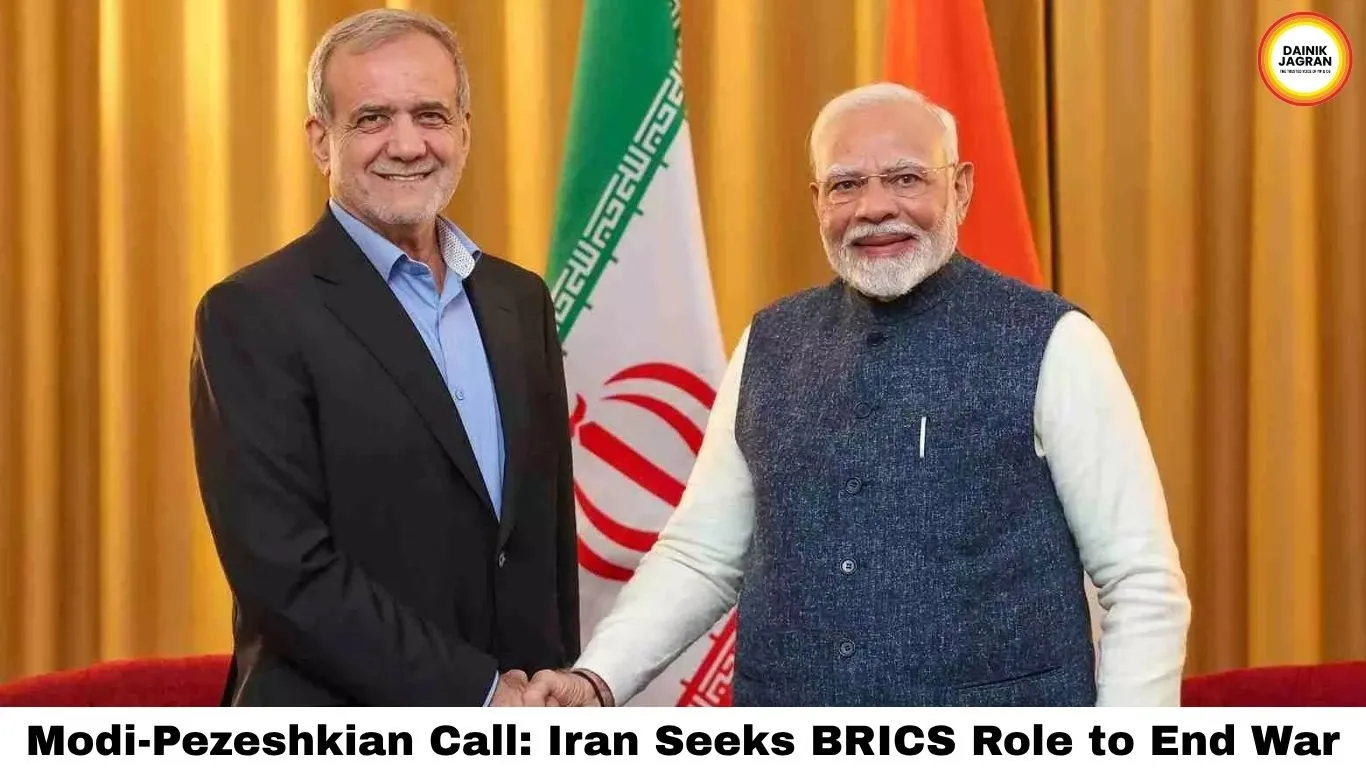
Modi-Pezeshkian Call: Iran Seeks BRICS Role to End War
Digital Desk
PM Modi and Iran's President Pezeshkian hold second call in 10 days — Tehran seeks India's BRICS role to halt US-Israel war; Modi pushes for open Strait of Hormuz and condemns infrastructure attacks.
Modi-Pezeshkian Call: Iran Seeks India's BRICS Muscle to End War, Modi Pushes for Open Shipping Lanes
In their second phone call in ten days, Iran's President urges India to leverage its BRICS chairmanship to halt US-Israel aggression — while PM Modi condemns infrastructure attacks and stresses the Strait of Hormuz must stay open.
Two Leaders, Two Agendas, One Phone Call
On Saturday March 21 — the occasion of both Eid-ul-Fitr and the Persian New Year Nowruz — Prime Minister Narendra Modi and Iranian President Masoud Pezeshkian held their second telephonic conversation since the US-Israel-Iran war broke out on February 28. The call lasted over an hour and covered ground that ranged from festive greetings to nuclear weapons, from shipping lane security to a proposed new regional security architecture for West Asia. Each leader came with a clear agenda — and neither fully yielded to the other.
Iran's Ask: Use BRICS to Stop the War
The Iranian readout of the conversation reveals what Tehran is asking of New Delhi in plain terms. Pezeshkian urged India, as the current rotating chair of BRICS — a bloc that now includes Iran as a member — to use its independent platform to halt what he described as unlawful US-Israeli aggression against Iran. He was explicit: a prerequisite for ending the conflict is the immediate cessation of military operations by the US and Israel, along with firm guarantees against their recurrence.
Pezeshkian argued that Iran did not initiate the war — and that the US launched military strikes against Iran even as nuclear negotiations were actively underway, contradicting Washington's stated justification that the operation was aimed at preventing Iran from acquiring nuclear weapons. He stressed that the late Supreme Leader Ayatollah Ali Khamenei had issued both administrative and religious directives firmly prohibiting the development of nuclear weapons — and that Iran remained committed to those directives.
Beyond the immediate conflict, Tehran placed a broader diplomatic proposal on the table: the creation of a West Asia regional security framework, led entirely by countries of the region, without foreign interference. The proposal envisions a collective architecture for peace and stability that explicitly excludes the United States and Israel from any governance role.
Modi's Message: War Serves No One, Hormuz Must Stay Open
Prime Minister Modi conveyed Eid and Nowruz greetings and expressed hope that the festive season would bring peace, stability and prosperity to a region consumed by conflict. But his substantive message was firm and consistent with India's stated position throughout this crisis.
Modi strongly condemned attacks on critical infrastructure — energy assets, logistics networks, and shipping corridors — warning that such actions pose serious risks not just to regional stability but to global food and energy security, including agricultural supply chains. He underscored in unambiguous terms that the Strait of Hormuz must remain open and secure — a direct reference to Iran's effective blockade of the waterway that handles approximately 20 percent of global oil and LNG trade.
Drawing on his ongoing consultations with leaders across multiple regions, Modi stressed that war is in no one's interest — and called on all parties to move toward peace as quickly as possible. He also appreciated Iran's assurances of continued support for the safety and security of Indian nationals currently residing in Iran.
A Second Call in Ten Days — India's Diplomatic Tempo
This was the second Modi-Pezeshkian conversation since hostilities began on February 28 — a frequency that signals India's calibrated but active diplomatic engagement in this conflict. In the days surrounding the call, Modi also spoke with Oman's Sultan Haitham bin Tariq, King Abdullah of Jordan, French President Emmanuel Macron, and Malaysian Prime Minister Anwar Ibrahim — building a parallel track of consultations that spans the Gulf, Europe and Southeast Asia simultaneously.
External Affairs Minister S Jaishankar separately spoke with Iranian Foreign Minister Seyed Abbas Araghchi on the same day — covering the West Asia conflict, its wider implications, shipping safety, bilateral cooperation, and BRICS-related matters. The dual-track engagement — head-of-government and foreign minister simultaneously — reflects the seriousness with which New Delhi is treating this crisis.
India's Strategic Calculus
India's position in this conflict is shaped by a precise and well-understood set of interests. As one of the world's largest oil importers, India depends heavily on the Persian Gulf for its energy security — and the disruption of the Strait of Hormuz has already pushed global oil prices to record levels and threatened India's economic stability. Keeping the Strait open is, for India, not merely a diplomatic aspiration but an economic necessity.
At the same time, India has deep people-to-people and bilateral ties with Iran — including the Chabahar port project, which provides India with a critical access route to Afghanistan and Central Asia. Hundreds of thousands of Indian nationals reside in the Gulf states on both sides of this conflict. India's ability to serve as a credible diplomatic interlocutor depends on not being seen as a partisan actor.
The Finnish President, speaking earlier in the week, had publicly suggested India could play a uniquely important diplomatic role in easing US-Iran tensions — a recognition of New Delhi's position as a major economy with meaningful relationships on multiple sides of this conflict.
Iran's Humanitarian Charge
Pezeshkian also shared with Modi a deeply disturbing claim from Tehran's perspective. He stated that a US airstrike, launched from bases in neighbouring countries that host American military installations, had struck a school in Minab — killing 168 schoolchildren. He described the broader US-Israeli campaign as profoundly inhumane and unethical. The US has not confirmed the Minab school strike. The claim, however, has circulated widely and is being examined by international humanitarian organisations.
What Comes Next
India's diplomatic engagement in this conflict is unlikely to diminish. The combination of energy stakes, diaspora welfare, strategic positioning, and BRICS chairmanship gives New Delhi both incentive and platform to remain actively engaged. Whether India can translate that engagement into tangible diplomatic movement — a ceasefire, a Hormuz agreement, or a pathway toward negotiation — is the critical open question. What is already clear is that both Iran and the West see value in keeping India in the conversation. And that, for New Delhi, is a position of influence it will use carefully.
Modi-Pezeshkian Call: Iran Seeks BRICS Role to End War
Digital Desk
Modi-Pezeshkian Call: Iran Seeks India's BRICS Muscle to End War, Modi Pushes for Open Shipping Lanes
In their second phone call in ten days, Iran's President urges India to leverage its BRICS chairmanship to halt US-Israel aggression — while PM Modi condemns infrastructure attacks and stresses the Strait of Hormuz must stay open.
Two Leaders, Two Agendas, One Phone Call
On Saturday March 21 — the occasion of both Eid-ul-Fitr and the Persian New Year Nowruz — Prime Minister Narendra Modi and Iranian President Masoud Pezeshkian held their second telephonic conversation since the US-Israel-Iran war broke out on February 28. The call lasted over an hour and covered ground that ranged from festive greetings to nuclear weapons, from shipping lane security to a proposed new regional security architecture for West Asia. Each leader came with a clear agenda — and neither fully yielded to the other.
Iran's Ask: Use BRICS to Stop the War
The Iranian readout of the conversation reveals what Tehran is asking of New Delhi in plain terms. Pezeshkian urged India, as the current rotating chair of BRICS — a bloc that now includes Iran as a member — to use its independent platform to halt what he described as unlawful US-Israeli aggression against Iran. He was explicit: a prerequisite for ending the conflict is the immediate cessation of military operations by the US and Israel, along with firm guarantees against their recurrence.
Pezeshkian argued that Iran did not initiate the war — and that the US launched military strikes against Iran even as nuclear negotiations were actively underway, contradicting Washington's stated justification that the operation was aimed at preventing Iran from acquiring nuclear weapons. He stressed that the late Supreme Leader Ayatollah Ali Khamenei had issued both administrative and religious directives firmly prohibiting the development of nuclear weapons — and that Iran remained committed to those directives.
Beyond the immediate conflict, Tehran placed a broader diplomatic proposal on the table: the creation of a West Asia regional security framework, led entirely by countries of the region, without foreign interference. The proposal envisions a collective architecture for peace and stability that explicitly excludes the United States and Israel from any governance role.
Modi's Message: War Serves No One, Hormuz Must Stay Open
Prime Minister Modi conveyed Eid and Nowruz greetings and expressed hope that the festive season would bring peace, stability and prosperity to a region consumed by conflict. But his substantive message was firm and consistent with India's stated position throughout this crisis.
Modi strongly condemned attacks on critical infrastructure — energy assets, logistics networks, and shipping corridors — warning that such actions pose serious risks not just to regional stability but to global food and energy security, including agricultural supply chains. He underscored in unambiguous terms that the Strait of Hormuz must remain open and secure — a direct reference to Iran's effective blockade of the waterway that handles approximately 20 percent of global oil and LNG trade.
Drawing on his ongoing consultations with leaders across multiple regions, Modi stressed that war is in no one's interest — and called on all parties to move toward peace as quickly as possible. He also appreciated Iran's assurances of continued support for the safety and security of Indian nationals currently residing in Iran.
A Second Call in Ten Days — India's Diplomatic Tempo
This was the second Modi-Pezeshkian conversation since hostilities began on February 28 — a frequency that signals India's calibrated but active diplomatic engagement in this conflict. In the days surrounding the call, Modi also spoke with Oman's Sultan Haitham bin Tariq, King Abdullah of Jordan, French President Emmanuel Macron, and Malaysian Prime Minister Anwar Ibrahim — building a parallel track of consultations that spans the Gulf, Europe and Southeast Asia simultaneously.
External Affairs Minister S Jaishankar separately spoke with Iranian Foreign Minister Seyed Abbas Araghchi on the same day — covering the West Asia conflict, its wider implications, shipping safety, bilateral cooperation, and BRICS-related matters. The dual-track engagement — head-of-government and foreign minister simultaneously — reflects the seriousness with which New Delhi is treating this crisis.
India's Strategic Calculus
India's position in this conflict is shaped by a precise and well-understood set of interests. As one of the world's largest oil importers, India depends heavily on the Persian Gulf for its energy security — and the disruption of the Strait of Hormuz has already pushed global oil prices to record levels and threatened India's economic stability. Keeping the Strait open is, for India, not merely a diplomatic aspiration but an economic necessity.
At the same time, India has deep people-to-people and bilateral ties with Iran — including the Chabahar port project, which provides India with a critical access route to Afghanistan and Central Asia. Hundreds of thousands of Indian nationals reside in the Gulf states on both sides of this conflict. India's ability to serve as a credible diplomatic interlocutor depends on not being seen as a partisan actor.
The Finnish President, speaking earlier in the week, had publicly suggested India could play a uniquely important diplomatic role in easing US-Iran tensions — a recognition of New Delhi's position as a major economy with meaningful relationships on multiple sides of this conflict.
Iran's Humanitarian Charge
Pezeshkian also shared with Modi a deeply disturbing claim from Tehran's perspective. He stated that a US airstrike, launched from bases in neighbouring countries that host American military installations, had struck a school in Minab — killing 168 schoolchildren. He described the broader US-Israeli campaign as profoundly inhumane and unethical. The US has not confirmed the Minab school strike. The claim, however, has circulated widely and is being examined by international humanitarian organisations.
What Comes Next
India's diplomatic engagement in this conflict is unlikely to diminish. The combination of energy stakes, diaspora welfare, strategic positioning, and BRICS chairmanship gives New Delhi both incentive and platform to remain actively engaged. Whether India can translate that engagement into tangible diplomatic movement — a ceasefire, a Hormuz agreement, or a pathway toward negotiation — is the critical open question. What is already clear is that both Iran and the West see value in keeping India in the conversation. And that, for New Delhi, is a position of influence it will use carefully.


