

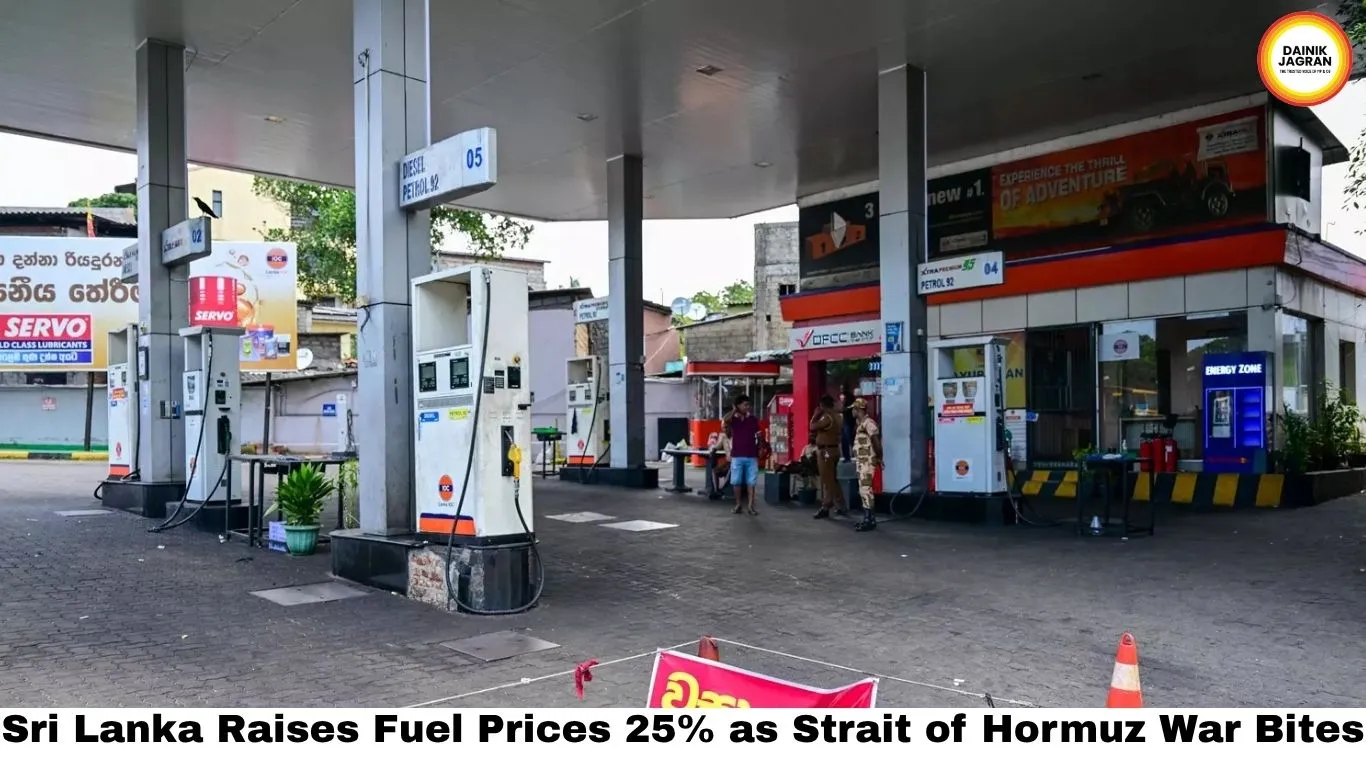
Sri Lanka Raises Fuel Prices 25% as Strait of Hormuz War Bites
Digital Desk
Sri Lanka hikes fuel prices 25% for the second time in two weeks — petrol at Rs 398, diesel at Rs 382 — as the Strait of Hormuz closure threatens the island's fragile economic recovery.
Middle East War Pushes Sri Lanka to Raise Fuel Prices 25% — Four-Day Work Week Ordered
Sri Lanka announces its second fuel price hike in two weeks — petrol now at Rs 398 per litre, diesel at Rs 382 — as the Strait of Hormuz closure threatens to derail the island nation's fragile recovery from its 2022 economic collapse.
The War's Nearest Economic Victim
Three weeks into the US-Israel-Iran war, the strategic and military consequences are dominating global headlines. But in Colombo, the consequences are being felt at the petrol pump — twice in two weeks. Sri Lanka, which imports every drop of its oil, raised fuel prices by 25 percent on Sunday, March 22 — the second increase since the war began and among the steepest emergency price corrections any Asian economy has been forced to implement so far.
For a country that only four years ago ran completely out of foreign exchange, defaulted on its sovereign debt, and watched its citizens queue for hours to buy fuel by candlelight, the echoes of 2022 are uncomfortable and impossible to ignore.
The New Prices — And What They Mean
Effective March 22, regular petrol in Sri Lanka now costs 398 Sri Lankan rupees per litre — up from 317 rupees, an increase of 81 rupees or approximately 25 percent in a single revision. Diesel, the fuel that powers the island's buses, three-wheelers, fishing boats and delivery trucks — the arteries of daily economic life for ordinary Sri Lankans — has risen by 79 rupees to 382 rupees per litre.
Just seven days earlier, the government had already pushed prices up by eight percent and introduced fuel rationing to limit consumption. Sunday's revision compounds that blow significantly. For the urban middle class, higher petrol costs are an inconvenience. For the rural poor, the fishermen, the small traders, and those dependent on public transport — a 25 percent fuel hike in a week is a serious economic shock.
Ceylon Petroleum Corporation: Targeting 15-20% Consumption Drop
Officials at the Ceylon Petroleum Corporation confirmed the rationale behind the sharp hike. The intention, they said, is to achieve a 15 to 20 percent reduction in national fuel consumption through price signalling — essentially using higher costs to reduce demand rather than relying solely on rationing. It is a blunt instrument, but in the absence of alternative supplies or pricing mechanisms, it is the one the government has reached for.
The government has also moved on the demand-management front beyond just fuel pricing. President Anura Kumara Dissanayake ordered a four-day working week effective from last Wednesday — directly modelled on a similar crisis-time measure Sri Lanka had implemented during the 2022 collapse. Employers across the public and private sectors have been asked to reintroduce work-from-home arrangements wherever operationally feasible. The logic is simple: fewer commutes, less fuel consumed, longer runway before reserves are critically depleted.
The Strait of Hormuz at the Centre of Everything
Sri Lanka's energy crisis is entirely an import crisis — and it is an import crisis because of what Iran has done to the Strait of Hormuz. The 33-kilometre waterway at the mouth of the Persian Gulf, through which approximately 20 percent of the world's oil and LNG exports flowed in peacetime, has been effectively sealed by Iran since the war began on February 28. Ships flagged to US allies, Western operators and vessels carrying cargo to or from Israel have been barred, interdicted or threatened. The resulting rerouting — around Africa's Cape of Good Hope — has added weeks to supply timelines and driven insurance and freight costs sharply higher.
Sri Lanka sources its refined petroleum products primarily from Singapore, Malaysia and South Korea — but the crude oil feedstock for its Iranian-built refinery comes directly from the Middle East. The closure of the Strait has disrupted both the feedstock supply chain and, through global price contagion, the cost of refined products in the Asian spot market.
The President's Warning: Prepare for a Long War
President Dissanayake has not sugarcoated the situation. He told Ceylon Petroleum Corporation officials last week that Sri Lanka must prepare for a prolonged Middle East conflict — one that could affect the island's energy supply for months, not weeks. The four-day work week, the rationing, and the price hikes are not crisis patches. They are the beginning of a managed austerity response to an external shock the country has no power to resolve.
It is a grim position for a president who came to power in September 2024 on a promise of systemic economic reform and a clean break from the mismanagement that caused the 2022 collapse. The war in the Middle East has handed him an early and severe test — one entirely outside his control and one his predecessors never had to navigate at this scale.
The 2022 Shadow
The context of Sri Lanka's 2022 economic collapse hangs over every decision Colombo makes in this crisis. The country defaulted on its $46 billion in foreign debt after foreign exchange reserves collapsed — unable to pay for fuel, medicine, food or fertiliser. Citizens endured power cuts of up to 13 hours a day. Long queues formed at petrol stations. There were street protests that eventually forced the previous president from power.
Since then, Sri Lanka has secured a $2.9 billion IMF bailout and has been navigating a slow, painful recovery. The bailout came with strict fiscal conditions — conditions that constrain how much the government can subsidise fuel or absorb external shocks through public spending. That is precisely why the government has been forced to pass the war's costs directly to consumers rather than absorb them through subsidies.
South Asia's Canary in the Coal Mine
Sri Lanka is not alone in its vulnerability, but it is among the most exposed. Energy-importing economies across South Asia — Bangladesh, Nepal, Pakistan — are watching Colombo's response closely as they manage their own exposure to the Hormuz closure and surging global oil prices. Sri Lanka's speed in adjusting prices and implementing demand-side measures may set a template — or a warning — for what other South Asian economies will face in the weeks ahead if the war does not end.
The Middle East is burning. But its heat is being felt, with quiet and devastating clarity, in the lamp oil and diesel queues of Colombo
Sri Lanka Raises Fuel Prices 25% as Strait of Hormuz War Bites
Digital Desk
Middle East War Pushes Sri Lanka to Raise Fuel Prices 25% — Four-Day Work Week Ordered
Sri Lanka announces its second fuel price hike in two weeks — petrol now at Rs 398 per litre, diesel at Rs 382 — as the Strait of Hormuz closure threatens to derail the island nation's fragile recovery from its 2022 economic collapse.
The War's Nearest Economic Victim
Three weeks into the US-Israel-Iran war, the strategic and military consequences are dominating global headlines. But in Colombo, the consequences are being felt at the petrol pump — twice in two weeks. Sri Lanka, which imports every drop of its oil, raised fuel prices by 25 percent on Sunday, March 22 — the second increase since the war began and among the steepest emergency price corrections any Asian economy has been forced to implement so far.
For a country that only four years ago ran completely out of foreign exchange, defaulted on its sovereign debt, and watched its citizens queue for hours to buy fuel by candlelight, the echoes of 2022 are uncomfortable and impossible to ignore.
The New Prices — And What They Mean
Effective March 22, regular petrol in Sri Lanka now costs 398 Sri Lankan rupees per litre — up from 317 rupees, an increase of 81 rupees or approximately 25 percent in a single revision. Diesel, the fuel that powers the island's buses, three-wheelers, fishing boats and delivery trucks — the arteries of daily economic life for ordinary Sri Lankans — has risen by 79 rupees to 382 rupees per litre.
Just seven days earlier, the government had already pushed prices up by eight percent and introduced fuel rationing to limit consumption. Sunday's revision compounds that blow significantly. For the urban middle class, higher petrol costs are an inconvenience. For the rural poor, the fishermen, the small traders, and those dependent on public transport — a 25 percent fuel hike in a week is a serious economic shock.
Ceylon Petroleum Corporation: Targeting 15-20% Consumption Drop
Officials at the Ceylon Petroleum Corporation confirmed the rationale behind the sharp hike. The intention, they said, is to achieve a 15 to 20 percent reduction in national fuel consumption through price signalling — essentially using higher costs to reduce demand rather than relying solely on rationing. It is a blunt instrument, but in the absence of alternative supplies or pricing mechanisms, it is the one the government has reached for.
The government has also moved on the demand-management front beyond just fuel pricing. President Anura Kumara Dissanayake ordered a four-day working week effective from last Wednesday — directly modelled on a similar crisis-time measure Sri Lanka had implemented during the 2022 collapse. Employers across the public and private sectors have been asked to reintroduce work-from-home arrangements wherever operationally feasible. The logic is simple: fewer commutes, less fuel consumed, longer runway before reserves are critically depleted.
The Strait of Hormuz at the Centre of Everything
Sri Lanka's energy crisis is entirely an import crisis — and it is an import crisis because of what Iran has done to the Strait of Hormuz. The 33-kilometre waterway at the mouth of the Persian Gulf, through which approximately 20 percent of the world's oil and LNG exports flowed in peacetime, has been effectively sealed by Iran since the war began on February 28. Ships flagged to US allies, Western operators and vessels carrying cargo to or from Israel have been barred, interdicted or threatened. The resulting rerouting — around Africa's Cape of Good Hope — has added weeks to supply timelines and driven insurance and freight costs sharply higher.
Sri Lanka sources its refined petroleum products primarily from Singapore, Malaysia and South Korea — but the crude oil feedstock for its Iranian-built refinery comes directly from the Middle East. The closure of the Strait has disrupted both the feedstock supply chain and, through global price contagion, the cost of refined products in the Asian spot market.
The President's Warning: Prepare for a Long War
President Dissanayake has not sugarcoated the situation. He told Ceylon Petroleum Corporation officials last week that Sri Lanka must prepare for a prolonged Middle East conflict — one that could affect the island's energy supply for months, not weeks. The four-day work week, the rationing, and the price hikes are not crisis patches. They are the beginning of a managed austerity response to an external shock the country has no power to resolve.
It is a grim position for a president who came to power in September 2024 on a promise of systemic economic reform and a clean break from the mismanagement that caused the 2022 collapse. The war in the Middle East has handed him an early and severe test — one entirely outside his control and one his predecessors never had to navigate at this scale.
The 2022 Shadow
The context of Sri Lanka's 2022 economic collapse hangs over every decision Colombo makes in this crisis. The country defaulted on its $46 billion in foreign debt after foreign exchange reserves collapsed — unable to pay for fuel, medicine, food or fertiliser. Citizens endured power cuts of up to 13 hours a day. Long queues formed at petrol stations. There were street protests that eventually forced the previous president from power.
Since then, Sri Lanka has secured a $2.9 billion IMF bailout and has been navigating a slow, painful recovery. The bailout came with strict fiscal conditions — conditions that constrain how much the government can subsidise fuel or absorb external shocks through public spending. That is precisely why the government has been forced to pass the war's costs directly to consumers rather than absorb them through subsidies.
South Asia's Canary in the Coal Mine
Sri Lanka is not alone in its vulnerability, but it is among the most exposed. Energy-importing economies across South Asia — Bangladesh, Nepal, Pakistan — are watching Colombo's response closely as they manage their own exposure to the Hormuz closure and surging global oil prices. Sri Lanka's speed in adjusting prices and implementing demand-side measures may set a template — or a warning — for what other South Asian economies will face in the weeks ahead if the war does not end.
The Middle East is burning. But its heat is being felt, with quiet and devastating clarity, in the lamp oil and diesel queues of Colombo


