

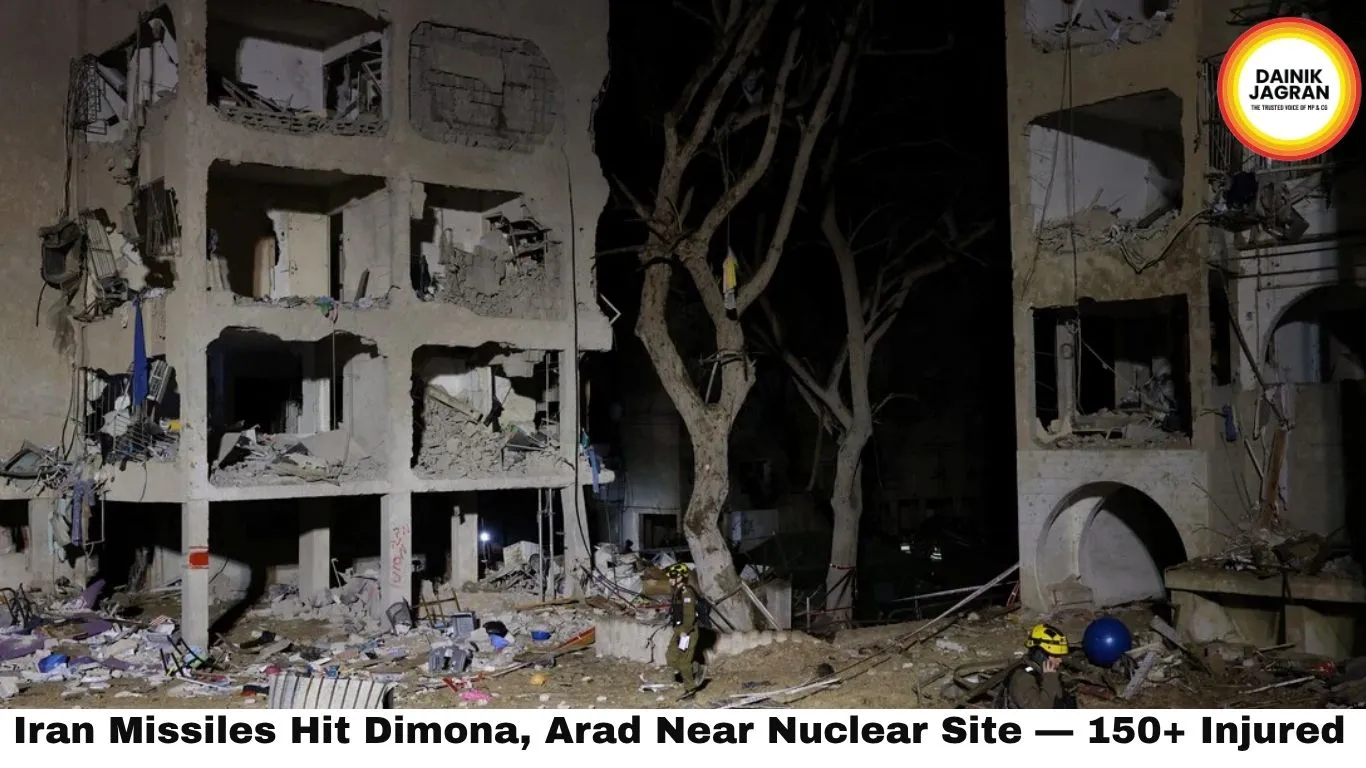
Iran Missiles Hit Dimona, Arad Near Nuclear Site — 150+ Injured

Digital Desk

 Iran Missiles Hit Dimona, Arad Near Nuclear Site — 150+ Injured

Iranian ballistic missiles breach Israel's air defences and strike Dimona and Arad, injuring nearly 200 including children, in direct retaliation for a US-Israeli attack on Iran's Natanz nuclear site.

Nuclear Site, Civilian Homes, Children: Iran's Tit-for-Tat Missile Strike on Dimona and Arad Injures Nearly 200

Iranian ballistic missiles pierce Israel's air defence system and strike Dimona and Arad — over 150 injured including children — in direct retaliation for a US-Israeli strike on Iran's Natanz nuclear enrichment complex.


The Night Israel's Skies Failed

On the evening of March 21, 2026, two Iranian ballistic missiles broke through Israel's most heavily fortified air defence layers and struck the southern cities of Dimona and Arad — towns that sit in the shadow of Israel's secretive nuclear programme, near military installations, and close to ordinary civilian neighbourhoods where families had gone to sleep expecting another night in a shelter, not a missile landing on their street.

Nearly 200 people were injured across both cities. Among them — a 12-year-old boy in critical condition with multiple shrapnel wounds in Dimona, and a 5-year-old girl seriously injured in Arad. Israel declared a mass casualty event. Emergency services operated through the night. And for the first time since this war began, Iran's Parliament Speaker declared: "Israel's skies are defenceless."


What Happened in Dimona

The first missile struck Dimona at approximately 8 pm local time. It hit a residential neighbourhood, destroying a one-storey building and sending shrapnel across surrounding streets. Footage verified by multiple outlets showed the missile hurtling from the sky before a large explosion consumed the strike zone. A three-storey building in a separate part of the city collapsed completely. Fires broke out at multiple locations. At least 39 people were injured in Dimona alone — several in moderate to serious condition. Israeli officials confirmed that interceptors had been launched but failed to bring the missile down.

The Shimon Peres Negev Nuclear Research Centre — Israel's undeclared nuclear facility, believed to house the Middle East's only nuclear arsenal, located approximately 13 kilometres southeast of Dimona's city centre — was not directly struck. The IAEA confirmed it received no reports of damage to the facility and that no abnormal radiation levels had been detected in the area. Questions, however, remain open about how much information Israel is sharing with international inspectors, given its longstanding policy of deliberate nuclear ambiguity.


Arad Hit Hours Later — Mass Casualty Event

Hours after Dimona, a second Iranian ballistic missile struck the city of Arad. The impact caused devastating damage across at least ten residential apartment buildings — three of them badly damaged and in imminent danger of collapse. At least 88 people were hospitalised, including 10 in serious condition. Emergency crews searched rubble through the night. Mayor Yair Maayan confirmed that approximately 150 families had to be evacuated from the affected neighbourhood. Patients from both cities were moved from southern hospitals to facilities in central Israel to relieve the burden on Soroka Hospital in Beersheba.

Israeli Prime Minister Benjamin Netanyahu spoke with Arad's mayor immediately after the strike, offering prayers for the injured and calling it "a very difficult evening in the campaign for our future." He pledged that Israel would continue striking its enemies on all fronts.


Why the Air Defence Failed

The failure to intercept two ballistic missiles near one of the most heavily protected areas in Israel has triggered a military investigation and rattled confidence in the country's multi-layered defence architecture. Israel's military spokesman confirmed that interceptors were launched against both missiles but failed to connect. He stressed the missiles were "not a special or unfamiliar type of munition" — which raised an uncomfortable question: if these were standard Iranian ballistic missiles, why did they get through?

Analysts point to saturation tactics — Iran has been launching coordinated multi-vector attacks that stretch interceptor batteries thin across multiple directions simultaneously. Others note that the warheads used, weighing several hundred kilograms each, are designed specifically to defeat terminal-phase interception.

Iran's Parliament Speaker interpreted the successful strikes with a pointed message — calling it an operational sign of entering "a new phase of the battle" and asserting that Iran has "pre-designed plans" ready to implement next.


The Natanz Connection — Nuclear for Nuclear

Tehran framed both strikes explicitly as retaliation for an earlier US-Israeli attack on Iran's Natanz nuclear enrichment complex on the morning of March 21. Iranian state television described the Dimona strike as a direct "response" to Natanz. Iran's atomic energy organisation confirmed that Natanz had been targeted — and reported no radioactive leakage.

Israel's military denied responsibility for the Natanz strike. The US has not confirmed it either. But the logic of the exchange is unmistakable: Iran struck near Israel's nuclear site in direct response to an attack on its own. Nuclear facility for nuclear facility — a tit-for-tat escalation that has brought the spectre of nuclear brinkmanship into the sharpest focus since the war began.

Israel struck back the same night — the Air Force launched simultaneous wide-scale strikes on over 200 targets across Iran and Hezbollah positions in Lebanon, including a research and development facility at Tehran's Malek Ashtar University, which the IDF said was used to develop components for nuclear weapons and ballistic missiles.


The Broader War Picture

US Central Command confirmed it has now struck over 8,000 military targets in Iran since the war began on February 28 — including 130 vessels. The US military assessment is that Iran's combat capability is on a steady decline. But the Dimona and Arad strikes tell a different story on the ground — one of a force that, even diminished, retains the capacity to break through the most sophisticated air defences in the world and deliver precision strikes on civilian areas near nuclear infrastructure.

Meanwhile, Iranian forces continued operations across the broader theatre. Cluster munitions struck a daycare centre in Rishon Lezion, central Israel, on the same day — fortunately, the facility was empty. Missiles were fired toward the Diego Garcia military base in the Indian Ocean — prompting the UK to denounce what it called Iran's reckless attacks. Israel's military chief said Iran had fired long-range 4,000-kilometre-range missiles — indicating a threat that now extends to European capitals.


Trump's 48-Hour Ultimatum

The strikes occurred hours after a remarkable public reversal by President Trump. On Friday, Trump had suggested the US was considering "winding down" military operations, claiming its objectives had been met weeks ahead of schedule. By Saturday evening, he had reversed course — threatening to "hit and obliterate" Iranian power plants, starting with the largest, if Tehran did not fully reopen the Strait of Hormuz within 48 hours. Iran responded by warning it would strike energy, desalination, and information technology infrastructure across US Gulf allies if its own energy sites were targeted.


What Comes Next

The IDF Chief of Staff has approved strikes on "all fronts." Israel's Health Ministry has activated full emergency protocols across the southern medical system. International alarm is rising — 22 nations have now formally condemned Iran's attacks on commercial shipping. The IAEA is monitoring nuclear sites across the region. And Trump's 48-hour deadline expires Monday evening.

Whether the Dimona and Arad strikes mark a turning point in this war — or simply the latest chapter in its relentless escalation — remains to be seen. What is already clear is that no city in Israel, however fortified, however protected, however close to a nuclear facility, is beyond Iran's reach tonight.

english.dainikjagranmpcg.com
22 Mar 2026 By Jiya.S

Iran Missiles Hit Dimona, Arad Near Nuclear Site — 150+ Injured

Digital Desk

Nuclear Site, Civilian Homes, Children: Iran's Tit-for-Tat Missile Strike on Dimona and Arad Injures Nearly 200

Iranian ballistic missiles pierce Israel's air defence system and strike Dimona and Arad — over 150 injured including children — in direct retaliation for a US-Israeli strike on Iran's Natanz nuclear enrichment complex.


The Night Israel's Skies Failed

On the evening of March 21, 2026, two Iranian ballistic missiles broke through Israel's most heavily fortified air defence layers and struck the southern cities of Dimona and Arad — towns that sit in the shadow of Israel's secretive nuclear programme, near military installations, and close to ordinary civilian neighbourhoods where families had gone to sleep expecting another night in a shelter, not a missile landing on their street.

Nearly 200 people were injured across both cities. Among them — a 12-year-old boy in critical condition with multiple shrapnel wounds in Dimona, and a 5-year-old girl seriously injured in Arad. Israel declared a mass casualty event. Emergency services operated through the night. And for the first time since this war began, Iran's Parliament Speaker declared: "Israel's skies are defenceless."


What Happened in Dimona

The first missile struck Dimona at approximately 8 pm local time. It hit a residential neighbourhood, destroying a one-storey building and sending shrapnel across surrounding streets. Footage verified by multiple outlets showed the missile hurtling from the sky before a large explosion consumed the strike zone. A three-storey building in a separate part of the city collapsed completely. Fires broke out at multiple locations. At least 39 people were injured in Dimona alone — several in moderate to serious condition. Israeli officials confirmed that interceptors had been launched but failed to bring the missile down.

The Shimon Peres Negev Nuclear Research Centre — Israel's undeclared nuclear facility, believed to house the Middle East's only nuclear arsenal, located approximately 13 kilometres southeast of Dimona's city centre — was not directly struck. The IAEA confirmed it received no reports of damage to the facility and that no abnormal radiation levels had been detected in the area. Questions, however, remain open about how much information Israel is sharing with international inspectors, given its longstanding policy of deliberate nuclear ambiguity.


Arad Hit Hours Later — Mass Casualty Event

Hours after Dimona, a second Iranian ballistic missile struck the city of Arad. The impact caused devastating damage across at least ten residential apartment buildings — three of them badly damaged and in imminent danger of collapse. At least 88 people were hospitalised, including 10 in serious condition. Emergency crews searched rubble through the night. Mayor Yair Maayan confirmed that approximately 150 families had to be evacuated from the affected neighbourhood. Patients from both cities were moved from southern hospitals to facilities in central Israel to relieve the burden on Soroka Hospital in Beersheba.

Israeli Prime Minister Benjamin Netanyahu spoke with Arad's mayor immediately after the strike, offering prayers for the injured and calling it "a very difficult evening in the campaign for our future." He pledged that Israel would continue striking its enemies on all fronts.


Why the Air Defence Failed

The failure to intercept two ballistic missiles near one of the most heavily protected areas in Israel has triggered a military investigation and rattled confidence in the country's multi-layered defence architecture. Israel's military spokesman confirmed that interceptors were launched against both missiles but failed to connect. He stressed the missiles were "not a special or unfamiliar type of munition" — which raised an uncomfortable question: if these were standard Iranian ballistic missiles, why did they get through?

Analysts point to saturation tactics — Iran has been launching coordinated multi-vector attacks that stretch interceptor batteries thin across multiple directions simultaneously. Others note that the warheads used, weighing several hundred kilograms each, are designed specifically to defeat terminal-phase interception.

Iran's Parliament Speaker interpreted the successful strikes with a pointed message — calling it an operational sign of entering "a new phase of the battle" and asserting that Iran has "pre-designed plans" ready to implement next.


The Natanz Connection — Nuclear for Nuclear

Tehran framed both strikes explicitly as retaliation for an earlier US-Israeli attack on Iran's Natanz nuclear enrichment complex on the morning of March 21. Iranian state television described the Dimona strike as a direct "response" to Natanz. Iran's atomic energy organisation confirmed that Natanz had been targeted — and reported no radioactive leakage.

Israel's military denied responsibility for the Natanz strike. The US has not confirmed it either. But the logic of the exchange is unmistakable: Iran struck near Israel's nuclear site in direct response to an attack on its own. Nuclear facility for nuclear facility — a tit-for-tat escalation that has brought the spectre of nuclear brinkmanship into the sharpest focus since the war began.

Israel struck back the same night — the Air Force launched simultaneous wide-scale strikes on over 200 targets across Iran and Hezbollah positions in Lebanon, including a research and development facility at Tehran's Malek Ashtar University, which the IDF said was used to develop components for nuclear weapons and ballistic missiles.


The Broader War Picture

US Central Command confirmed it has now struck over 8,000 military targets in Iran since the war began on February 28 — including 130 vessels. The US military assessment is that Iran's combat capability is on a steady decline. But the Dimona and Arad strikes tell a different story on the ground — one of a force that, even diminished, retains the capacity to break through the most sophisticated air defences in the world and deliver precision strikes on civilian areas near nuclear infrastructure.

Meanwhile, Iranian forces continued operations across the broader theatre. Cluster munitions struck a daycare centre in Rishon Lezion, central Israel, on the same day — fortunately, the facility was empty. Missiles were fired toward the Diego Garcia military base in the Indian Ocean — prompting the UK to denounce what it called Iran's reckless attacks. Israel's military chief said Iran had fired long-range 4,000-kilometre-range missiles — indicating a threat that now extends to European capitals.


Trump's 48-Hour Ultimatum

The strikes occurred hours after a remarkable public reversal by President Trump. On Friday, Trump had suggested the US was considering "winding down" military operations, claiming its objectives had been met weeks ahead of schedule. By Saturday evening, he had reversed course — threatening to "hit and obliterate" Iranian power plants, starting with the largest, if Tehran did not fully reopen the Strait of Hormuz within 48 hours. Iran responded by warning it would strike energy, desalination, and information technology infrastructure across US Gulf allies if its own energy sites were targeted.


What Comes Next

The IDF Chief of Staff has approved strikes on "all fronts." Israel's Health Ministry has activated full emergency protocols across the southern medical system. International alarm is rising — 22 nations have now formally condemned Iran's attacks on commercial shipping. The IAEA is monitoring nuclear sites across the region. And Trump's 48-hour deadline expires Monday evening.

Whether the Dimona and Arad strikes mark a turning point in this war — or simply the latest chapter in its relentless escalation — remains to be seen. What is already clear is that no city in Israel, however fortified, however protected, however close to a nuclear facility, is beyond Iran's reach tonight.

https://english.dainikjagranmpcg.com/international/-iran-missiles-hit-dimona-arad-near-nuclear-site-%E2%80%94/article-15790

Related Posts

Advertisement

Latest News


