

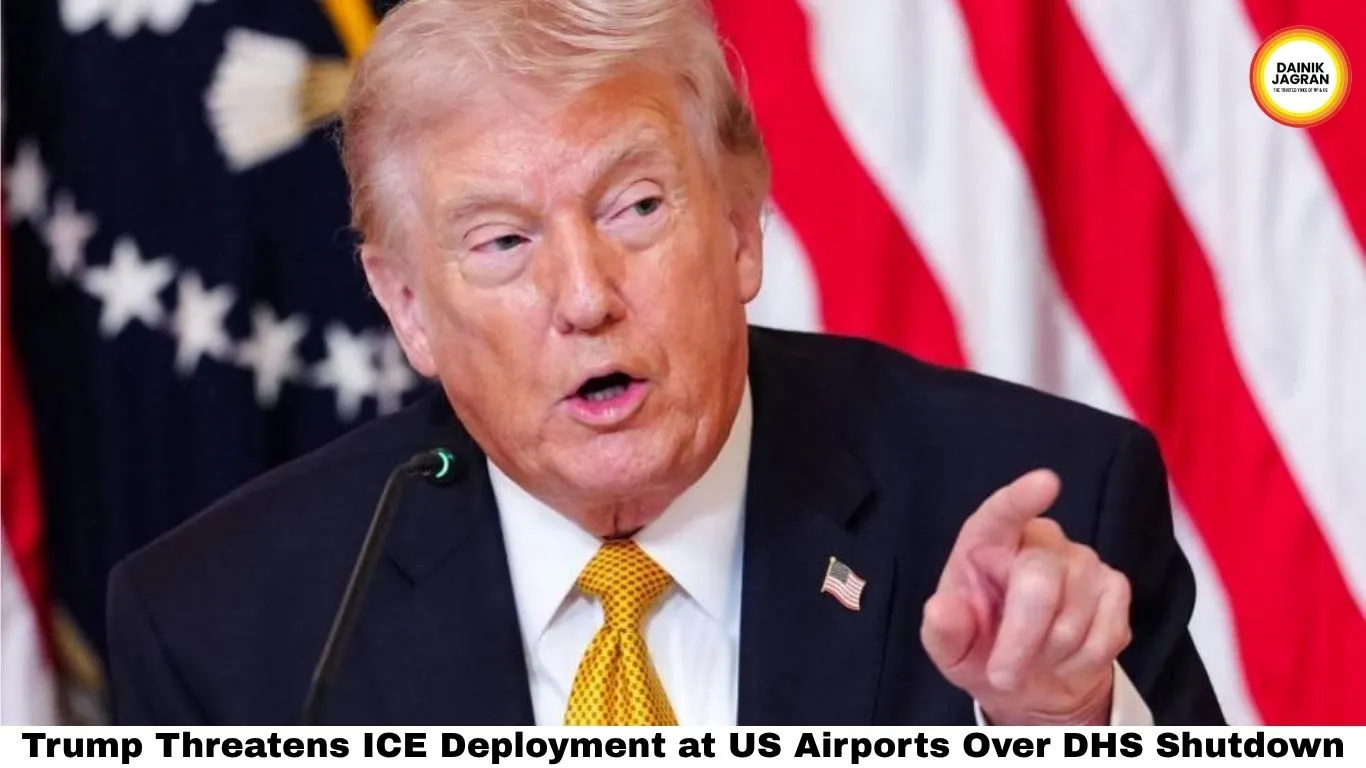
Trump Threatens ICE Deployment at US Airports Over DHS Shutdown
Digital Desk
Trump threatens to deploy ICE agents to US airports from Monday unless Democrats fund DHS — as TSA workers go unpaid, queues grow, and a partial government shutdown enters its sixth week.
ICE at Airport Gates: Trump Threatens to Deploy Immigration Officers as DHS Shutdown Drags Into Week Six
With TSA workers going unpaid and airport queues growing, Trump threatens to deploy ICE agents to US airports from Monday unless Democrats agree to fund the Department of Homeland Security — escalating an already tense congressional standoff.
A Shutdown With a New Threat
Six weeks into a partial US government shutdown that has left Transportation Security Administration workers going without pay, President Donald Trump escalated the standoff sharply on Saturday — threatening to deploy Immigration and Customs Enforcement agents to the nation's airports starting Monday if Congress does not reach a deal to fund the Department of Homeland Security.
The announcement — made via social media posts from Trump's Florida residence — immediately raised questions about what exactly ICE agents would do at airport security checkpoints, how they would interact with the TSA's existing screening architecture, and whether the move was a genuine operational plan or a pressure tactic aimed at forcing Democratic concessions on immigration.
What Trump Said
Trump's posts were characteristically direct and combative. He threatened to move ICE into airports on Monday and said he had already told the agency to "get ready." He accused Democrats of playing games and said that if they did not allow proper security at airports, ICE would do the job "far better than ever done before."
In a subsequent post, he specified that ICE officers deployed to airports would focus on arresting undocumented immigrants — singling out Somali nationals by name. He also made a sweeping and contested claim about the Somali community in Minnesota, saying they had "totally destroyed" the state — a remark that immediately drew criticism from civil rights organisations and Democratic lawmakers.
The TSA Crisis Behind the Threat
The backdrop to Trump's airport ultimatum is a real and worsening crisis at US airports. The partial government shutdown — which began on February 14 when Congress failed to pass a full DHS funding bill — has left TSA employees classified as essential workers and required to report to work, but without receiving paychecks. The financial strain on workers is mounting. At least 376 TSA employees have resigned since the shutdown began. Call-out rates — staff absences — have begun increasing at some of the country's largest airports. The combination of resignations, absences and understaffing has contributed to visibly longer screening lines at major hubs.
The TSA processes roughly two million passengers per day at US airports. Any significant degradation of its workforce capacity has direct and immediate consequences for air travel across the country.
The Minnesota Flashpoint
The immigration dimension of the DHS standoff is inseparable from events in Minnesota. Democrats have pledged to block DHS funding unless meaningful changes are made to federal immigration enforcement following a controversial ICE operation in the state that resulted in the fatal shootings of two protesters. Democratic demands include better identification requirements for federal law enforcement officers operating in civilian areas, a new code of conduct governing immigration enforcement agencies, and greater use of judicial warrants before arrests.
The Minnesota operation was linked in part to allegations of welfare fraud involving Somali residents — a community with a significant presence in Minneapolis. Trump's Saturday comments specifically targeting Somalis at airports extended the same political line into a new operational context, drawing a direct connection between the congressional standoff and his administration's immigration enforcement priorities.
Congress: Closed Doors, Cautious Progress
Despite the confrontational public posture from the White House, there were signs of movement behind the scenes. Republican and Democratic senators convened for a third consecutive day of closed-door talks with White House officials on Saturday. Senate Democratic leader Chuck Schumer described the conversations as productive. Senate Majority Leader John Thune urged the bipartisan group to find a solution quickly, warning that without resolution, conditions at airports would continue to deteriorate.
Earlier on Saturday, the Senate rejected a Democratic motion to take up legislation that would have specifically reopened TSA operations and resumed pay for its workers — without addressing the broader DHS funding dispute. Republicans argued that selective, piecemeal funding of individual agencies was not an acceptable approach. They want a comprehensive DHS bill or nothing.
What ICE at Airports Would Actually Mean
Trump's posts did not provide operational detail on how ICE would integrate into airport security — a significant omission, given that TSA's mandate is the screening of passengers and baggage for hazardous items, a function that has no obvious overlap with ICE's immigration enforcement role. The two agencies operate under different legal authorities, different training frameworks, and different chains of command. Legal experts noted that deploying ICE inside airport security zones would raise immediate questions about jurisdiction, civil liberties, and the rights of passengers — including lawful permanent residents and visa holders — who could potentially be subject to immigration checks as a condition of boarding domestic flights.
Civil liberties organisations indicated they would move quickly to challenge any such deployment in federal court if implemented.
The Bigger Picture: Immigration as Everything
What Saturday's episode illustrates, more than anything, is the extent to which immigration has become the master frame through which the Trump administration approaches every domestic policy challenge. A funding standoff over airport security — fundamentally a labour and logistics issue — has been recast as an immigration enforcement opportunity. The shutdown's impact on ordinary travellers has been secondary to the administration's desire to use the crisis as leverage for a broader political objective.
Whether that leverage produces a deal before Monday — or whether ICE agents actually appear at airport security lines — remains to be seen. What is already clear is that the 2026 version of American governance operates on a compressed timeline of escalation, and airport queues are now part of the immigration debate.
Trump Threatens ICE Deployment at US Airports Over DHS Shutdown
Digital Desk
ICE at Airport Gates: Trump Threatens to Deploy Immigration Officers as DHS Shutdown Drags Into Week Six
With TSA workers going unpaid and airport queues growing, Trump threatens to deploy ICE agents to US airports from Monday unless Democrats agree to fund the Department of Homeland Security — escalating an already tense congressional standoff.
A Shutdown With a New Threat
Six weeks into a partial US government shutdown that has left Transportation Security Administration workers going without pay, President Donald Trump escalated the standoff sharply on Saturday — threatening to deploy Immigration and Customs Enforcement agents to the nation's airports starting Monday if Congress does not reach a deal to fund the Department of Homeland Security.
The announcement — made via social media posts from Trump's Florida residence — immediately raised questions about what exactly ICE agents would do at airport security checkpoints, how they would interact with the TSA's existing screening architecture, and whether the move was a genuine operational plan or a pressure tactic aimed at forcing Democratic concessions on immigration.
What Trump Said
Trump's posts were characteristically direct and combative. He threatened to move ICE into airports on Monday and said he had already told the agency to "get ready." He accused Democrats of playing games and said that if they did not allow proper security at airports, ICE would do the job "far better than ever done before."
In a subsequent post, he specified that ICE officers deployed to airports would focus on arresting undocumented immigrants — singling out Somali nationals by name. He also made a sweeping and contested claim about the Somali community in Minnesota, saying they had "totally destroyed" the state — a remark that immediately drew criticism from civil rights organisations and Democratic lawmakers.
The TSA Crisis Behind the Threat
The backdrop to Trump's airport ultimatum is a real and worsening crisis at US airports. The partial government shutdown — which began on February 14 when Congress failed to pass a full DHS funding bill — has left TSA employees classified as essential workers and required to report to work, but without receiving paychecks. The financial strain on workers is mounting. At least 376 TSA employees have resigned since the shutdown began. Call-out rates — staff absences — have begun increasing at some of the country's largest airports. The combination of resignations, absences and understaffing has contributed to visibly longer screening lines at major hubs.
The TSA processes roughly two million passengers per day at US airports. Any significant degradation of its workforce capacity has direct and immediate consequences for air travel across the country.
The Minnesota Flashpoint
The immigration dimension of the DHS standoff is inseparable from events in Minnesota. Democrats have pledged to block DHS funding unless meaningful changes are made to federal immigration enforcement following a controversial ICE operation in the state that resulted in the fatal shootings of two protesters. Democratic demands include better identification requirements for federal law enforcement officers operating in civilian areas, a new code of conduct governing immigration enforcement agencies, and greater use of judicial warrants before arrests.
The Minnesota operation was linked in part to allegations of welfare fraud involving Somali residents — a community with a significant presence in Minneapolis. Trump's Saturday comments specifically targeting Somalis at airports extended the same political line into a new operational context, drawing a direct connection between the congressional standoff and his administration's immigration enforcement priorities.
Congress: Closed Doors, Cautious Progress
Despite the confrontational public posture from the White House, there were signs of movement behind the scenes. Republican and Democratic senators convened for a third consecutive day of closed-door talks with White House officials on Saturday. Senate Democratic leader Chuck Schumer described the conversations as productive. Senate Majority Leader John Thune urged the bipartisan group to find a solution quickly, warning that without resolution, conditions at airports would continue to deteriorate.
Earlier on Saturday, the Senate rejected a Democratic motion to take up legislation that would have specifically reopened TSA operations and resumed pay for its workers — without addressing the broader DHS funding dispute. Republicans argued that selective, piecemeal funding of individual agencies was not an acceptable approach. They want a comprehensive DHS bill or nothing.
What ICE at Airports Would Actually Mean
Trump's posts did not provide operational detail on how ICE would integrate into airport security — a significant omission, given that TSA's mandate is the screening of passengers and baggage for hazardous items, a function that has no obvious overlap with ICE's immigration enforcement role. The two agencies operate under different legal authorities, different training frameworks, and different chains of command. Legal experts noted that deploying ICE inside airport security zones would raise immediate questions about jurisdiction, civil liberties, and the rights of passengers — including lawful permanent residents and visa holders — who could potentially be subject to immigration checks as a condition of boarding domestic flights.
Civil liberties organisations indicated they would move quickly to challenge any such deployment in federal court if implemented.
The Bigger Picture: Immigration as Everything
What Saturday's episode illustrates, more than anything, is the extent to which immigration has become the master frame through which the Trump administration approaches every domestic policy challenge. A funding standoff over airport security — fundamentally a labour and logistics issue — has been recast as an immigration enforcement opportunity. The shutdown's impact on ordinary travellers has been secondary to the administration's desire to use the crisis as leverage for a broader political objective.
Whether that leverage produces a deal before Monday — or whether ICE agents actually appear at airport security lines — remains to be seen. What is already clear is that the 2026 version of American governance operates on a compressed timeline of escalation, and airport queues are now part of the immigration debate.


