
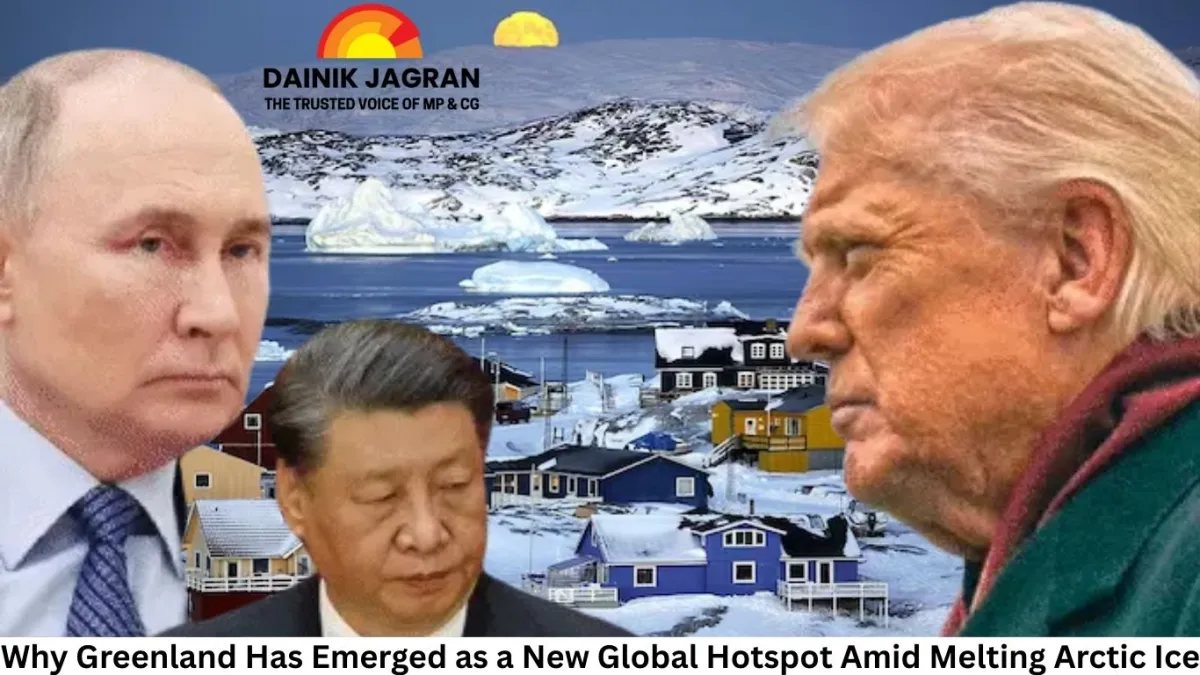

Why Greenland Has Emerged as a New Global Hotspot Amid Melting Arctic Ice
Digital Desk
Situated between North America and Europe, Greenland is an autonomous territory of Denmark and lies close to key Arctic maritime corridors. Rising global temperatures have reduced Arctic sea ice by about 27 per cent compared with late-20th-century averages, opening waters that were previously navigable only by icebreakers. These changes are transforming the Arctic into a viable commercial and strategic zone.
One of the most significant developments is the emergence of shorter shipping routes between Asia, Europe and North America. The Northern Sea Route along Russia’s Arctic coast has already seen a sharp rise in traffic, cutting transit times and fuel costs. Other passages, including the Northwest Passage through Canada’s Arctic islands, are also gaining attention. For global trade, these routes offer alternatives to traditional chokepoints such as the Suez Canal.
Equally important are Greenland’s natural resources. According to international assessments, the island ranks among the top regions globally for rare earth minerals, with an estimated 1.5 million tonnes of reserves. These include elements critical for electric vehicles, renewable energy technologies and advanced electronics. As ice retreats, access to oil, gas and mineral deposits is becoming technically easier, intensifying competition among major economies seeking secure supply chains.
Geopolitical tensions are rising alongside economic interest. The Arctic brings NATO countries and Russia into close proximity, and recent developments have heightened sensitivities. Finland and Sweden’s accession to NATO has altered the region’s security balance, prompting Moscow to reinforce its Arctic infrastructure and military presence. The United States already operates a key military base in northwestern Greenland, supporting missile warning and space surveillance. China, which declared itself a “near-Arctic state” in 2018, has expanded scientific missions and shown interest in infrastructure and mining projects.
Greenland’s growing prominence has also revived political debates. Former US President Donald Trump’s past remarks about acquiring Greenland, once dismissed as rhetorical, are now viewed by analysts as reflecting Washington’s long-term strategic concerns in the Arctic.
For countries beyond the Arctic, including India, developments in Greenland matter for climate, trade and resource security. Arctic warming influences global weather systems, including the Indian monsoon, while new shipping routes and access to critical minerals carry long-term economic implications.
As climate change reshapes the Arctic faster than any other region, Greenland is no longer a remote icebound land but an emerging focal point where climate, commerce and security increasingly intersect.
.jpg)




