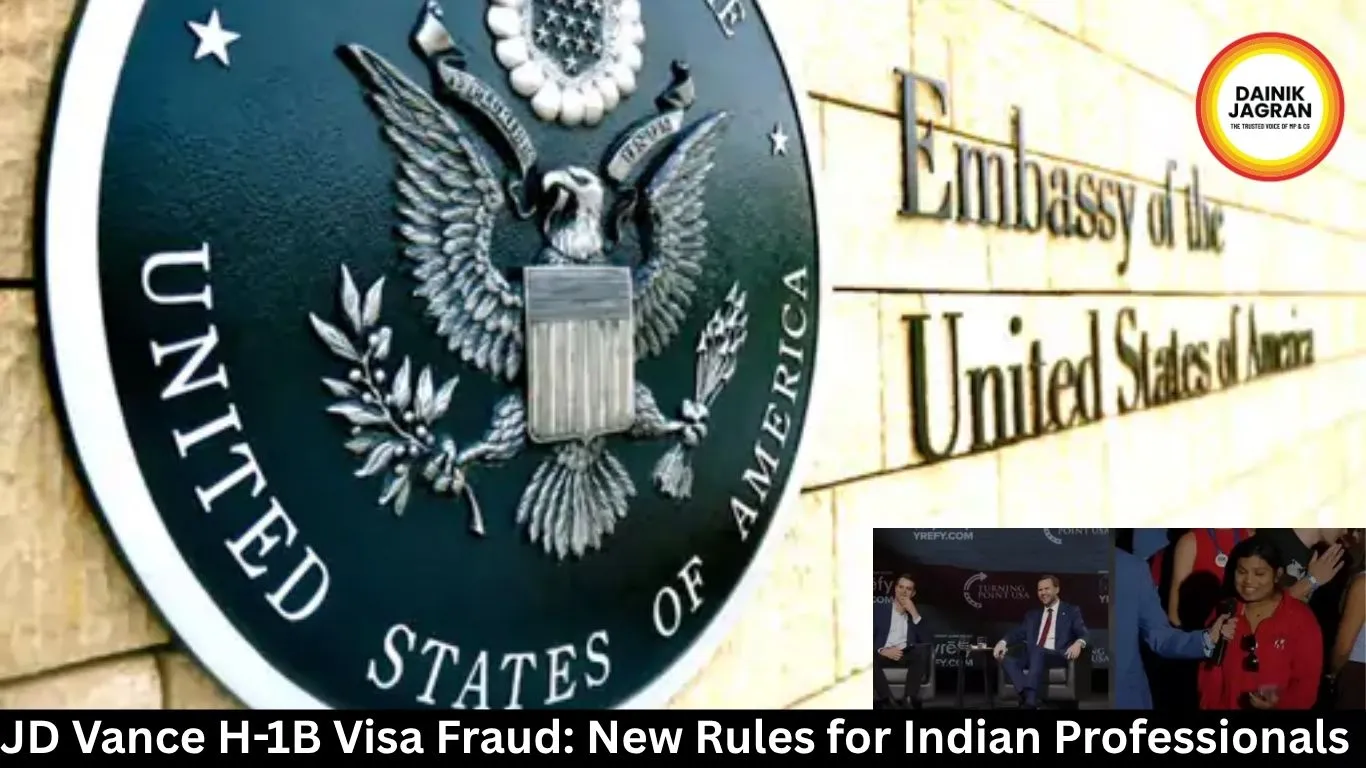
JD Vance H-1B Visa Fraud: New Rules for Indian Professionals
Digital Desk
US VP JD Vance flags H-1B visa fraud, calling for American identity. Read about the $100,000 fee, salary-based lottery, and impact on Indian professionals.
JD Vance Warns of H-1B ‘Fraud’, Calls for ‘America First’ Identity
US VP emphasizes national loyalty as India-China nationals dominate 80% of visa pool; administration tightens screening rules.
United States Vice President JD Vance has flagged significant concerns regarding "widespread fraud" within the H-1B visa program, while simultaneously balancing the critique with praise for immigrants who have contributed to the American economy. Speaking at a Turning Point USA event at the University of Georgia on Tuesday, Vance asserted that the specialized work visa system only remains sustainable when beneficiaries prioritize their American identity over their country of origin.
"On one hand, there is a lot of fraud in the H-1B system, and on the other, there are people who came in and enriched the country, like my in-laws," Vance said, referencing his wife Usha Vance’s parents. He noted that while legal immigration has historically bolstered the US, new citizens bear an "obligation" to think of the American national interest first.
Massive crackdown on visa misuse
The remarks come amid an intensified crackdown by the Trump administration on legal immigration pathways. Describing H-1B abuse as a "national security threat," the White House recently implemented a staggering $100,000 fee for new H-1B visa petitions filed for beneficiaries currently outside the United States.
The move has sent shockwaves through the Indian tech corridor, as Indian professionals consistently make up the lion's share of the H-1B pool. According to recent government data, Indian and Chinese nationals account for over 80% of all H-1B recipients, a statistic the administration is now using to justify stricter oversight and "America First" hiring mandates.
Impact on the domestic workforce
The administration has cited several corporate case studies to argue that the current system disadvantages domestic talent. Officials pointed to Microsoft, claiming over 16,000 employees were displaced following the approval of 9,000 H-1B visas in 2025. Similar claims were made regarding FedEx, where the use of the program allegedly contributed to the shuttering of over 100 facilities across the US.
"The system works only when everyone thinks of themselves as Americans," Vance reiterated, contrasting his father-in-law's integration with other instances where immigrants allegedly prioritized the interests of their home countries. He cited a specific anecdote involving a Ukrainian-American constituent to emphasize that US citizenship must mean putting America's needs above all others.
Transition to salary-driven selection
In a major structural shift, the US Citizenship and Immigration Services (USCIS) has officially moved away from the traditional random lottery. Starting this April, a salary-driven selection process has been implemented to favor higher-paid, highly-skilled professionals over entry-level workers.
Under the new wage-weighted system:
-
Level 4 candidates (highest paid) receive four entries in the selection pool.
-
Level 1 candidates (entry-level) are restricted to a single entry.
-
Employers must now provide granular, job-specific data to justify foreign hires over local candidates.
Enhanced screening and vetting
Beyond financial hurdles, the US State Department has introduced mandatory social media vetting for H-1B and H-4 visa applicants. Applicants are now required to provide social media handles, which are scrutinized as part of a "continuous improvement" of security procedures.
Sources indicated that this digital vetting aims to identify potential security risks or inconsistencies in an applicant’s background. The administration maintains these measures are necessary to ensure the program serves its original purpose of bringing in "extraordinary talent" rather than simply providing low-cost labor for large corporations.
Future outlook for professionals
As the 2026 cap season begins, the landscape for Indian professionals appears increasingly restrictive. With the $100,000 fee and the new wage-based lottery, industry experts predict a sharp decline in registrations from outsourcing firms, shifting the focus toward "super-specialists" and senior executives.
While the administration insists these changes protect the American worker, critics argue they could stifle innovation by making it prohibitively expensive to attract global talent. For thousands of Indian engineers and doctors, the "American Dream" now comes with a much higher price tag and a mandatory pledge of absolute national loyalty.

--------
๐จ Beat the News Rush โ Join Now!
Get breaking alerts, hot exclusives, and game-changing stories instantly on your phone. No delays, no fluff โ just the edge you need. โก
Tap to join:ย
๐ข WhatsApp Channel: Dainik Jagran MP CG
Crave more?
๐ Facebook: Dainik Jagran MP CG English
๐ ง Twitter (X): Dainik Jagran MP CG
๐ Instagram: Dainik Jagran MP CG
Share the fire โ keep your crew ahead! ๐๏ธ๐ฅ
JD Vance H-1B Visa Fraud: New Rules for Indian Professionals
Digital Desk
JD Vance Warns of H-1B ‘Fraud’, Calls for ‘America First’ Identity
US VP emphasizes national loyalty as India-China nationals dominate 80% of visa pool; administration tightens screening rules.
United States Vice President JD Vance has flagged significant concerns regarding "widespread fraud" within the H-1B visa program, while simultaneously balancing the critique with praise for immigrants who have contributed to the American economy. Speaking at a Turning Point USA event at the University of Georgia on Tuesday, Vance asserted that the specialized work visa system only remains sustainable when beneficiaries prioritize their American identity over their country of origin.
"On one hand, there is a lot of fraud in the H-1B system, and on the other, there are people who came in and enriched the country, like my in-laws," Vance said, referencing his wife Usha Vance’s parents. He noted that while legal immigration has historically bolstered the US, new citizens bear an "obligation" to think of the American national interest first.
Massive crackdown on visa misuse
The remarks come amid an intensified crackdown by the Trump administration on legal immigration pathways. Describing H-1B abuse as a "national security threat," the White House recently implemented a staggering $100,000 fee for new H-1B visa petitions filed for beneficiaries currently outside the United States.
The move has sent shockwaves through the Indian tech corridor, as Indian professionals consistently make up the lion's share of the H-1B pool. According to recent government data, Indian and Chinese nationals account for over 80% of all H-1B recipients, a statistic the administration is now using to justify stricter oversight and "America First" hiring mandates.
Impact on the domestic workforce
The administration has cited several corporate case studies to argue that the current system disadvantages domestic talent. Officials pointed to Microsoft, claiming over 16,000 employees were displaced following the approval of 9,000 H-1B visas in 2025. Similar claims were made regarding FedEx, where the use of the program allegedly contributed to the shuttering of over 100 facilities across the US.
"The system works only when everyone thinks of themselves as Americans," Vance reiterated, contrasting his father-in-law's integration with other instances where immigrants allegedly prioritized the interests of their home countries. He cited a specific anecdote involving a Ukrainian-American constituent to emphasize that US citizenship must mean putting America's needs above all others.
Transition to salary-driven selection
In a major structural shift, the US Citizenship and Immigration Services (USCIS) has officially moved away from the traditional random lottery. Starting this April, a salary-driven selection process has been implemented to favor higher-paid, highly-skilled professionals over entry-level workers.
Under the new wage-weighted system:
-
Level 4 candidates (highest paid) receive four entries in the selection pool.
-
Level 1 candidates (entry-level) are restricted to a single entry.
-
Employers must now provide granular, job-specific data to justify foreign hires over local candidates.
Enhanced screening and vetting
Beyond financial hurdles, the US State Department has introduced mandatory social media vetting for H-1B and H-4 visa applicants. Applicants are now required to provide social media handles, which are scrutinized as part of a "continuous improvement" of security procedures.
Sources indicated that this digital vetting aims to identify potential security risks or inconsistencies in an applicant’s background. The administration maintains these measures are necessary to ensure the program serves its original purpose of bringing in "extraordinary talent" rather than simply providing low-cost labor for large corporations.
Future outlook for professionals
As the 2026 cap season begins, the landscape for Indian professionals appears increasingly restrictive. With the $100,000 fee and the new wage-based lottery, industry experts predict a sharp decline in registrations from outsourcing firms, shifting the focus toward "super-specialists" and senior executives.
While the administration insists these changes protect the American worker, critics argue they could stifle innovation by making it prohibitively expensive to attract global talent. For thousands of Indian engineers and doctors, the "American Dream" now comes with a much higher price tag and a mandatory pledge of absolute national loyalty.