

PSL 2026 to Be Played in Empty Stadiums — Iran War Forces Major Changes

Digital Desk

PSL 2026 to Be Played in Empty Stadiums — Iran War Forces Major Changes

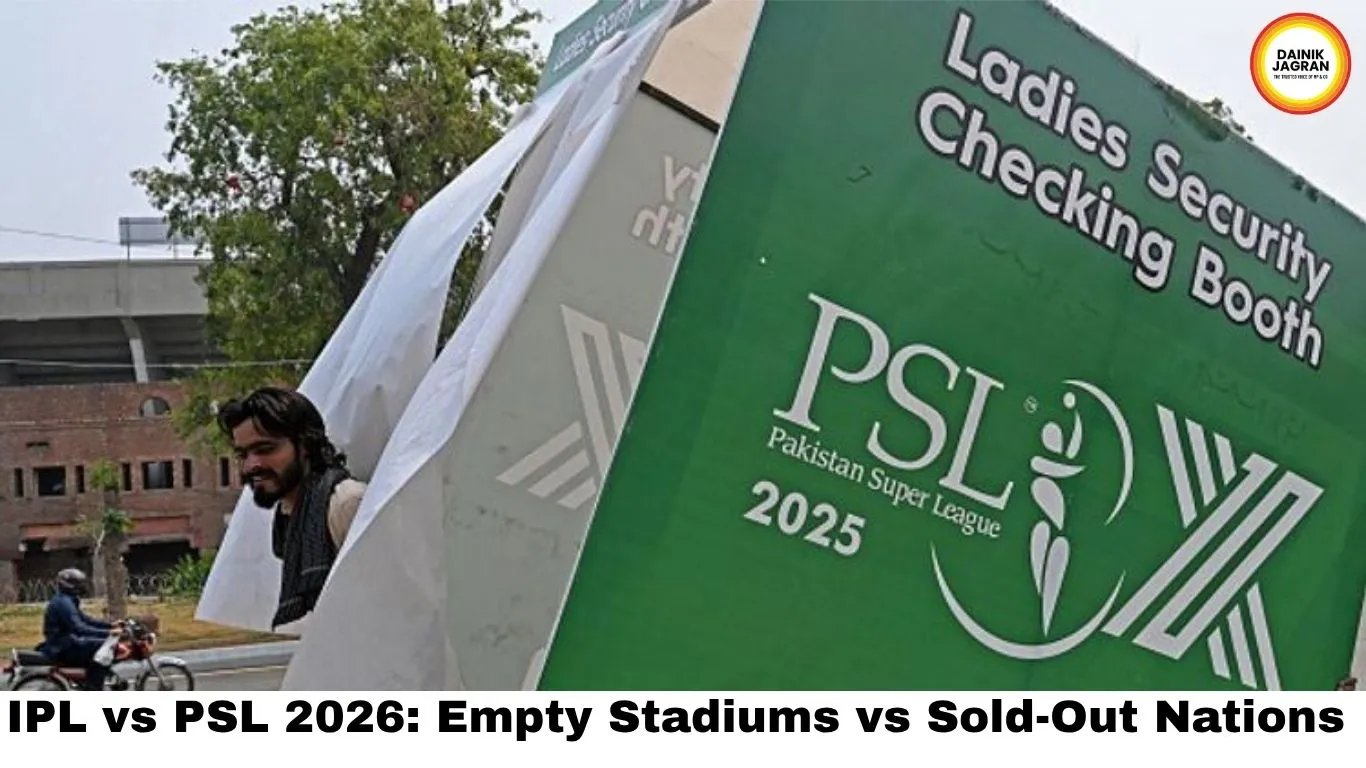
PSL 2026 begins March 26 behind closed doors — reduced to Lahore and Karachi from six venues, opening ceremony cancelled, foreign players exit as Iran war triggers Pakistan fuel crisis.

IPL Sells Out Nations. PSL Empties Them. The 2026 Numbers Tell a Story Pakistan Cannot Spin Away.

While India launches Fan Parks in 15 cities, sells out 74 matches and signs ₹48,390 crore in broadcast deals — Pakistan cancels its opening ceremony, locks out fans and watches its own players flee to join the IPL.


Two Leagues. Two Worlds.

On March 28, 2026, the Indian Premier League opens at Bengaluru's M Chinnaswamy Stadium with Royal Challengers Bengaluru facing Sunrisers Hyderabad. The stadium will be packed. The broadcast will reach 140 countries. The atmosphere will be electric. Bollywood will be there. The world will be watching.

Two days earlier, on March 26, the Pakistan Super League opens in Lahore. The stadium will be empty. The opening ceremony has been cancelled. Four of the six originally planned host cities have been dropped. Players are fleeing to join the IPL. And a cricket league that once dared to call itself a rival to India's most successful sporting property is now begging its own fans to watch on television because the government cannot afford the fuel to let them drive to the ground.

This is not a rivalry. It is a reckoning.


The Numbers Don't Lie — They Embarrass

Let the data speak first, because nothing else needs to.

IPL media rights for 2023–2027 were sold for ₹48,390 crore — approximately $6.4 billion. That works out to ₹118 crore per match. The PSL's entire broadcast and streaming deal with its rights partner for 2026–2029 is worth $93 million across four seasons. The per-match media value ratio between IPL and PSL is 267 to 1. Not 10 to 1. Not 50 to 1. Two hundred and sixty-seven to one.

IPL's total annual revenue exceeds ₹11,000 crore. PSL's total commercial revenue — including rights, sponsorships, ticketing and all other income streams — sits in the low hundreds of crores. IPL's digital viewership in 2024 reached 620 million on JioCinema alone, with 510 million more on Star Sports. PSL's total digital viewership in 2024 was reported at 150 million. The digital viewership ratio: 4 to 1 in India's favour — and that was before PSL locked its own fans out of stadiums.

IPL expansion franchises — Lucknow Super Giants and Gujarat Titans — sold for ₹7,090 crore and ₹5,625 crore respectively in 2021. PSL's two newest franchises — Hyderabad and Sialkot, added in 2026 — sold for approximately ₹56–59 crore each. An IPL team costs roughly 100 to 125 times more than a PSL team. The most valuable IPL franchise — Royal Challengers Bengaluru — is valued at ₹2,327 crore. PSL's most valuable franchise tops out at ₹540 crore on its best day.


IPL Goes to 15 Cities. PSL Retreats to Two.

While IPL 2026 launches Fan Parks across 15 Indian cities — giving fans who cannot get stadium tickets a free match-day experience in their own neighbourhoods — PSL 2026 has collapsed from six planned host cities to two. Rawalpindi gone. Faisalabad gone. Multan gone. And most painfully, Peshawar — which was supposed to host a PSL match for the very first time in the city's history, a moment of civic pride years in the making — gone. Cancelled. The seats empty before they were ever filled.

The IPL is expanding its footprint across a nation of 1.4 billion people who want to watch cricket. The PSL is contracting to survive.


Players Vote With Their Feet

When cricketers from around the world are given a choice between IPL and PSL, the decision is increasingly not a decision at all. In 2026, the departures from PSL to IPL have been systematic. Zimbabwe's Blessing Muzarabani left Islamabad United for KKR. Sri Lanka's T20I captain Dasun Shanaka left Lahore Qalandars for Rajasthan Royals. Jake Fraser-McGurk, Spencer Johnson, Ottneil Baartman and Gudakesh Motie all withdrew from PSL commitments. The PCB chairman threatened legal action — the same threat it made last year when a player was banned for one year. The players went anyway.

The PCB's response to the departures was revealing in its defensiveness. "Clashing with the IPL is not an issue because if players are going there, we're getting excellent players coming here as well," Naqvi said. It is the kind of statement that sounds confident until you notice that no one from IPL is rushing to join PSL — and that Cricket Australia explicitly warned its players against travelling to Peshawar even before the city was dropped from the schedule.


The Fuel Crisis That Shut the Gates

Pakistan's PSL 2026 crisis has a specific, documented cause — the US-Israel-Iran war and the closure of the Strait of Hormuz. Pakistan imports the majority of its petroleum from the Middle East. When the Strait was disrupted, Pakistan's fuel supply buckled within weeks. The government closed schools. It mandated work from home. It extended Eid holidays to reduce movement. It asked its entire population to conserve fuel and restrict unnecessary travel.

And then it tried to run a cricket tournament in front of 30,000 people per night.

The contradiction was unsustainable. PCB chairman Naqvi acknowledged it directly: "We can't ask people to restrict their movements and then have 30,000 people in stadiums every day." He was right. But the statement itself tells you everything. Pakistan's energy infrastructure is so fragile that running a single cricket tournament requires the government to choose between cricket and keeping the lights on.

India does not face that choice. It never has.


The Terrorism Index and the Empty Seats

The PSL's empty stadiums do not exist in isolation. They are part of a broader picture of a country under acute and compounding pressure. In March 2026, Pakistan was ranked number one on the Global Terrorism Index for the first time in the index's history — 1,139 terrorism deaths in 2025, the highest since 2013, with the TTP launching 595 attacks, a 24 percent increase over the previous year. The same country that cannot fuel its cricket stadiums is also the country most affected by terrorism on the planet.

Australia's cricket board cleared its players to travel to Pakistan for PSL — but explicitly warned them against going to Peshawar. That warning came before the war made the fuel situation critical. The security concerns and the energy crisis are not separate stories. They are symptoms of the same structural fragility.


What Cricket Is Telling Us

Cricket has always been a mirror that reflects the societies that play it. In 2026, IPL's mirror shows a confident, commercially aggressive, globally connected India that is growing faster than its own capacity to absorb its growth. PSL's mirror shows something different — a country whose cricket league has been brought to its knees not by sporting failure but by the accumulated weight of energy dependence, security fragility, economic instability and geopolitical exposure.

The players have made their choice. The broadcast market has priced its verdict. The stadiums — empty on one side, sold out on the other — have delivered their judgement without a single word.

You do not need to mock Pakistan to make this point. The numbers do it more efficiently than any editorial ever could.

english.dainikjagranmpcg.com
23 Mar 2026 By Jiya.S

PSL 2026 to Be Played in Empty Stadiums — Iran War Forces Major Changes

Digital Desk

IPL Sells Out Nations. PSL Empties Them. The 2026 Numbers Tell a Story Pakistan Cannot Spin Away.

While India launches Fan Parks in 15 cities, sells out 74 matches and signs ₹48,390 crore in broadcast deals — Pakistan cancels its opening ceremony, locks out fans and watches its own players flee to join the IPL.


Two Leagues. Two Worlds.

On March 28, 2026, the Indian Premier League opens at Bengaluru's M Chinnaswamy Stadium with Royal Challengers Bengaluru facing Sunrisers Hyderabad. The stadium will be packed. The broadcast will reach 140 countries. The atmosphere will be electric. Bollywood will be there. The world will be watching.

Two days earlier, on March 26, the Pakistan Super League opens in Lahore. The stadium will be empty. The opening ceremony has been cancelled. Four of the six originally planned host cities have been dropped. Players are fleeing to join the IPL. And a cricket league that once dared to call itself a rival to India's most successful sporting property is now begging its own fans to watch on television because the government cannot afford the fuel to let them drive to the ground.

This is not a rivalry. It is a reckoning.


The Numbers Don't Lie — They Embarrass

Let the data speak first, because nothing else needs to.

IPL media rights for 2023–2027 were sold for ₹48,390 crore — approximately $6.4 billion. That works out to ₹118 crore per match. The PSL's entire broadcast and streaming deal with its rights partner for 2026–2029 is worth $93 million across four seasons. The per-match media value ratio between IPL and PSL is 267 to 1. Not 10 to 1. Not 50 to 1. Two hundred and sixty-seven to one.

IPL's total annual revenue exceeds ₹11,000 crore. PSL's total commercial revenue — including rights, sponsorships, ticketing and all other income streams — sits in the low hundreds of crores. IPL's digital viewership in 2024 reached 620 million on JioCinema alone, with 510 million more on Star Sports. PSL's total digital viewership in 2024 was reported at 150 million. The digital viewership ratio: 4 to 1 in India's favour — and that was before PSL locked its own fans out of stadiums.

IPL expansion franchises — Lucknow Super Giants and Gujarat Titans — sold for ₹7,090 crore and ₹5,625 crore respectively in 2021. PSL's two newest franchises — Hyderabad and Sialkot, added in 2026 — sold for approximately ₹56–59 crore each. An IPL team costs roughly 100 to 125 times more than a PSL team. The most valuable IPL franchise — Royal Challengers Bengaluru — is valued at ₹2,327 crore. PSL's most valuable franchise tops out at ₹540 crore on its best day.


IPL Goes to 15 Cities. PSL Retreats to Two.

While IPL 2026 launches Fan Parks across 15 Indian cities — giving fans who cannot get stadium tickets a free match-day experience in their own neighbourhoods — PSL 2026 has collapsed from six planned host cities to two. Rawalpindi gone. Faisalabad gone. Multan gone. And most painfully, Peshawar — which was supposed to host a PSL match for the very first time in the city's history, a moment of civic pride years in the making — gone. Cancelled. The seats empty before they were ever filled.

The IPL is expanding its footprint across a nation of 1.4 billion people who want to watch cricket. The PSL is contracting to survive.


Players Vote With Their Feet

When cricketers from around the world are given a choice between IPL and PSL, the decision is increasingly not a decision at all. In 2026, the departures from PSL to IPL have been systematic. Zimbabwe's Blessing Muzarabani left Islamabad United for KKR. Sri Lanka's T20I captain Dasun Shanaka left Lahore Qalandars for Rajasthan Royals. Jake Fraser-McGurk, Spencer Johnson, Ottneil Baartman and Gudakesh Motie all withdrew from PSL commitments. The PCB chairman threatened legal action — the same threat it made last year when a player was banned for one year. The players went anyway.

The PCB's response to the departures was revealing in its defensiveness. "Clashing with the IPL is not an issue because if players are going there, we're getting excellent players coming here as well," Naqvi said. It is the kind of statement that sounds confident until you notice that no one from IPL is rushing to join PSL — and that Cricket Australia explicitly warned its players against travelling to Peshawar even before the city was dropped from the schedule.


The Fuel Crisis That Shut the Gates

Pakistan's PSL 2026 crisis has a specific, documented cause — the US-Israel-Iran war and the closure of the Strait of Hormuz. Pakistan imports the majority of its petroleum from the Middle East. When the Strait was disrupted, Pakistan's fuel supply buckled within weeks. The government closed schools. It mandated work from home. It extended Eid holidays to reduce movement. It asked its entire population to conserve fuel and restrict unnecessary travel.

And then it tried to run a cricket tournament in front of 30,000 people per night.

The contradiction was unsustainable. PCB chairman Naqvi acknowledged it directly: "We can't ask people to restrict their movements and then have 30,000 people in stadiums every day." He was right. But the statement itself tells you everything. Pakistan's energy infrastructure is so fragile that running a single cricket tournament requires the government to choose between cricket and keeping the lights on.

India does not face that choice. It never has.


The Terrorism Index and the Empty Seats

The PSL's empty stadiums do not exist in isolation. They are part of a broader picture of a country under acute and compounding pressure. In March 2026, Pakistan was ranked number one on the Global Terrorism Index for the first time in the index's history — 1,139 terrorism deaths in 2025, the highest since 2013, with the TTP launching 595 attacks, a 24 percent increase over the previous year. The same country that cannot fuel its cricket stadiums is also the country most affected by terrorism on the planet.

Australia's cricket board cleared its players to travel to Pakistan for PSL — but explicitly warned them against going to Peshawar. That warning came before the war made the fuel situation critical. The security concerns and the energy crisis are not separate stories. They are symptoms of the same structural fragility.


What Cricket Is Telling Us

Cricket has always been a mirror that reflects the societies that play it. In 2026, IPL's mirror shows a confident, commercially aggressive, globally connected India that is growing faster than its own capacity to absorb its growth. PSL's mirror shows something different — a country whose cricket league has been brought to its knees not by sporting failure but by the accumulated weight of energy dependence, security fragility, economic instability and geopolitical exposure.

The players have made their choice. The broadcast market has priced its verdict. The stadiums — empty on one side, sold out on the other — have delivered their judgement without a single word.

You do not need to mock Pakistan to make this point. The numbers do it more efficiently than any editorial ever could.

https://english.dainikjagranmpcg.com/international/psl-2026-to-be-played-in-empty-stadiums-%E2%80%94-iran/article-15843

Related Posts

Advertisement

Latest News


