

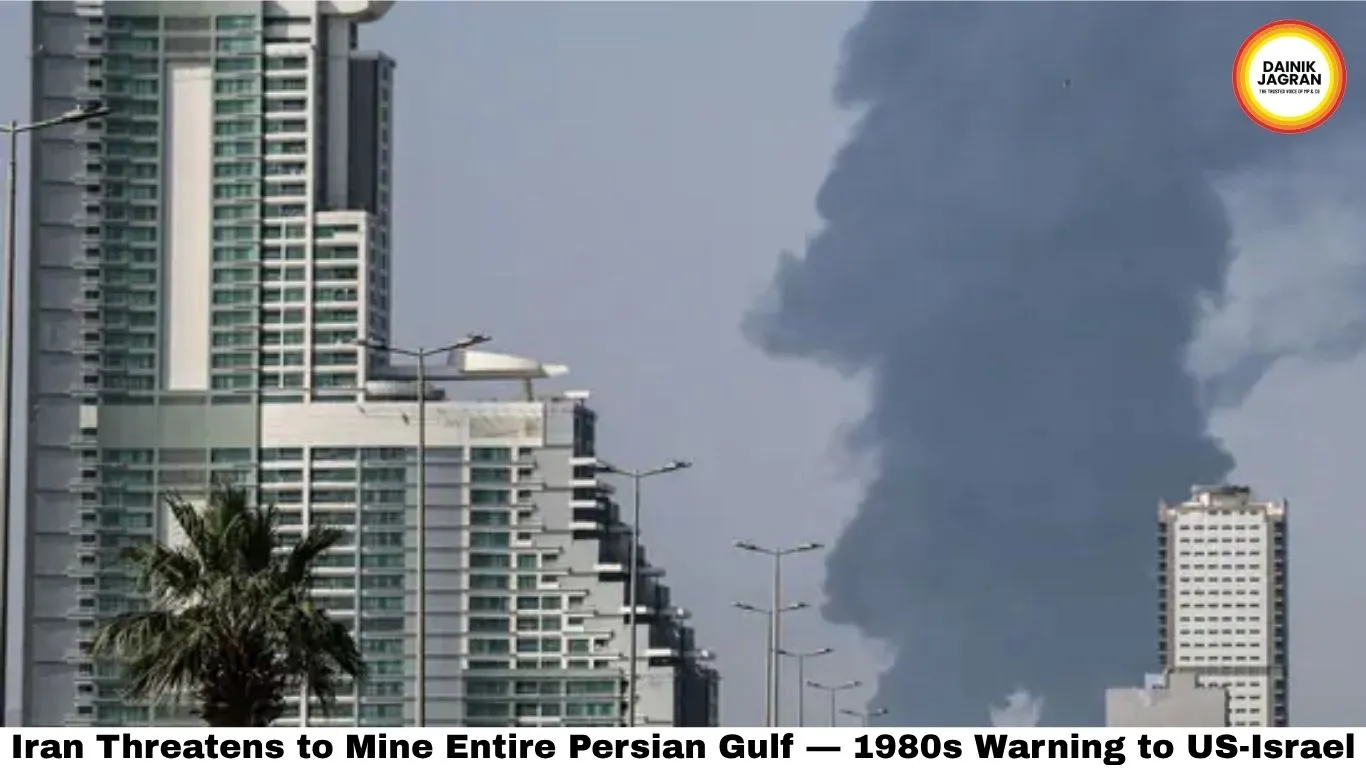
Iran Threatens to Mine Entire Persian Gulf — 1980s Warning to US-Israel

Digital Desk

Iran Threatens to Mine Entire Persian Gulf — 1980s Warning to US-Israel

Iran's Defence Council warns it will mine the entire Persian Gulf with moored and drifting mines if US-Israel attack its coasts — citing 1980s failure of 100 minesweepers as Trump's ultimatum expires.

'Remember 1980s — 100 Minesweepers Failed': Iran Threatens to Mine Entire Persian Gulf if US-Israel Attack Its Coast

Iran's Defence Council warns all Gulf access routes will be mined with moored and drifting naval mines if its coasts or islands are attacked — as Israel launches wide-scale strikes on Tehran government infrastructure and Trump's ultimatum expires Monday evening.


The Threat That Changes Everything

If the Strait of Hormuz being effectively closed was already the most consequential single development of the US-Israel-Iran war, Iran has now raised the stakes to a level that would make the current disruption look modest by comparison. On Monday, March 23 — as Trump's 48-hour ultimatum to reopen the Strait expired — Iran's Defence Council issued a formal military warning that if the United States or Israel attacks Iranian coasts or islands, Tehran will mine the entire Persian Gulf. Not the Strait of Hormuz alone. The entire Gulf.

"Any attempt to attack Iran's coasts or islands will cause all access routes in the Gulf to be mined with various types of sea mines, including floating mines that can be released from the coast," the Defence Council said. "In this case, the entire Gulf will practically be in a situation similar to the Strait of Hormuz for a long time. One should not forget the failure of over 100 minesweepers in the 1980s in removing a few sea mines." OpIndia

The reference to the 1980s is not rhetorical decoration. It is a precise historical warning about what naval mine warfare in the Persian Gulf actually looks like — and how long it takes to undo.


What Happened in the 1980s — The History Iran Wants the World to Remember

The 1980s tanker war — fought during the final phase of the Iran-Iraq War between 1984 and 1988 — saw Iran lay mines throughout the Persian Gulf and the Strait of Hormuz as a strategic tool to disrupt Iraqi oil exports and pressure the international community. The results were dramatic. US Navy warships, including the frigate USS Samuel B Roberts, struck Iranian mines. A large multinational minesweeping operation — involving the US, UK, France, Belgium, Italy and the Netherlands — was assembled. Despite deploying over 100 minesweepers, the operation took months and never fully cleared all mines from the waterway.

Iran has been assessed to have the capacity — via the threatened or actual use of mines, speed boats, submarines, shore-based cruise missiles, aircraft, and other systems — to disrupt the flow of commercial shipping into and out of the Persian Gulf. Prior to the onset of conflict in February 2026, there was consensus among analysts that the US military has the capacity to counter Iran's forces and restore the flow of shipping if necessary. However, such an effort would likely take some time — days, weeks, or perhaps months — depending on what forms an Iranian attempt to close the Gulf to shipping might take. Onmanorama

The distinction matters enormously. Closing the Strait of Hormuz — 33 kilometres wide — is one thing. Mining the entire Persian Gulf — a body of water stretching 990 kilometres in length and up to 340 kilometres in width — is an entirely different order of magnitude. It would make every shipping lane, every port approach, every oil tanker loading terminal from Kuwait to Oman a potential mine-field. The clean-up timeline would not be measured in weeks. It would be measured in years.


The Two Types of Mines — Why Drifting Mines Are the Nightmare Scenario

Iran's Defence Council specifically referenced two categories of naval mines — moored mines and drifting mines. The distinction is operationally critical. Moored mines are anchored to the seabed at a fixed depth — dangerous but at least static and mappable. Drifting mines are released from the coast and float freely with currents — making them virtually impossible to track, predict or clear systematically. "Any enemy attempt to attack Iranian coasts or islands will naturally lead, following standard military procedures, to the deployment of various naval mines — including moored and drifting mines — across all access routes and communication lines in the Persian Gulf," India.com the statement said.

Drifting mines released from Iran's extensive Gulf coastline — which stretches over 2,000 kilometres — could reach shipping lanes from Kuwait, Saudi Arabia, Qatar, UAE and Bahrain within hours of deployment. They are indiscriminate weapons that cannot distinguish between a US aircraft carrier and an Indian LPG tanker. The threat is not theoretical. Iran demonstrated the capability in the 1980s and has significantly expanded its naval mine arsenal since.


The Context — US Marines Arriving, Israel Strikes Tehran

The warning comes as the US deploys more amphibious assault ships and additional Marines to the Middle East — ahead of what Iran has been warned could be a coastal or island assault. BollywoodShaadis Trump has publicly stated he has no plans to send ground forces into Iran — but has retained all options. Israel has separately suggested its ground forces could take part in operations inside Iran.

The Israel Defence Forces launched a widespread wave of attacks against Iranian government infrastructure in the capital Tehran on Monday NewsGram — striking targets including Basij paramilitary checkpoints and government ministry buildings. Iran retaliated with fresh missile and drone attacks on Israel and Gulf states. Saudi Arabia intercepted one of two ballistic missiles targeting Riyadh on Monday morning — the second fell in an uninhabited area. UAE air defences were actively intercepting incoming missiles and drones. Sirens sounded in Bahrain. Citizens across the Gulf were urged to seek shelter.


China Warns of 'Uncontrollable Situation' — The World Responds

China warned on Monday that further attacks on the Middle East risk creating an "uncontrollable situation" in the war-torn region. "If the war expands further and the situation deteriorates again, the entire region could be plunged into an uncontrollable situation," China's foreign ministry spokesman said. DNP INDIA

Iran's Foreign Minister maintained on Sunday that the Strait of Hormuz is not formally closed — framing the reduced shipping traffic as insurers' fear of war risk rather than an official Iranian blockade. The distinction is legally significant but practically irrelevant — ships are not moving, oil is not flowing, and the world's most critical energy waterway has been effectively shut regardless of what it is officially called.


What a Mined Persian Gulf Would Mean for India

For India — which imports over 70 percent of its crude oil requirements and 60 percent of its LPG from the Gulf region — a mined Persian Gulf would represent a supply chain catastrophe of a different order than the current Strait disruption. The Strait of Hormuz closure has already pushed LPG prices up by ₹60 per cylinder, driven petrol above ₹100 in multiple cities, and triggered a commercial cooking gas crisis across Madhya Pradesh, Chhattisgarh and other states.

A mined Persian Gulf — with mine clearance potentially taking months — would mean that even the diversified supply routes India has developed, including US LPG imports and Russian crude, would be insufficient to plug the gap. The strategic petroleum reserve of 53 lakh metric tonnes that PM Modi disclosed in Parliament on Monday provides some buffer. But against a months-long Gulf closure, it is not enough.


The War's Most Dangerous Moment

The conflict has killed more than 2,000 people, shaken the global economy, sent oil prices surging, and endangered some of the world's busiest air corridors. Trump's ultimatum and Iran's promise of retaliation now threaten to raise the stakes yet again, with potentially catastrophic repercussions for civilians across the region. BollywoodShaadis

As Trump's deadline expires Monday evening, the world is watching one of the most consequential decisions in recent military history. Strike Iran's power plants — and trigger a response that could mine the entire Persian Gulf, plunge 40 percent of the world's seaborne oil trade into indefinite disruption, and push a regional war toward a global energy catastrophe. Or hold back — and watch the Strait remain closed, Iran's leverage grow, and the precedent set that ultimatums to Tehran can be issued and then quietly shelved.

There is no clean choice. There is only the one that is made — and the consequences that follow.

english.dainikjagranmpcg.com
23 Mar 2026 By Jiya.S

Iran Threatens to Mine Entire Persian Gulf — 1980s Warning to US-Israel

Digital Desk

'Remember 1980s — 100 Minesweepers Failed': Iran Threatens to Mine Entire Persian Gulf if US-Israel Attack Its Coast

Iran's Defence Council warns all Gulf access routes will be mined with moored and drifting naval mines if its coasts or islands are attacked — as Israel launches wide-scale strikes on Tehran government infrastructure and Trump's ultimatum expires Monday evening.


The Threat That Changes Everything

If the Strait of Hormuz being effectively closed was already the most consequential single development of the US-Israel-Iran war, Iran has now raised the stakes to a level that would make the current disruption look modest by comparison. On Monday, March 23 — as Trump's 48-hour ultimatum to reopen the Strait expired — Iran's Defence Council issued a formal military warning that if the United States or Israel attacks Iranian coasts or islands, Tehran will mine the entire Persian Gulf. Not the Strait of Hormuz alone. The entire Gulf.

"Any attempt to attack Iran's coasts or islands will cause all access routes in the Gulf to be mined with various types of sea mines, including floating mines that can be released from the coast," the Defence Council said. "In this case, the entire Gulf will practically be in a situation similar to the Strait of Hormuz for a long time. One should not forget the failure of over 100 minesweepers in the 1980s in removing a few sea mines." OpIndia

The reference to the 1980s is not rhetorical decoration. It is a precise historical warning about what naval mine warfare in the Persian Gulf actually looks like — and how long it takes to undo.


What Happened in the 1980s — The History Iran Wants the World to Remember

The 1980s tanker war — fought during the final phase of the Iran-Iraq War between 1984 and 1988 — saw Iran lay mines throughout the Persian Gulf and the Strait of Hormuz as a strategic tool to disrupt Iraqi oil exports and pressure the international community. The results were dramatic. US Navy warships, including the frigate USS Samuel B Roberts, struck Iranian mines. A large multinational minesweeping operation — involving the US, UK, France, Belgium, Italy and the Netherlands — was assembled. Despite deploying over 100 minesweepers, the operation took months and never fully cleared all mines from the waterway.

Iran has been assessed to have the capacity — via the threatened or actual use of mines, speed boats, submarines, shore-based cruise missiles, aircraft, and other systems — to disrupt the flow of commercial shipping into and out of the Persian Gulf. Prior to the onset of conflict in February 2026, there was consensus among analysts that the US military has the capacity to counter Iran's forces and restore the flow of shipping if necessary. However, such an effort would likely take some time — days, weeks, or perhaps months — depending on what forms an Iranian attempt to close the Gulf to shipping might take. Onmanorama

The distinction matters enormously. Closing the Strait of Hormuz — 33 kilometres wide — is one thing. Mining the entire Persian Gulf — a body of water stretching 990 kilometres in length and up to 340 kilometres in width — is an entirely different order of magnitude. It would make every shipping lane, every port approach, every oil tanker loading terminal from Kuwait to Oman a potential mine-field. The clean-up timeline would not be measured in weeks. It would be measured in years.


The Two Types of Mines — Why Drifting Mines Are the Nightmare Scenario

Iran's Defence Council specifically referenced two categories of naval mines — moored mines and drifting mines. The distinction is operationally critical. Moored mines are anchored to the seabed at a fixed depth — dangerous but at least static and mappable. Drifting mines are released from the coast and float freely with currents — making them virtually impossible to track, predict or clear systematically. "Any enemy attempt to attack Iranian coasts or islands will naturally lead, following standard military procedures, to the deployment of various naval mines — including moored and drifting mines — across all access routes and communication lines in the Persian Gulf," India.com the statement said.

Drifting mines released from Iran's extensive Gulf coastline — which stretches over 2,000 kilometres — could reach shipping lanes from Kuwait, Saudi Arabia, Qatar, UAE and Bahrain within hours of deployment. They are indiscriminate weapons that cannot distinguish between a US aircraft carrier and an Indian LPG tanker. The threat is not theoretical. Iran demonstrated the capability in the 1980s and has significantly expanded its naval mine arsenal since.


The Context — US Marines Arriving, Israel Strikes Tehran

The warning comes as the US deploys more amphibious assault ships and additional Marines to the Middle East — ahead of what Iran has been warned could be a coastal or island assault. BollywoodShaadis Trump has publicly stated he has no plans to send ground forces into Iran — but has retained all options. Israel has separately suggested its ground forces could take part in operations inside Iran.

The Israel Defence Forces launched a widespread wave of attacks against Iranian government infrastructure in the capital Tehran on Monday NewsGram — striking targets including Basij paramilitary checkpoints and government ministry buildings. Iran retaliated with fresh missile and drone attacks on Israel and Gulf states. Saudi Arabia intercepted one of two ballistic missiles targeting Riyadh on Monday morning — the second fell in an uninhabited area. UAE air defences were actively intercepting incoming missiles and drones. Sirens sounded in Bahrain. Citizens across the Gulf were urged to seek shelter.


China Warns of 'Uncontrollable Situation' — The World Responds

China warned on Monday that further attacks on the Middle East risk creating an "uncontrollable situation" in the war-torn region. "If the war expands further and the situation deteriorates again, the entire region could be plunged into an uncontrollable situation," China's foreign ministry spokesman said. DNP INDIA

Iran's Foreign Minister maintained on Sunday that the Strait of Hormuz is not formally closed — framing the reduced shipping traffic as insurers' fear of war risk rather than an official Iranian blockade. The distinction is legally significant but practically irrelevant — ships are not moving, oil is not flowing, and the world's most critical energy waterway has been effectively shut regardless of what it is officially called.


What a Mined Persian Gulf Would Mean for India

For India — which imports over 70 percent of its crude oil requirements and 60 percent of its LPG from the Gulf region — a mined Persian Gulf would represent a supply chain catastrophe of a different order than the current Strait disruption. The Strait of Hormuz closure has already pushed LPG prices up by ₹60 per cylinder, driven petrol above ₹100 in multiple cities, and triggered a commercial cooking gas crisis across Madhya Pradesh, Chhattisgarh and other states.

A mined Persian Gulf — with mine clearance potentially taking months — would mean that even the diversified supply routes India has developed, including US LPG imports and Russian crude, would be insufficient to plug the gap. The strategic petroleum reserve of 53 lakh metric tonnes that PM Modi disclosed in Parliament on Monday provides some buffer. But against a months-long Gulf closure, it is not enough.


The War's Most Dangerous Moment

The conflict has killed more than 2,000 people, shaken the global economy, sent oil prices surging, and endangered some of the world's busiest air corridors. Trump's ultimatum and Iran's promise of retaliation now threaten to raise the stakes yet again, with potentially catastrophic repercussions for civilians across the region. BollywoodShaadis

As Trump's deadline expires Monday evening, the world is watching one of the most consequential decisions in recent military history. Strike Iran's power plants — and trigger a response that could mine the entire Persian Gulf, plunge 40 percent of the world's seaborne oil trade into indefinite disruption, and push a regional war toward a global energy catastrophe. Or hold back — and watch the Strait remain closed, Iran's leverage grow, and the precedent set that ultimatums to Tehran can be issued and then quietly shelved.

There is no clean choice. There is only the one that is made — and the consequences that follow.

https://english.dainikjagranmpcg.com/national/69c11b1a7f78b/article-15861

Related Posts

Advertisement

Latest News


