

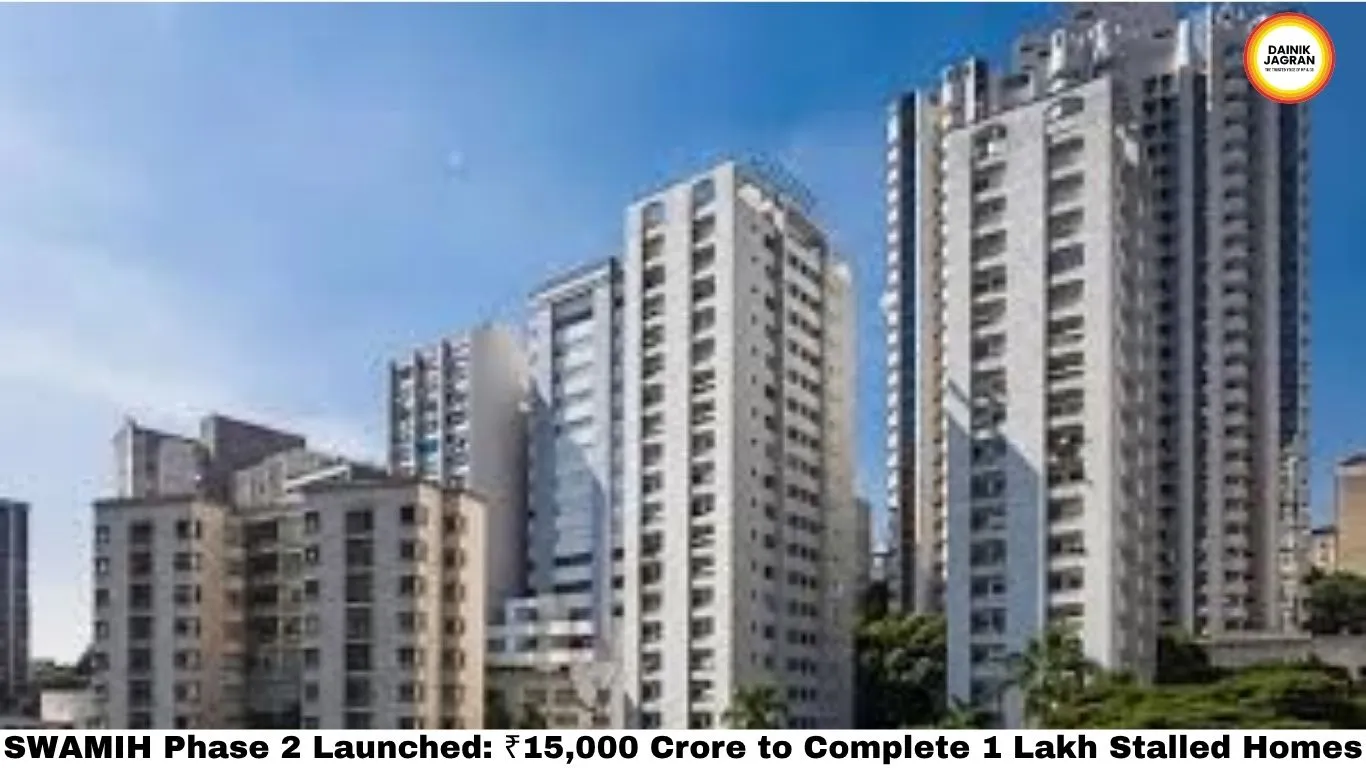
SWAMIH Phase 2 Launched: ₹15,000 Crore to Complete 1 Lakh Stalled Homes
Digital Desk
FM Sitharaman announces SWAMIH Phase 2 in Lok Sabha — ₹15,000 crore fund to complete 1 lakh stalled homes after Phase 1 spent ₹10,037 crore and delivered 63,200 units. Six eligibility rules explained.
SWAMIH Phase 2 Launched in Parliament: FM Sitharaman Announces ₹15,000 Crore Fund to Complete 1 Lakh More Stalled Homes — 6 Key Rules Explained
After Phase 1 spent ₹10,037 crore to complete 63,200 homes, Finance Minister Nirmala Sitharaman told Lok Sabha on March 23 that Phase 2 is now active — targeting 1 lakh more stalled units for India's severely affected middle-income homebuyers.
The Homes That Were Paid For But Never Delivered
Across India's major cities — Mumbai, Noida, Gurugram, Bengaluru, Pune, Hyderabad — thousands of families have been living in a peculiar purgatory for years. They paid for a home. They received a registration document. They have been servicing an EMI every month — sometimes for five, seven, or ten years. And yet the keys have never arrived because the builder ran out of money, went into insolvency, or simply stopped construction midway.
On March 23, 2026 — as the Lok Sabha took up the Finance Bill for 2026-27 — Finance Minister Nirmala Sitharaman formally announced the launch of Phase 2 of the SWAMIH Fund, India's most consequential intervention in the stalled housing crisis. It is the government's clearest signal yet that the promise of delivery to India's middle class homebuyers is not negotiable — and that public capital will be deployed to make it happen.
What FM Sitharaman Said in Lok Sabha
Addressing Parliament, Sitharaman confirmed that Phase 1 of the SWAMIH Fund — launched in November 2019 — had spent ₹10,037.5 crore and achieved final closure in December 2022. Of the total portfolio of 1.14 lakh homes targeted for completion under Phase 1, 63,200 units have been completed and handed over to buyers to date. Phase 2 has now been initiated to address the remaining inventory of stalled homes. The intention, she emphasised, is to complete as many projects as possible to assist the middle-income group — which she described as being severely affected by the stalled housing crisis.
What Is SWAMIH — The Scheme Behind the Numbers
SWAMIH stands for Special Window for Affordable and Mid-Income Housing. It is a government-backed Category-II Alternative Investment Fund — managed by SBICAP Ventures Ltd., a subsidiary of the State Bank of India — under the sponsorship of the Ministry of Finance's Department of Economic Affairs. It pools capital from the government, public sector banks and LIC to provide priority debt financing to residential housing projects that are viable but stalled due to lack of funds.
SWAMIH is explicitly a last-resort lender. It steps in where banks, NBFCs and private investors have refused to go — including projects with litigation, customer complaints, non-performing asset classification and even cases before the National Company Law Tribunal. Its mandate is one and only one thing: get the homes finished and get families into possession.
SWAMIH Phase 1 — What Was Achieved
The scale of Phase 1's achievement is significant. Over ₹10,037 crore was invested across 127 projects spanning 30 cities — unlocking total capital of over ₹37,400 crore across 90 million square feet of construction. More than 63,200 homes have been completed and handed over. Over 36,000 jobs were created — including 3,520 permanent roles, with women accounting for 15 percent of the workforce. More than 5.33 lakh people's lives were directly impacted. SWAMIH-backed projects generated demand for over 20 lakh tonnes of cement and 5.5 lakh tonnes of steel — a significant downstream economic impact.
The fund's investment cycle under Phase 1 was formally completed on December 5, 2025.
SWAMIH Phase 2 — The New Numbers
Phase 2 was announced in Union Budget 2025-26 as a ₹15,000 crore blended finance facility — contributed by the government, banks and private investors. It is administered by SBICAP Ventures Ltd. under the same framework as Phase 1. The target is the completion of an additional 1 lakh stalled housing units — focused specifically on the affordable and mid-income segment where the bulk of India's housing distress is concentrated.
The government has committed ₹1,500 crore as seed capital for Phase 2. The remaining ₹13,500 crore is expected to be raised from public sector banks, LIC and private investors through the blended finance structure.
6 Rules for Projects Seeking SWAMIH Funding
Rule 1 — Must Be RERA Registered Only projects formally registered under the Real Estate Regulatory Authority are eligible. Unregistered projects do not qualify under any circumstances.
Rule 2 — Stalled Due to Funding Shortage Only The project must have been delayed primarily due to lack of adequate funds — not due to land disputes, approvals pending, or fundamental commercial unviability. Projects stalled for non-financial reasons are not eligible.
Rule 3 — Affordable or Mid-Income Segment Eligible units must fall within the affordable or mid-income housing category — defined as RERA carpet area up to 200 square metres within specified price limits. Price caps by city are: Mumbai Metropolitan Region — under ₹2 crore; NCR, Chennai, Kolkata, Pune, Hyderabad, Bengaluru, Ahmedabad — under ₹1.5 crore; Rest of India — under ₹1 crore.
Rule 4 — Net Worth Positive The project must be net worth positive — meaning the value of receivables plus unsold inventory must exceed outstanding liabilities and the estimated cost of completion. Projects that are fundamentally underwater do not qualify.
Rule 5 — Advanced Stage of Construction Priority is given to projects that are in an advanced stage of completion — typically 60 to 90 percent complete. The closer to delivery, the higher the priority for funding allocation.
Rule 6 — NPAs and NCLT Projects Also Eligible Unlike conventional lenders, SWAMIH explicitly considers projects classified as Non-Performing Assets and projects undergoing insolvency proceedings before the NCLT — making it the only structured government fund willing to intervene in the most complex and legally entangled stalled projects.
Why This Matters for Middle-Class India
The middle-income homebuyer caught in a stalled project is among the most financially vulnerable categories in urban India. Typically a salaried professional who stretched their savings and took a home loan at a stretch — they are simultaneously paying EMI on a loan for a flat they cannot occupy, and rent for a flat they are actually living in. The double financial burden stretches for years. Families delay milestones. Savings are depleted. Mental health suffers.
SWAMIH's direct impact on this category — 63,200 families already delivered keys under Phase 1, 1 lakh more targeted under Phase 2 — is among the most tangible welfare outcomes the government has produced for the urban middle class in the past decade. It does not involve a subsidy, a waiver or a handout. It involves last-mile capital to finish construction that was already sold, already paid for, and already promised — and never delivered.
SWAMIH Phase 2 Launched: ₹15,000 Crore to Complete 1 Lakh Stalled Homes
Digital Desk
SWAMIH Phase 2 Launched in Parliament: FM Sitharaman Announces ₹15,000 Crore Fund to Complete 1 Lakh More Stalled Homes — 6 Key Rules Explained
After Phase 1 spent ₹10,037 crore to complete 63,200 homes, Finance Minister Nirmala Sitharaman told Lok Sabha on March 23 that Phase 2 is now active — targeting 1 lakh more stalled units for India's severely affected middle-income homebuyers.
The Homes That Were Paid For But Never Delivered
Across India's major cities — Mumbai, Noida, Gurugram, Bengaluru, Pune, Hyderabad — thousands of families have been living in a peculiar purgatory for years. They paid for a home. They received a registration document. They have been servicing an EMI every month — sometimes for five, seven, or ten years. And yet the keys have never arrived because the builder ran out of money, went into insolvency, or simply stopped construction midway.
On March 23, 2026 — as the Lok Sabha took up the Finance Bill for 2026-27 — Finance Minister Nirmala Sitharaman formally announced the launch of Phase 2 of the SWAMIH Fund, India's most consequential intervention in the stalled housing crisis. It is the government's clearest signal yet that the promise of delivery to India's middle class homebuyers is not negotiable — and that public capital will be deployed to make it happen.
What FM Sitharaman Said in Lok Sabha
Addressing Parliament, Sitharaman confirmed that Phase 1 of the SWAMIH Fund — launched in November 2019 — had spent ₹10,037.5 crore and achieved final closure in December 2022. Of the total portfolio of 1.14 lakh homes targeted for completion under Phase 1, 63,200 units have been completed and handed over to buyers to date. Phase 2 has now been initiated to address the remaining inventory of stalled homes. The intention, she emphasised, is to complete as many projects as possible to assist the middle-income group — which she described as being severely affected by the stalled housing crisis.
What Is SWAMIH — The Scheme Behind the Numbers
SWAMIH stands for Special Window for Affordable and Mid-Income Housing. It is a government-backed Category-II Alternative Investment Fund — managed by SBICAP Ventures Ltd., a subsidiary of the State Bank of India — under the sponsorship of the Ministry of Finance's Department of Economic Affairs. It pools capital from the government, public sector banks and LIC to provide priority debt financing to residential housing projects that are viable but stalled due to lack of funds.
SWAMIH is explicitly a last-resort lender. It steps in where banks, NBFCs and private investors have refused to go — including projects with litigation, customer complaints, non-performing asset classification and even cases before the National Company Law Tribunal. Its mandate is one and only one thing: get the homes finished and get families into possession.
SWAMIH Phase 1 — What Was Achieved
The scale of Phase 1's achievement is significant. Over ₹10,037 crore was invested across 127 projects spanning 30 cities — unlocking total capital of over ₹37,400 crore across 90 million square feet of construction. More than 63,200 homes have been completed and handed over. Over 36,000 jobs were created — including 3,520 permanent roles, with women accounting for 15 percent of the workforce. More than 5.33 lakh people's lives were directly impacted. SWAMIH-backed projects generated demand for over 20 lakh tonnes of cement and 5.5 lakh tonnes of steel — a significant downstream economic impact.
The fund's investment cycle under Phase 1 was formally completed on December 5, 2025.
SWAMIH Phase 2 — The New Numbers
Phase 2 was announced in Union Budget 2025-26 as a ₹15,000 crore blended finance facility — contributed by the government, banks and private investors. It is administered by SBICAP Ventures Ltd. under the same framework as Phase 1. The target is the completion of an additional 1 lakh stalled housing units — focused specifically on the affordable and mid-income segment where the bulk of India's housing distress is concentrated.
The government has committed ₹1,500 crore as seed capital for Phase 2. The remaining ₹13,500 crore is expected to be raised from public sector banks, LIC and private investors through the blended finance structure.
6 Rules for Projects Seeking SWAMIH Funding
Rule 1 — Must Be RERA Registered Only projects formally registered under the Real Estate Regulatory Authority are eligible. Unregistered projects do not qualify under any circumstances.
Rule 2 — Stalled Due to Funding Shortage Only The project must have been delayed primarily due to lack of adequate funds — not due to land disputes, approvals pending, or fundamental commercial unviability. Projects stalled for non-financial reasons are not eligible.
Rule 3 — Affordable or Mid-Income Segment Eligible units must fall within the affordable or mid-income housing category — defined as RERA carpet area up to 200 square metres within specified price limits. Price caps by city are: Mumbai Metropolitan Region — under ₹2 crore; NCR, Chennai, Kolkata, Pune, Hyderabad, Bengaluru, Ahmedabad — under ₹1.5 crore; Rest of India — under ₹1 crore.
Rule 4 — Net Worth Positive The project must be net worth positive — meaning the value of receivables plus unsold inventory must exceed outstanding liabilities and the estimated cost of completion. Projects that are fundamentally underwater do not qualify.
Rule 5 — Advanced Stage of Construction Priority is given to projects that are in an advanced stage of completion — typically 60 to 90 percent complete. The closer to delivery, the higher the priority for funding allocation.
Rule 6 — NPAs and NCLT Projects Also Eligible Unlike conventional lenders, SWAMIH explicitly considers projects classified as Non-Performing Assets and projects undergoing insolvency proceedings before the NCLT — making it the only structured government fund willing to intervene in the most complex and legally entangled stalled projects.
Why This Matters for Middle-Class India
The middle-income homebuyer caught in a stalled project is among the most financially vulnerable categories in urban India. Typically a salaried professional who stretched their savings and took a home loan at a stretch — they are simultaneously paying EMI on a loan for a flat they cannot occupy, and rent for a flat they are actually living in. The double financial burden stretches for years. Families delay milestones. Savings are depleted. Mental health suffers.
SWAMIH's direct impact on this category — 63,200 families already delivered keys under Phase 1, 1 lakh more targeted under Phase 2 — is among the most tangible welfare outcomes the government has produced for the urban middle class in the past decade. It does not involve a subsidy, a waiver or a handout. It involves last-mile capital to finish construction that was already sold, already paid for, and already promised — and never delivered.


