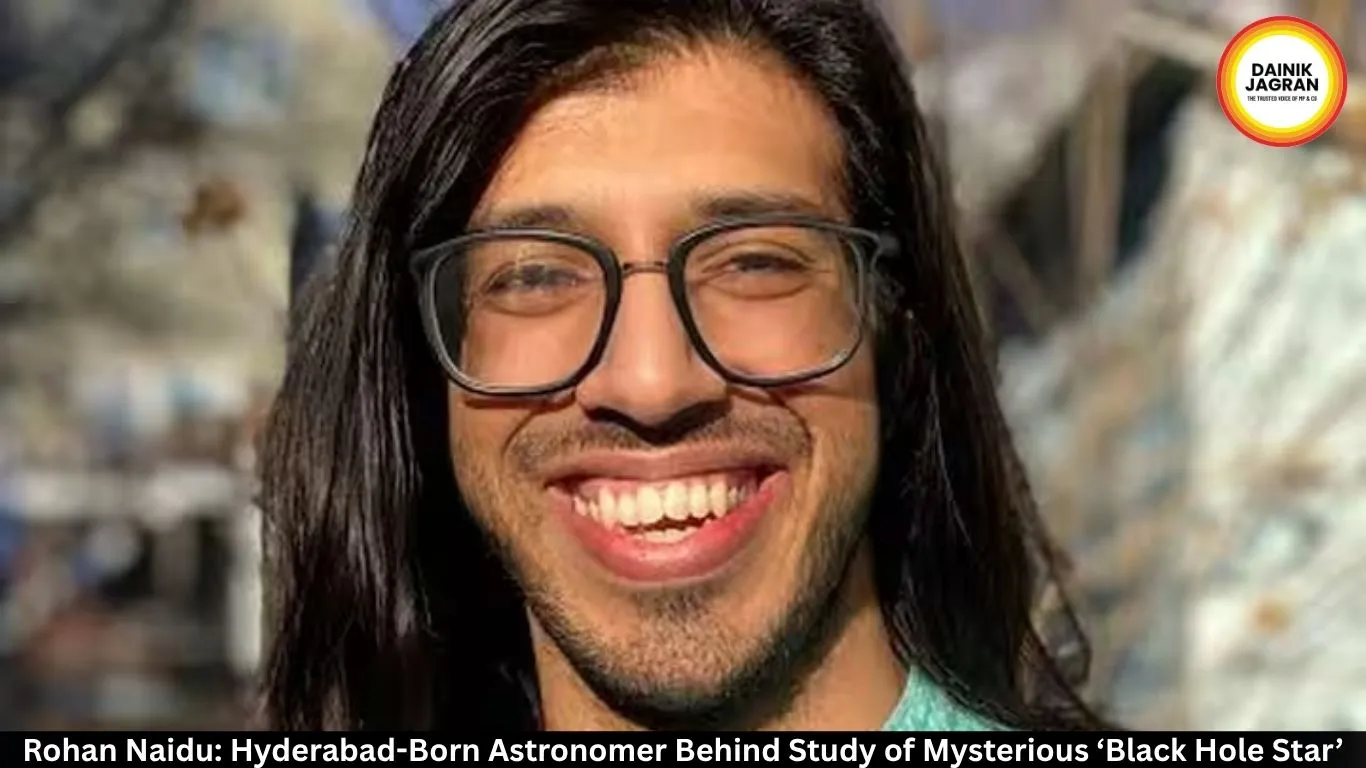
Rohan Naidu: Hyderabad-Born Astronomer Behind ‘Black Hole Star’ Study

Digital desk

Rohan Naidu: Hyderabad-Born Astronomer Behind ‘Black Hole Star’ Study

Hyderabad-born astronomer Rohan Naidu is leading research into a mysterious ‘black hole star’ observed by the James Webb Space Telescope in the early universe.

A mysterious object observed in the early universe has attracted the attention of astronomers after researchers identified characteristics that do not fit neatly into the known categories of stars or black holes. At the centre of the international research team studying the object is Rohan Naidu, a Hyderabad-born astronomer who left engineering college at the age of 18 before pursuing a career in astronomy.

The object, described by researchers as a possible “black hole star”, was identified using observations from NASA’s James Webb Space Telescope (JWST). Scientists believe it could provide important clues about how the earliest supermassive black holes formed.

Who Is Rohan Naidu?

Naidu was born in Hyderabad and initially chose engineering as his field of study. However, according to his profile at the Massachusetts Institute of Technology (MIT), he left engineering school and took what the institution describes as a dramatic turn towards astronomy.

Also Read... Europe Witnesses First Total Solar Eclipse in 27 Years in Spain, Iceland

He joined the founding class of Yale-NUS College in Singapore, where his interest in astronomy developed further.

Also Read... Five Years of Taliban Rule: Women’s Rights, Media Freedom and Afghanistan Economy

Naidu began his research career studying blazars in the Chilean Andes under astronomer Charles Bailyn. He later pursued a PhD at Harvard University under Professor Charlie Conroy, focusing on ancient galaxies hidden within the Milky Way.

Also Read...  Pakistan Rejects Discovery Documentary on Operation Sindoor

His academic career subsequently included a NASA Hubble Fellowship and a Pappalardo Fellowship at MIT’s Kavli Institute for Astrophysics and Space Research.

Naidu is currently an Assistant Professor at the Institute for Astronomy at the University of Hawaiʻi.

Mysterious Object in Early Universe

The research team identified the unusual object after examining images of the early universe captured by the James Webb Space Telescope.

The object, designated MoM-BH-1*, appears as an extremely bright and unusually red source. It is located in the constellation Cetus, also known as the Whale, billions of light years from Earth.

Researchers estimate that the object existed around 660 million years after the Big Bang, placing it in an extremely early phase of cosmic history.

The object is roughly comparable in size to the Solar System and is surrounded by a cloud of gas. Its extraordinary energy output has made it particularly interesting to astronomers.

Why It Is Called a ‘Black Hole Star’

The researchers believe the object could represent a previously unrecognised phase in the development of massive black holes.

Rather than being an ordinary star, the object may contain a rapidly growing black hole surrounded by dense material. The surrounding gas could be producing the unusual characteristics detected by JWST.

Naidu and his colleagues believe such objects could help explain how supermassive black holes became so large relatively early in the history of the universe.

Possible Seeds of Supermassive Black Holes

One of the most important questions in modern astronomy is how supermassive black holes formed in the early universe.

Black holes at the centres of galaxies can eventually grow to enormous sizes. The Milky Way, for example, contains a supermassive black hole known as Sagittarius A* at its centre.

The researchers suggest that objects such as black hole stars could represent an early stage in this process.

Naidu said the objects could be the previously anticipated early phase from which supermassive black holes began their evolution.

JWST Provides a New Window

The discovery demonstrates the importance of the James Webb Space Telescope in studying the early universe.

JWST is designed to observe some of the oldest and most distant objects in space. Its ability to detect infrared light allows astronomers to examine galaxies and other sources whose light has been stretched towards longer wavelengths during its journey across the expanding universe.

The unusual red appearance of MoM-BH*-1 helped draw the researchers' attention to the object.

According to Naidu, the way the object's light appears almost entirely red before abruptly disappearing below a particular wavelength makes it unlike previously known classes of astronomical objects.

A New Area of Research

The researchers have described the findings as an opportunity to investigate a potentially new type of astrophysical object.

Naidu said the team is excited to study the object and that there remains significant work to determine exactly what it is and how it formed.

Independent astronomers have also taken note of the discovery. Christian Wolf of the Australian National University, who was not involved in the research, described it as an exceptionally exciting development in black hole research.

From Engineering to Astronomy

Naidu's journey has also drawn attention because of his unconventional academic path.

Leaving engineering at 18, he moved into astronomy and eventually became involved in research into the first stars, galaxies and black holes formed after the Big Bang.

Beyond astronomy, his MIT profile describes him as a quiz and trivia enthusiast and a published poet. He is also known for his interest in Test cricket.

The study of the possible black hole star now places Naidu at the centre of research that could help answer one of astronomy's long-standing questions: how did the first supermassive black holes emerge so early in the history of the universe?


 

english.dainikjagranmpcg.com
17 Aug 2026 By Abhishek Joshi

Rohan Naidu: Hyderabad-Born Astronomer Behind ‘Black Hole Star’ Study

Digital desk

A mysterious object observed in the early universe has attracted the attention of astronomers after researchers identified characteristics that do not fit neatly into the known categories of stars or black holes. At the centre of the international research team studying the object is Rohan Naidu, a Hyderabad-born astronomer who left engineering college at the age of 18 before pursuing a career in astronomy.

The object, described by researchers as a possible “black hole star”, was identified using observations from NASA’s James Webb Space Telescope (JWST). Scientists believe it could provide important clues about how the earliest supermassive black holes formed.

Who Is Rohan Naidu?

Naidu was born in Hyderabad and initially chose engineering as his field of study. However, according to his profile at the Massachusetts Institute of Technology (MIT), he left engineering school and took what the institution describes as a dramatic turn towards astronomy.

He joined the founding class of Yale-NUS College in Singapore, where his interest in astronomy developed further.

Naidu began his research career studying blazars in the Chilean Andes under astronomer Charles Bailyn. He later pursued a PhD at Harvard University under Professor Charlie Conroy, focusing on ancient galaxies hidden within the Milky Way.

His academic career subsequently included a NASA Hubble Fellowship and a Pappalardo Fellowship at MIT’s Kavli Institute for Astrophysics and Space Research.

Naidu is currently an Assistant Professor at the Institute for Astronomy at the University of Hawaiʻi.

Mysterious Object in Early Universe

The research team identified the unusual object after examining images of the early universe captured by the James Webb Space Telescope.

The object, designated MoM-BH-1*, appears as an extremely bright and unusually red source. It is located in the constellation Cetus, also known as the Whale, billions of light years from Earth.

Researchers estimate that the object existed around 660 million years after the Big Bang, placing it in an extremely early phase of cosmic history.

The object is roughly comparable in size to the Solar System and is surrounded by a cloud of gas. Its extraordinary energy output has made it particularly interesting to astronomers.

Why It Is Called a ‘Black Hole Star’

The researchers believe the object could represent a previously unrecognised phase in the development of massive black holes.

Rather than being an ordinary star, the object may contain a rapidly growing black hole surrounded by dense material. The surrounding gas could be producing the unusual characteristics detected by JWST.

Naidu and his colleagues believe such objects could help explain how supermassive black holes became so large relatively early in the history of the universe.

Possible Seeds of Supermassive Black Holes

One of the most important questions in modern astronomy is how supermassive black holes formed in the early universe.

Black holes at the centres of galaxies can eventually grow to enormous sizes. The Milky Way, for example, contains a supermassive black hole known as Sagittarius A* at its centre.

The researchers suggest that objects such as black hole stars could represent an early stage in this process.

Naidu said the objects could be the previously anticipated early phase from which supermassive black holes began their evolution.

JWST Provides a New Window

The discovery demonstrates the importance of the James Webb Space Telescope in studying the early universe.

JWST is designed to observe some of the oldest and most distant objects in space. Its ability to detect infrared light allows astronomers to examine galaxies and other sources whose light has been stretched towards longer wavelengths during its journey across the expanding universe.

The unusual red appearance of MoM-BH*-1 helped draw the researchers' attention to the object.

According to Naidu, the way the object's light appears almost entirely red before abruptly disappearing below a particular wavelength makes it unlike previously known classes of astronomical objects.

A New Area of Research

The researchers have described the findings as an opportunity to investigate a potentially new type of astrophysical object.

Naidu said the team is excited to study the object and that there remains significant work to determine exactly what it is and how it formed.

Independent astronomers have also taken note of the discovery. Christian Wolf of the Australian National University, who was not involved in the research, described it as an exceptionally exciting development in black hole research.

From Engineering to Astronomy

Naidu's journey has also drawn attention because of his unconventional academic path.

Leaving engineering at 18, he moved into astronomy and eventually became involved in research into the first stars, galaxies and black holes formed after the Big Bang.

Beyond astronomy, his MIT profile describes him as a quiz and trivia enthusiast and a published poet. He is also known for his interest in Test cricket.

The study of the possible black hole star now places Naidu at the centre of research that could help answer one of astronomy's long-standing questions: how did the first supermassive black holes emerge so early in the history of the universe?

 

https://english.dainikjagranmpcg.com/international/rohan-naidu-hyderabad-born-astronomer-behind-%E2%80%98black-hole-star%E2%80%99-study/article-26468

--------

🚨 Beat the News Rush – Join Now!

Get breaking alerts, hot exclusives, and game-changing stories instantly on your phone. No delays, no fluff – just the edge you need. ⚡

Tap to join: 

🟢 WhatsApp Channel: Dainik Jagran MP CG

Crave more?

🅕 Facebook: Dainik Jagran MP CG English

🅧 Twitter (X): Dainik Jagran MP CG

🅘 Instagram: Dainik Jagran MP CG

Share the fire – keep your crew ahead! 🗞️🔥

Trending News