Europe Witnesses First Total Solar Eclipse in 27 Years in Spain, Iceland
Digital desk
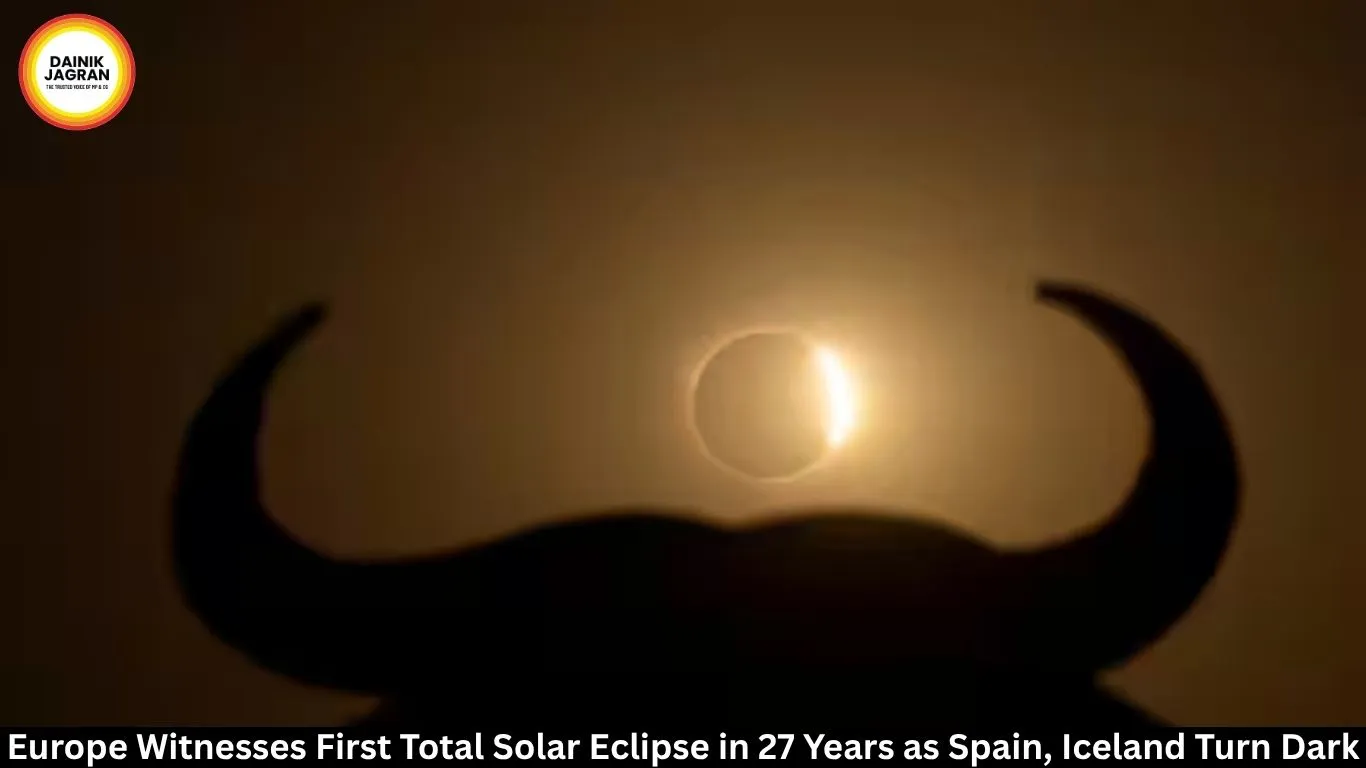
Spain and Iceland witnessed a rare total solar eclipse on August 12, marking Europe's first total eclipse in 27 years and drawing millions of spectators.
Millions of spectators across parts of Spain and Iceland looked to the skies on Wednesday as a rare total solar eclipsecrossed Europe, marking the continent’s first total solar eclipse in 27 years.
The August 12 eclipse drew large crowds to viewing locations, particularly across rural parts of Spain, where authorities had prepared special observation areas and deployed additional police personnel to manage the expected influx of visitors.
Spain Sees Spectacular Totality
In Spain, spectators gathered in locations along the eclipse path to witness the Moon completely cover the Sun. In Buitrago de Lozoya, north of Madrid, crowds reportedly cheered and applauded as daylight faded and the sky briefly turned dark.
The period of totality lasted for only around a minute in some locations, but the short spectacle produced dramatic changes in the appearance of the sky. Bright points known as Baily's beads, created by sunlight passing through valleys on the Moon's surface, were visible around the edge of the eclipsed Sun.
Photographers and astronomy enthusiasts also travelled to areas offering clearer views of the event.
Crowds Gather Across Rural Areas
Spain prepared extensively for the eclipse, with authorities expecting as many as 6 million visitors in areas along the path of totality, including northern parts of the country and the Balearic Islands.
Several rural communities used the event to attract tourists beyond Spain's traditional coastal destinations. Special viewing locations were established, while local authorities increased security and crowd-management measures.
The eclipse also brought together professional astronomers, amateur observers and tourists carrying telescopes and specialised cameras.
Iceland Gets a Cloudy View
Iceland also fell within the path of totality, although weather conditions made viewing more difficult.
Large parts of the country were covered by clouds, including areas around Reykjavik. However, breaks in the cloud cover in western Iceland allowed some observers to catch glimpses of the eclipse.
Even where the Sun itself was obscured, the sudden darkness associated with totality could still be experienced.
Brian May Among Eclipse Watchers
The eclipse attracted several well-known observers. Brian May, guitarist of the rock band Queen and an astronomy enthusiast, travelled to an observatory in Spain's Teruel province to watch the event.
May documented the experience on social media as the Moon moved across the Sun. Spectators at the site reportedly applauded and cheered as totality approached.
The presence of astronomy enthusiasts such as May added to the global attention surrounding an event that had been anticipated for years.
Rare Event for Europe
The eclipse was particularly significant because of its rarity. It was described as Europe's first total solar eclipse in 27 years.
The Iberian Peninsula had not experienced a total solar eclipse since 1912. However, the region will not have to wait another century for the next one.
Another total solar eclipse is expected on August 2, 2027, while an annular solar eclipse is due in January 2028. Together, the events have been described as part of an "Iberian Eclipse Trio".
A Major Tourism Opportunity
Beyond its astronomical significance, the eclipse provided Spain with an opportunity to promote lesser-known destinations.
Authorities and tourism bodies had encouraged visitors to travel to rural areas along the eclipse path, helping communities that typically receive fewer tourists than Spain's major beach destinations.
The event also became an occasion for special gatherings and celebrations, with some visitors reportedly choosing eclipse-viewing locations for weddings and other events.
For astronomers and the public alike, however, the main attraction remained the brief moment when the Moon completely blocked the Sun, transforming daytime into darkness across parts of Europe.

Europe Witnesses First Total Solar Eclipse in 27 Years in Spain, Iceland
Digital desk
Millions of spectators across parts of Spain and Iceland looked to the skies on Wednesday as a rare total solar eclipsecrossed Europe, marking the continent’s first total solar eclipse in 27 years.
The August 12 eclipse drew large crowds to viewing locations, particularly across rural parts of Spain, where authorities had prepared special observation areas and deployed additional police personnel to manage the expected influx of visitors.
Spain Sees Spectacular Totality
In Spain, spectators gathered in locations along the eclipse path to witness the Moon completely cover the Sun. In Buitrago de Lozoya, north of Madrid, crowds reportedly cheered and applauded as daylight faded and the sky briefly turned dark.
The period of totality lasted for only around a minute in some locations, but the short spectacle produced dramatic changes in the appearance of the sky. Bright points known as Baily's beads, created by sunlight passing through valleys on the Moon's surface, were visible around the edge of the eclipsed Sun.
Photographers and astronomy enthusiasts also travelled to areas offering clearer views of the event.
Crowds Gather Across Rural Areas
Spain prepared extensively for the eclipse, with authorities expecting as many as 6 million visitors in areas along the path of totality, including northern parts of the country and the Balearic Islands.
Several rural communities used the event to attract tourists beyond Spain's traditional coastal destinations. Special viewing locations were established, while local authorities increased security and crowd-management measures.
The eclipse also brought together professional astronomers, amateur observers and tourists carrying telescopes and specialised cameras.
Iceland Gets a Cloudy View
Iceland also fell within the path of totality, although weather conditions made viewing more difficult.
Large parts of the country were covered by clouds, including areas around Reykjavik. However, breaks in the cloud cover in western Iceland allowed some observers to catch glimpses of the eclipse.
Even where the Sun itself was obscured, the sudden darkness associated with totality could still be experienced.
Brian May Among Eclipse Watchers
The eclipse attracted several well-known observers. Brian May, guitarist of the rock band Queen and an astronomy enthusiast, travelled to an observatory in Spain's Teruel province to watch the event.
May documented the experience on social media as the Moon moved across the Sun. Spectators at the site reportedly applauded and cheered as totality approached.
The presence of astronomy enthusiasts such as May added to the global attention surrounding an event that had been anticipated for years.
Rare Event for Europe
The eclipse was particularly significant because of its rarity. It was described as Europe's first total solar eclipse in 27 years.
The Iberian Peninsula had not experienced a total solar eclipse since 1912. However, the region will not have to wait another century for the next one.
Another total solar eclipse is expected on August 2, 2027, while an annular solar eclipse is due in January 2028. Together, the events have been described as part of an "Iberian Eclipse Trio".
A Major Tourism Opportunity
Beyond its astronomical significance, the eclipse provided Spain with an opportunity to promote lesser-known destinations.
Authorities and tourism bodies had encouraged visitors to travel to rural areas along the eclipse path, helping communities that typically receive fewer tourists than Spain's major beach destinations.
The event also became an occasion for special gatherings and celebrations, with some visitors reportedly choosing eclipse-viewing locations for weddings and other events.
For astronomers and the public alike, however, the main attraction remained the brief moment when the Moon completely blocked the Sun, transforming daytime into darkness across parts of Europe.

Recommended For You
--------
🚨 Beat the News Rush – Join Now!
Get breaking alerts, hot exclusives, and game-changing stories instantly on your phone. No delays, no fluff – just the edge you need. ⚡
Tap to join:
🟢 WhatsApp Channel: Dainik Jagran MP CG
Crave more?
🅕 Facebook: Dainik Jagran MP CG English
🅧 Twitter (X): Dainik Jagran MP CG
🅘 Instagram: Dainik Jagran MP CG
Share the fire – keep your crew ahead! 🗞️🔥