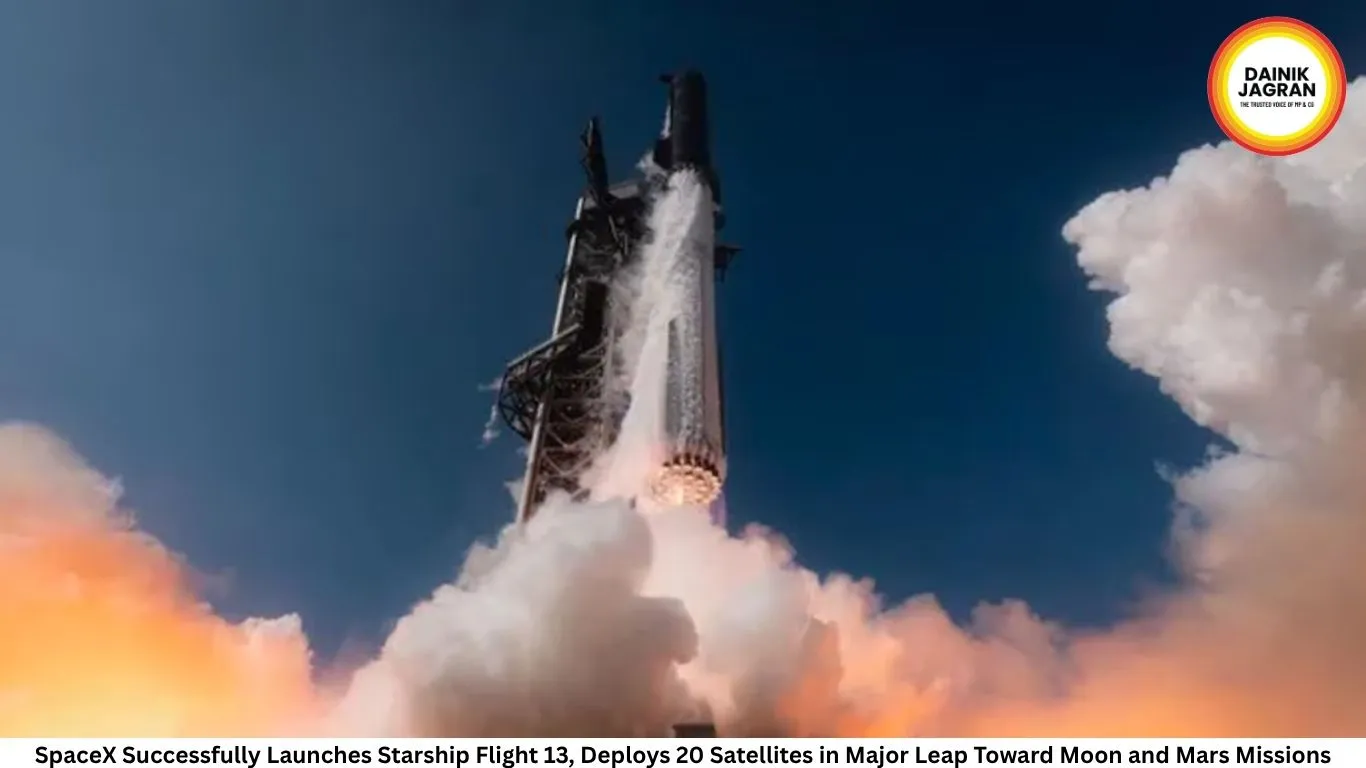
SpaceX Successfully Launches Starship Flight 13, Deploys 20 Satellites in Major Leap Toward Moon and Mars Missions

Digital Desk

SpaceX Successfully Launches Starship Flight 13, Deploys 20 Satellites in Major Leap Toward Moon and Mars Missions

SpaceX has successfully launched Starship Flight 13, deploying 20 next-generation Starlink V3 test satellites and achieving its first controlled water landing of the upper-stage spacecraft. The mission marks another major milestone in the company's quest to build a fully reusable rocket for future Moon and Mars exploration.

SpaceX has successfully completed the 13th integrated test flight of Starship, taking another significant step toward developing the world's first fully reusable launch system. The mission, known as Starship Flight 13, successfully deployed 20 next-generation Starlink V3 test satellites, achieved a controlled splashdown of the Starship spacecraft, and demonstrated major improvements over previous test flights.

The launch took place from Starbase, Texas, after multiple delays caused by engine issues and poor weather. Engineers replaced faulty Raptor engines following a failed launch attempt last week, paving the way for Friday's successful mission.

The test is considered one of SpaceX's most important achievements yet as it moves closer to supporting NASA's Artemis Moon program and the company's long-term ambition of sending humans to Mars.

Successful Launch After Earlier Setbacks

Flight 13 faced several challenges before liftoff.

The first launch attempt on July 17 was automatically aborted at the final countdown after four Raptor engines failed to ignite properly. Engineers later inspected and replaced the affected engines before rolling the massive rocket back to the launch pad.

A second attempt was delayed due to unfavorable weather conditions, pushing the launch back by another 24 hours.

When the countdown resumed on Friday, all 33 Raptor engines on the Super Heavy booster ignited successfully, producing nearly 18 million pounds of thrust and sending the world's most powerful rocket into the sky.

According to SpaceX Senior Director of Starship Launches Justin Steyer, the booster generated thrust comparable to "the world's largest machine gun firing 11 pickup trucks every second instead of bullets."

20 Starlink V3 Satellites Successfully Deployed

The highlight of Flight 13 was the successful deployment of 20 Starlink Version 3 test satellites, marking the first time Starship has carried this new generation of internet satellites into space.

SpaceX confirmed it established communication with all 20 satellites shortly after deployment.

Unlike operational Starlink satellites, these were test payloads placed on a suborbital trajectory. They remained in space for only about 20 minutes before safely burning up in Earth's atmosphere as planned.

The mission demonstrated that Starship can now function as a practical satellite launcher rather than only a test vehicle.

Why These Satellites Matter

Although the satellites were intentionally destroyed after completing their mission, they played a crucial role in testing technologies that will power SpaceX's future satellite network.

Among the key experiments:

  • Six satellites carried cameras to inspect Starship's heat shield from space and transmit detailed images back to Earth.
  • The satellites deployed solar panels and communication antennas before testing laser links with the existing Starlink network.
  • SpaceX also tested its new Pez dispenser-style deployment system, which ejects the flat satellites through a narrow opening in the spacecraft.

These experiments will help improve satellite deployment, communication systems, and spacecraft durability for future commercial missions.

Historic Water Landing for Starship

Another major achievement came during Starship's return to Earth.

After completing its mission, the spacecraft executed a controlled descent before performing its famous "belly-flop" maneuver. It then rotated into a vertical position and landed safely in the ocean.

According to SpaceX spokesperson Dan Huot, this marked the first time an entire Starship spacecraft successfully landed intact in water.

Following touchdown, the vehicle floated briefly before gradually tilting onto its side, providing valuable engineering data for future recovery operations.

Improved Booster Performance

The Super Heavy booster also showed major improvements compared to previous test flights.

Following stage separation through the hot-staging process approximately two minutes after launch, the booster executed a successful boostback burn using all 13 designated engines.

Although not every landing engine ignited during the final descent, the booster still achieved a controlled splashdown in the Gulf, demonstrating significant progress in SpaceX's reusable rocket technology.

The improvements addressed several engine synchronization issues that affected the previous Version 3 flight in May.

What Is Starship?

Starship is SpaceX's fully reusable launch system, designed to carry satellites, cargo, and eventually astronauts to destinations including the Moon and Mars.

The system consists of two reusable stages:

  • Super Heavy Booster – the first stage powered by 33 Raptor engines, responsible for lifting the rocket off the launch pad.
  • Starship Spacecraft – the upper stage designed to transport satellites, cargo, and future human crews.

Together, the vehicle can carry more payload than any rocket ever built.

Its fully reusable design is expected to dramatically reduce launch costs and make deep-space missions more frequent and affordable.

How Flight 13 Differs From Previous Missions

Unlike earlier Starship test flights, Flight 13 introduced several important firsts:

  • First deployment of 20 Starlink Version 3 satellites
  • First demonstration of Starship as an operational satellite launcher
  • First in-space inspection of the spacecraft's heat shield using onboard satellites
  • First successful deployment using the new satellite ejection mechanism
  • Improved engine reliability and flight stability following hardware and software upgrades

These achievements move Starship beyond simple flight testing and closer to operational missions.

A Step Closer to the Moon and Mars

SpaceX continues refining Starship's landing capabilities, but Flight 13 represents one of the company's most successful missions to date.

The successful satellite deployment, improved booster performance, and controlled splashdown demonstrate steady progress toward building a fully reusable launch system capable of supporting NASA's Artemis missions, launching large satellite constellations, and eventually transporting astronauts to Mars.

With each successful flight, SpaceX moves closer to transforming the future of space exploration.

--------

🚨 Beat the News Rush – Join Now!

Get breaking alerts, hot exclusives, and game-changing stories instantly on your phone. No delays, no fluff – just the edge you need. ⚡

Tap to join: 

🟢 WhatsApp Channel: Dainik Jagran MP CG

Crave more?

🅕 Facebook: Dainik Jagran MP CG English

🅧 Twitter (X): Dainik Jagran MP CG

🅘 Instagram: Dainik Jagran MP CG

Share the fire – keep your crew ahead! 🗞️🔥

english.dainikjagranmpcg.com
25 Jul 2026 By Rishita

SpaceX Successfully Launches Starship Flight 13, Deploys 20 Satellites in Major Leap Toward Moon and Mars Missions

Digital Desk

SpaceX has successfully completed the 13th integrated test flight of Starship, taking another significant step toward developing the world's first fully reusable launch system. The mission, known as Starship Flight 13, successfully deployed 20 next-generation Starlink V3 test satellites, achieved a controlled splashdown of the Starship spacecraft, and demonstrated major improvements over previous test flights.

The launch took place from Starbase, Texas, after multiple delays caused by engine issues and poor weather. Engineers replaced faulty Raptor engines following a failed launch attempt last week, paving the way for Friday's successful mission.

The test is considered one of SpaceX's most important achievements yet as it moves closer to supporting NASA's Artemis Moon program and the company's long-term ambition of sending humans to Mars.

Successful Launch After Earlier Setbacks

Flight 13 faced several challenges before liftoff.

The first launch attempt on July 17 was automatically aborted at the final countdown after four Raptor engines failed to ignite properly. Engineers later inspected and replaced the affected engines before rolling the massive rocket back to the launch pad.

A second attempt was delayed due to unfavorable weather conditions, pushing the launch back by another 24 hours.

When the countdown resumed on Friday, all 33 Raptor engines on the Super Heavy booster ignited successfully, producing nearly 18 million pounds of thrust and sending the world's most powerful rocket into the sky.

According to SpaceX Senior Director of Starship Launches Justin Steyer, the booster generated thrust comparable to "the world's largest machine gun firing 11 pickup trucks every second instead of bullets."

20 Starlink V3 Satellites Successfully Deployed

The highlight of Flight 13 was the successful deployment of 20 Starlink Version 3 test satellites, marking the first time Starship has carried this new generation of internet satellites into space.

SpaceX confirmed it established communication with all 20 satellites shortly after deployment.

Unlike operational Starlink satellites, these were test payloads placed on a suborbital trajectory. They remained in space for only about 20 minutes before safely burning up in Earth's atmosphere as planned.

The mission demonstrated that Starship can now function as a practical satellite launcher rather than only a test vehicle.

Why These Satellites Matter

Although the satellites were intentionally destroyed after completing their mission, they played a crucial role in testing technologies that will power SpaceX's future satellite network.

Among the key experiments:

  • Six satellites carried cameras to inspect Starship's heat shield from space and transmit detailed images back to Earth.
  • The satellites deployed solar panels and communication antennas before testing laser links with the existing Starlink network.
  • SpaceX also tested its new Pez dispenser-style deployment system, which ejects the flat satellites through a narrow opening in the spacecraft.

These experiments will help improve satellite deployment, communication systems, and spacecraft durability for future commercial missions.

Historic Water Landing for Starship

Another major achievement came during Starship's return to Earth.

After completing its mission, the spacecraft executed a controlled descent before performing its famous "belly-flop" maneuver. It then rotated into a vertical position and landed safely in the ocean.

According to SpaceX spokesperson Dan Huot, this marked the first time an entire Starship spacecraft successfully landed intact in water.

Following touchdown, the vehicle floated briefly before gradually tilting onto its side, providing valuable engineering data for future recovery operations.

Improved Booster Performance

The Super Heavy booster also showed major improvements compared to previous test flights.

Following stage separation through the hot-staging process approximately two minutes after launch, the booster executed a successful boostback burn using all 13 designated engines.

Although not every landing engine ignited during the final descent, the booster still achieved a controlled splashdown in the Gulf, demonstrating significant progress in SpaceX's reusable rocket technology.

The improvements addressed several engine synchronization issues that affected the previous Version 3 flight in May.

What Is Starship?

Starship is SpaceX's fully reusable launch system, designed to carry satellites, cargo, and eventually astronauts to destinations including the Moon and Mars.

The system consists of two reusable stages:

  • Super Heavy Booster – the first stage powered by 33 Raptor engines, responsible for lifting the rocket off the launch pad.
  • Starship Spacecraft – the upper stage designed to transport satellites, cargo, and future human crews.

Together, the vehicle can carry more payload than any rocket ever built.

Its fully reusable design is expected to dramatically reduce launch costs and make deep-space missions more frequent and affordable.

How Flight 13 Differs From Previous Missions

Unlike earlier Starship test flights, Flight 13 introduced several important firsts:

  • First deployment of 20 Starlink Version 3 satellites
  • First demonstration of Starship as an operational satellite launcher
  • First in-space inspection of the spacecraft's heat shield using onboard satellites
  • First successful deployment using the new satellite ejection mechanism
  • Improved engine reliability and flight stability following hardware and software upgrades

These achievements move Starship beyond simple flight testing and closer to operational missions.

A Step Closer to the Moon and Mars

SpaceX continues refining Starship's landing capabilities, but Flight 13 represents one of the company's most successful missions to date.

The successful satellite deployment, improved booster performance, and controlled splashdown demonstrate steady progress toward building a fully reusable launch system capable of supporting NASA's Artemis missions, launching large satellite constellations, and eventually transporting astronauts to Mars.

With each successful flight, SpaceX moves closer to transforming the future of space exploration.

https://english.dainikjagranmpcg.com/international/spacex-successfully-launches-starship-flight-13-deploys-20-satellites-in/article-23528

Trending News