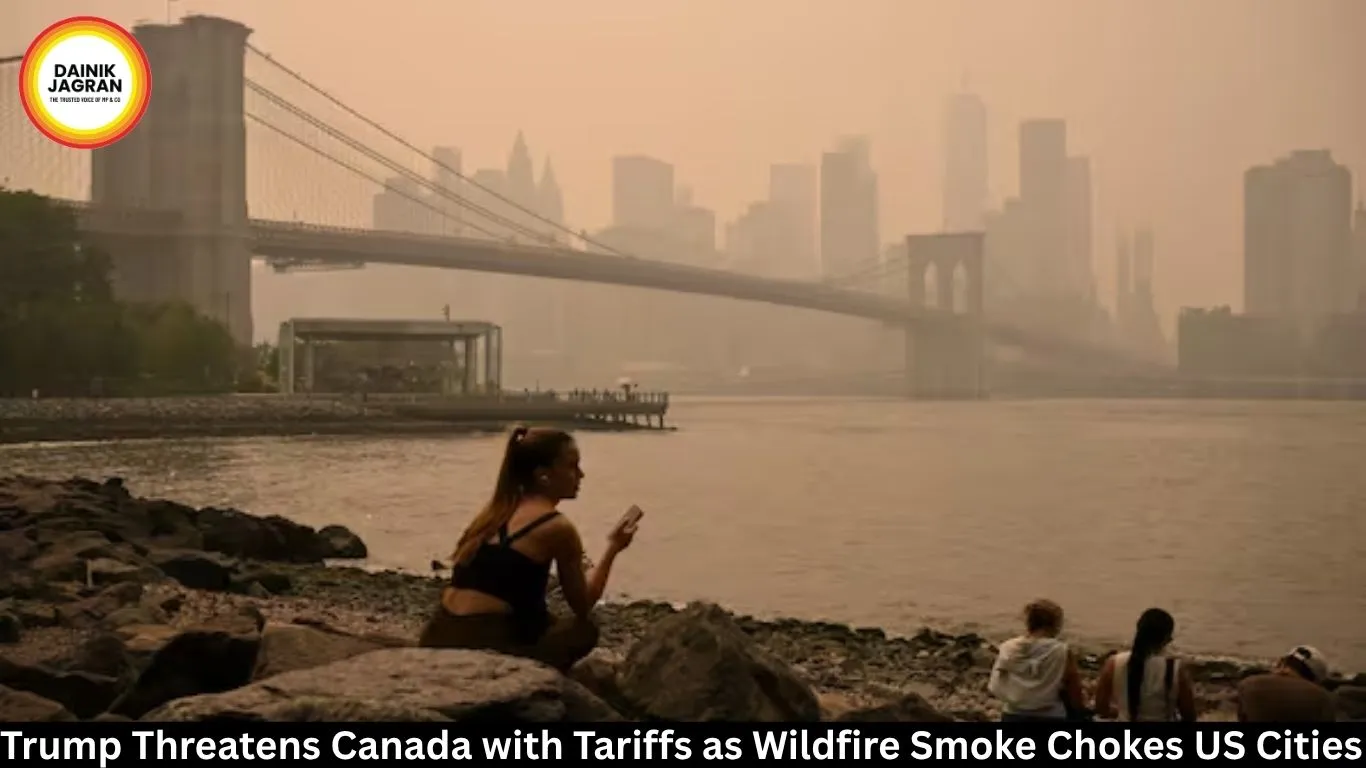
Trump Threatens Canada with Tariffs as Wildfire Smoke Worsens Air Quality in US

Digital Desk

Trump Threatens Canada with Tariffs as Wildfire Smoke Worsens Air Quality in US

US President Donald Trump has threatened new tariffs on Canada, accusing it of "willful negligence" as massive wildfires continue to send hazardous smoke across several American states.

US President Donald Trump has threatened to impose new tariffs on Canada, accusing Ottawa of "willful negligence" as massive wildfires continue to send thick smoke across the northern United States, worsening air quality in several major cities.

The remarks have added a political dimension to Canada's ongoing wildfire crisis, which has already become one of the country's most severe environmental emergencies this year.

Trump Blames Canada for Smoke Crisis

In a post on Truth Social, Trump claimed that the United States was being "unnecessarily invaded by filthy, polluted and unhealthy air" originating from Canada.

He alleged that Canadian authorities had failed to properly manage forests and brushlands, calling the situation an example of "willful negligence." Trump also said he was considering imposing fresh tariffs on Canadian goods and planned to speak with Canadian Prime Minister Mark Carney regarding the issue.

The comments came as dense wildfire smoke continued drifting across several US states, reducing visibility and triggering widespread air quality alerts.

Wildfires Continue to Rage Across Canada

According to the Canadian Wildland Fire Information System, nearly 900 wildfires remained active across Canada as of Friday, with a significant number classified as out of control.

Ontario has emerged as one of the worst-affected provinces, battling more than 190 active fires, many of which continue to spread despite extensive firefighting efforts.

Emergency crews have deployed aircraft, helicopters and thousands of firefighters, but prolonged dry weather and high temperatures have complicated containment operations.

US Cities Face Hazardous Air Quality

Smoke from the Canadian wildfires has spread across large parts of the northern and northeastern United States, prompting health advisories for millions of residents.

States including Minnesota, Wisconsin, Michigan and Illinois have experienced some of the poorest air quality levels in recent days. Smoke has also reached the East Coast, affecting cities such as New York.

Air quality monitoring platform IQAir ranked Chicago and Detroit among the world's most polluted cities during the peak of the smoke event, while authorities in Chicago temporarily closed public beaches because of hazardous conditions.

New York officials warned that fine particulate pollution had reached levels considered unhealthy for all residents, urging people to limit outdoor activities.

Canada Urges Cooperation, Not Criticism

Ontario Premier Doug Ford responded by calling on the United States to assist in battling the wildfires rather than criticising Canada.

He urged Washington to provide additional firefighting resources, describing the disaster as a shared North American challenge requiring cross-border cooperation.

Prime Minister Mark Carney had earlier stressed that climate change and increasingly severe wildfire seasons require joint efforts between Canada and the United States rather than political confrontation.

Canadian officials have not formally responded to Trump's tariff threat.

Political Debate Intensifies

Trump's comments have also reignited broader political debates surrounding US-Canada relations.

Some Republican lawmakers echoed calls for tougher measures against Canada, while others revived Trump's long-standing suggestion that Canada should become America's "51st state"—a proposal that has repeatedly drawn criticism from Canadian leaders and the public.

The wildfire crisis has already strained cross-border travel, disrupted outdoor activities and raised fresh concerns over climate resilience and emergency preparedness across North America.

Climate and Economic Concerns

Scientists have linked the severity of Canada's wildfire season to prolonged heat, below-average rainfall and dry forest conditions. Forecasts indicate that above-normal temperatures could continue through the coming weeks, increasing the risk of additional fires and prolonged smoke events.

With air quality deteriorating across both countries and the political rhetoric escalating, the crisis is increasingly becoming not only an environmental challenge but also a diplomatic issue between two of North America's closest allies.


 

--------

🚨 Beat the News Rush – Join Now!

Get breaking alerts, hot exclusives, and game-changing stories instantly on your phone. No delays, no fluff – just the edge you need. ⚡

Tap to join: 

🟢 WhatsApp Channel: Dainik Jagran MP CG

Crave more?

🅕 Facebook: Dainik Jagran MP CG English

🅧 Twitter (X): Dainik Jagran MP CG

🅘 Instagram: Dainik Jagran MP CG

Share the fire – keep your crew ahead! 🗞️🔥

english.dainikjagranmpcg.com
18 Jul 2026 By Abhishek Joshi

Trump Threatens Canada with Tariffs as Wildfire Smoke Worsens Air Quality in US

Digital Desk

US President Donald Trump has threatened to impose new tariffs on Canada, accusing Ottawa of "willful negligence" as massive wildfires continue to send thick smoke across the northern United States, worsening air quality in several major cities.

The remarks have added a political dimension to Canada's ongoing wildfire crisis, which has already become one of the country's most severe environmental emergencies this year.

Trump Blames Canada for Smoke Crisis

In a post on Truth Social, Trump claimed that the United States was being "unnecessarily invaded by filthy, polluted and unhealthy air" originating from Canada.

He alleged that Canadian authorities had failed to properly manage forests and brushlands, calling the situation an example of "willful negligence." Trump also said he was considering imposing fresh tariffs on Canadian goods and planned to speak with Canadian Prime Minister Mark Carney regarding the issue.

The comments came as dense wildfire smoke continued drifting across several US states, reducing visibility and triggering widespread air quality alerts.

Wildfires Continue to Rage Across Canada

According to the Canadian Wildland Fire Information System, nearly 900 wildfires remained active across Canada as of Friday, with a significant number classified as out of control.

Ontario has emerged as one of the worst-affected provinces, battling more than 190 active fires, many of which continue to spread despite extensive firefighting efforts.

Emergency crews have deployed aircraft, helicopters and thousands of firefighters, but prolonged dry weather and high temperatures have complicated containment operations.

US Cities Face Hazardous Air Quality

Smoke from the Canadian wildfires has spread across large parts of the northern and northeastern United States, prompting health advisories for millions of residents.

States including Minnesota, Wisconsin, Michigan and Illinois have experienced some of the poorest air quality levels in recent days. Smoke has also reached the East Coast, affecting cities such as New York.

Air quality monitoring platform IQAir ranked Chicago and Detroit among the world's most polluted cities during the peak of the smoke event, while authorities in Chicago temporarily closed public beaches because of hazardous conditions.

New York officials warned that fine particulate pollution had reached levels considered unhealthy for all residents, urging people to limit outdoor activities.

Canada Urges Cooperation, Not Criticism

Ontario Premier Doug Ford responded by calling on the United States to assist in battling the wildfires rather than criticising Canada.

He urged Washington to provide additional firefighting resources, describing the disaster as a shared North American challenge requiring cross-border cooperation.

Prime Minister Mark Carney had earlier stressed that climate change and increasingly severe wildfire seasons require joint efforts between Canada and the United States rather than political confrontation.

Canadian officials have not formally responded to Trump's tariff threat.

Political Debate Intensifies

Trump's comments have also reignited broader political debates surrounding US-Canada relations.

Some Republican lawmakers echoed calls for tougher measures against Canada, while others revived Trump's long-standing suggestion that Canada should become America's "51st state"—a proposal that has repeatedly drawn criticism from Canadian leaders and the public.

The wildfire crisis has already strained cross-border travel, disrupted outdoor activities and raised fresh concerns over climate resilience and emergency preparedness across North America.

Climate and Economic Concerns

Scientists have linked the severity of Canada's wildfire season to prolonged heat, below-average rainfall and dry forest conditions. Forecasts indicate that above-normal temperatures could continue through the coming weeks, increasing the risk of additional fires and prolonged smoke events.

With air quality deteriorating across both countries and the political rhetoric escalating, the crisis is increasingly becoming not only an environmental challenge but also a diplomatic issue between two of North America's closest allies.


https://english.dainikjagranmpcg.com/international/trump-threatens-canada-with-tariffs-as-wildfire-smoke-worsens-air/article-22691

Trending News