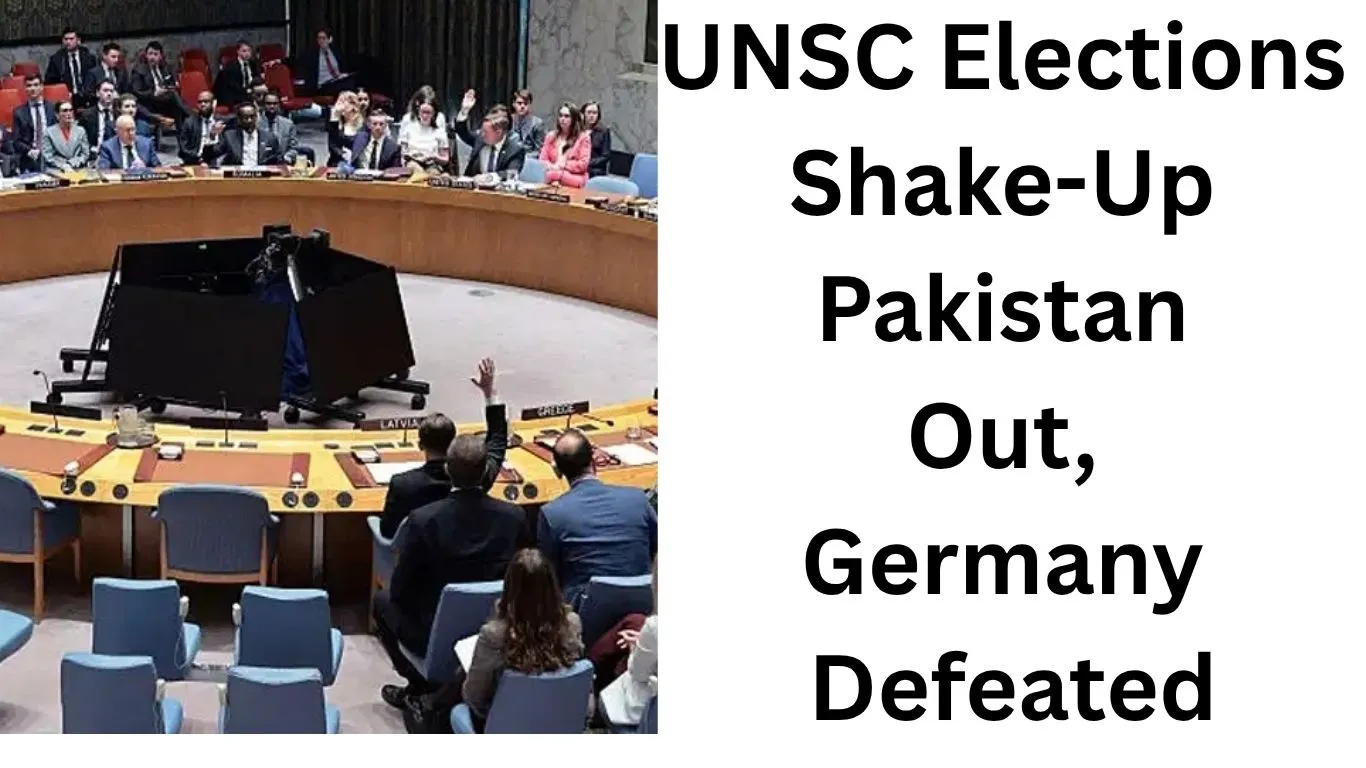
UN Security Council Elections Bring Major Shake-Up: Pakistan Out, Germany Defeated, US Faces Diplomatic Setback

United Nations

UN Security Council Elections Bring Major Shake-Up: Pakistan Out, Germany Defeated, US Faces Diplomatic Setback

The latest elections to the United Nations Security Council (UNSC) have resulted in significant geopolitical shifts, with Kyrgyzstan emerging as a surprise entrant, Germany suffering an unexpected defeat, and the United States facing a diplomatic setback linked to the loss of its strategic ally, the Philippines. The United Nations General Assembly (UNGA) elected five new non-permanent members for the 2027–2028 term in a closely watched vote that has reshaped the composition of the global security body.

The newly elected members include Austria, Kyrgyzstan, Portugal, Trinidad and Tobago, and Zimbabwe. These countries will begin their two-year term on January 1, 2027, replacing outgoing members and joining the ongoing rotating membership system of the Council.

One of the most notable changes is Pakistan’s exit from the Council. Pakistan had served as a non-permanent member for the 2025–2026 term and had previously held influential roles, including chairing the Taliban Sanctions Committee in 2025 and serving as vice-chair of the Counter-Terrorism Committee. Its term will officially end on December 31, 2026. Kyrgyzstan will now represent the Asia-Pacific group in its place, marking its first-ever entry into the UNSC.

Kyrgyzstan’s election is being seen as a significant development in regional representation. In a competitive vote that went through multiple rounds, Kyrgyzstan secured 142 votes, comfortably crossing the required two-thirds majority, while the Philippines received 49 votes. The outcome reflects shifting diplomatic alignments within the UN system.

Perhaps the most surprising outcome was Germany’s failure to secure a seat. Competing for two Western European seats alongside Austria and Portugal, Germany managed to secure only 104 votes, while Portugal received 134 votes and Austria 131 votes, resulting in Germany’s unexpected defeat. This marks the first time in years that Germany has failed to secure a non-permanent seat, despite having served on the Council six times previously.

The result has sparked political debate in Berlin, with German Chancellor Friedrich Merz calling it a diplomatic setback. Analysts suggest that Germany’s positions on key global conflicts, including the Israel situation and the US-Iran tensions, may have influenced voting patterns among member states. Interestingly, the election process was presided over by Germany’s former foreign minister Annalena Baerbock, who currently serves as President of the UN General Assembly.

The United States also faces an indirect setback following the Philippines’ loss to Kyrgyzstan. Washington has long viewed the Philippines as a key strategic partner in the Indo-Pacific region, particularly in balancing China’s growing influence. The defeat is being interpreted by analysts as a signal of shifting regional alignments and reduced coordination effectiveness for US-backed diplomatic efforts within the UN framework.

In other regional outcomes, Zimbabwe was elected unopposed from the African group, replacing Somalia, while Trinidad and Tobago secured the Latin America and Caribbean seat, replacing Panama. Austria and Portugal will replace Denmark and Greece in the Western European group. These newly elected members will join the current Council alongside Bahrain, Colombia, the Republic of the Congo, Latvia, and Liberia, forming the next rotating composition of the 15-member body.

The elections come at a time when the Security Council continues to face major global challenges, including ongoing conflicts in Ukraine and the Middle East. Growing rivalry among major powers has increasingly complicated decision-making within the Council, raising questions about its effectiveness in maintaining international peace and security.

The UNSC remains the most powerful body within the United Nations system, responsible for authorizing sanctions, peacekeeping missions, and military actions. It consists of five permanent members—the United States, Russia, China, France, and the United Kingdom—all of whom hold veto power. The remaining ten non-permanent members are elected for two-year terms based on regional representation, ensuring rotation among Africa, Asia-Pacific, Latin America, Western Europe, and Eastern Europe.


--------

🚨 Beat the News Rush – Join Now!

Get breaking alerts, hot exclusives, and game-changing stories instantly on your phone. No delays, no fluff – just the edge you need. ⚡

Tap to join: 

🟢 WhatsApp Channel: Dainik Jagran MP CG

Crave more?

🅕 Facebook: Dainik Jagran MP CG English

🅧 Twitter (X): Dainik Jagran MP CG

🅘 Instagram: Dainik Jagran MP CG

Share the fire – keep your crew ahead! 🗞️🔥

english.dainikjagranmpcg.com
04 Jun 2026 By Danik Jagran English

UN Security Council Elections Bring Major Shake-Up: Pakistan Out, Germany Defeated, US Faces Diplomatic Setback

United Nations

The latest elections to the United Nations Security Council (UNSC) have resulted in significant geopolitical shifts, with Kyrgyzstan emerging as a surprise entrant, Germany suffering an unexpected defeat, and the United States facing a diplomatic setback linked to the loss of its strategic ally, the Philippines. The United Nations General Assembly (UNGA) elected five new non-permanent members for the 2027–2028 term in a closely watched vote that has reshaped the composition of the global security body.

The newly elected members include Austria, Kyrgyzstan, Portugal, Trinidad and Tobago, and Zimbabwe. These countries will begin their two-year term on January 1, 2027, replacing outgoing members and joining the ongoing rotating membership system of the Council.

One of the most notable changes is Pakistan’s exit from the Council. Pakistan had served as a non-permanent member for the 2025–2026 term and had previously held influential roles, including chairing the Taliban Sanctions Committee in 2025 and serving as vice-chair of the Counter-Terrorism Committee. Its term will officially end on December 31, 2026. Kyrgyzstan will now represent the Asia-Pacific group in its place, marking its first-ever entry into the UNSC.

Kyrgyzstan’s election is being seen as a significant development in regional representation. In a competitive vote that went through multiple rounds, Kyrgyzstan secured 142 votes, comfortably crossing the required two-thirds majority, while the Philippines received 49 votes. The outcome reflects shifting diplomatic alignments within the UN system.

Perhaps the most surprising outcome was Germany’s failure to secure a seat. Competing for two Western European seats alongside Austria and Portugal, Germany managed to secure only 104 votes, while Portugal received 134 votes and Austria 131 votes, resulting in Germany’s unexpected defeat. This marks the first time in years that Germany has failed to secure a non-permanent seat, despite having served on the Council six times previously.

The result has sparked political debate in Berlin, with German Chancellor Friedrich Merz calling it a diplomatic setback. Analysts suggest that Germany’s positions on key global conflicts, including the Israel situation and the US-Iran tensions, may have influenced voting patterns among member states. Interestingly, the election process was presided over by Germany’s former foreign minister Annalena Baerbock, who currently serves as President of the UN General Assembly.

The United States also faces an indirect setback following the Philippines’ loss to Kyrgyzstan. Washington has long viewed the Philippines as a key strategic partner in the Indo-Pacific region, particularly in balancing China’s growing influence. The defeat is being interpreted by analysts as a signal of shifting regional alignments and reduced coordination effectiveness for US-backed diplomatic efforts within the UN framework.

In other regional outcomes, Zimbabwe was elected unopposed from the African group, replacing Somalia, while Trinidad and Tobago secured the Latin America and Caribbean seat, replacing Panama. Austria and Portugal will replace Denmark and Greece in the Western European group. These newly elected members will join the current Council alongside Bahrain, Colombia, the Republic of the Congo, Latvia, and Liberia, forming the next rotating composition of the 15-member body.

The elections come at a time when the Security Council continues to face major global challenges, including ongoing conflicts in Ukraine and the Middle East. Growing rivalry among major powers has increasingly complicated decision-making within the Council, raising questions about its effectiveness in maintaining international peace and security.

The UNSC remains the most powerful body within the United Nations system, responsible for authorizing sanctions, peacekeeping missions, and military actions. It consists of five permanent members—the United States, Russia, China, France, and the United Kingdom—all of whom hold veto power. The remaining ten non-permanent members are elected for two-year terms based on regional representation, ensuring rotation among Africa, Asia-Pacific, Latin America, Western Europe, and Eastern Europe.

https://english.dainikjagranmpcg.com/international/un-security-council-elections-bring-major-shake-up-pakistan-out-germany/article-19694
Tags:

Latest News