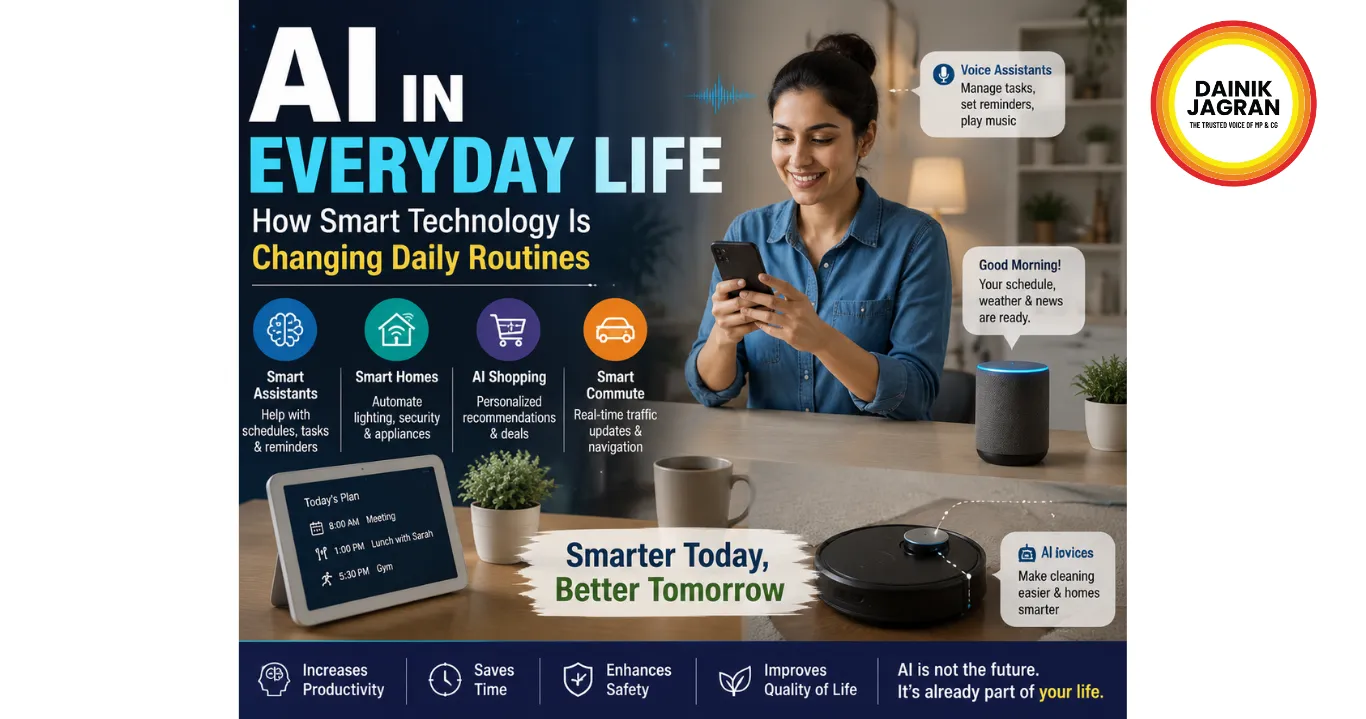
AI in Everyday Life: How Smart Technology Is Changing Daily Routines

Digital Desk

AI in Everyday Life: How Smart Technology Is Changing Daily Routines

Artificial intelligence is steadily moving beyond research labs and workplaces into homes, smartphones and daily routines, transforming the way millions of people manage everyday tasks. From AI-powered personal assistants and smart home devices to productivity applications that organise schedules and automate repetitive work, the technology is becoming an increasingly common part of modern life.

The shift has accelerated over the past few years as technology companies have integrated AI into consumer products designed to save time, improve convenience and personalise user experiences. Industry analysts say consumers are now interacting with artificial intelligence more frequently than many realise, often through devices and apps they already use every day.

Voice-enabled smart speakers, intelligent security systems, robot vacuum cleaners and connected home appliances are among the most visible examples of AI adoption. These devices can learn user preferences, automate household routines and respond to voice commands, allowing users to control lighting, temperature, entertainment systems and even home security with minimal effort.

Outside the home, AI-powered personal assistants are helping users manage calendars, send reminders, summarise emails and provide real-time navigation. Productivity applications equipped with artificial intelligence can now organise meetings, draft documents, analyse data and automate routine administrative tasks, reducing the amount of manual work required in both personal and professional settings.

Businesses have also embraced AI-driven tools to improve workplace efficiency. Employees increasingly rely on intelligent software to generate reports, transcribe meetings, organise projects and streamline communication. Technology experts say automation is enabling workers to focus on higher-value tasks while reducing time spent on repetitive processes.

The growing use of AI has also influenced consumer behaviour. Streaming platforms recommend movies and music based on viewing habits, shopping websites personalise product suggestions and financial applications monitor spending patterns to offer budgeting insights. These personalised services have become a major factor behind the widespread acceptance of artificial intelligence in everyday life.

Health and wellness technologies are another area seeing rapid adoption. Smartwatches and fitness applications use AI to analyse activity levels, sleep quality and heart rate patterns, providing users with personalised recommendations to support healthier lifestyles. Some digital health platforms also assist with medication reminders and wellness tracking, although medical experts stress that such tools should complement, not replace, professional healthcare.

While the benefits are significant, privacy and data security remain central concerns. AI-powered services often rely on large volumes of personal information to deliver personalised experiences. Cybersecurity specialists advise users to carefully review privacy settings, understand how their data is collected and shared, and regularly update passwords and software to reduce potential risks.

Digital rights advocates have also raised questions about transparency and accountability. As AI systems become more capable of making recommendations and automated decisions, experts say companies must ensure that algorithms operate fairly and responsibly. Governments in several countries are reviewing regulatory frameworks aimed at improving consumer protection while encouraging technological innovation.

The rapid expansion of generative AI has further changed public perception of the technology. Tools capable of creating text, images, presentations and software code are increasingly being used by students, professionals, content creators and small businesses. Industry observers believe these applications will continue to reshape education, customer service and knowledge-based professions in the coming years.

Despite concerns over privacy and automation, technology researchers say artificial intelligence is likely to become even more deeply integrated into daily life. Future developments are expected to focus on smarter home ecosystems, improved language translation, personalised education, enhanced accessibility tools and more efficient digital services.

For consumers, the challenge is no longer whether to use AI, but how to use it responsibly. As smart technology continues to evolve, balancing convenience with privacy and maintaining human oversight will remain key to ensuring that artificial intelligence improves quality of life without compromising personal security.


--------

🚨 Beat the News Rush – Join Now!

Get breaking alerts, hot exclusives, and game-changing stories instantly on your phone. No delays, no fluff – just the edge you need. ⚡

Tap to join: 

🟢 WhatsApp Channel: Dainik Jagran MP CG

Crave more?

🅕 Facebook: Dainik Jagran MP CG English

🅧 Twitter (X): Dainik Jagran MP CG

🅘 Instagram: Dainik Jagran MP CG

Share the fire – keep your crew ahead! 🗞️🔥

english.dainikjagranmpcg.com
23 Jul 2026 By Priyanshu.Jha

AI in Everyday Life: How Smart Technology Is Changing Daily Routines

Digital Desk

The shift has accelerated over the past few years as technology companies have integrated AI into consumer products designed to save time, improve convenience and personalise user experiences. Industry analysts say consumers are now interacting with artificial intelligence more frequently than many realise, often through devices and apps they already use every day.

Voice-enabled smart speakers, intelligent security systems, robot vacuum cleaners and connected home appliances are among the most visible examples of AI adoption. These devices can learn user preferences, automate household routines and respond to voice commands, allowing users to control lighting, temperature, entertainment systems and even home security with minimal effort.

Outside the home, AI-powered personal assistants are helping users manage calendars, send reminders, summarise emails and provide real-time navigation. Productivity applications equipped with artificial intelligence can now organise meetings, draft documents, analyse data and automate routine administrative tasks, reducing the amount of manual work required in both personal and professional settings.

Businesses have also embraced AI-driven tools to improve workplace efficiency. Employees increasingly rely on intelligent software to generate reports, transcribe meetings, organise projects and streamline communication. Technology experts say automation is enabling workers to focus on higher-value tasks while reducing time spent on repetitive processes.

The growing use of AI has also influenced consumer behaviour. Streaming platforms recommend movies and music based on viewing habits, shopping websites personalise product suggestions and financial applications monitor spending patterns to offer budgeting insights. These personalised services have become a major factor behind the widespread acceptance of artificial intelligence in everyday life.

Health and wellness technologies are another area seeing rapid adoption. Smartwatches and fitness applications use AI to analyse activity levels, sleep quality and heart rate patterns, providing users with personalised recommendations to support healthier lifestyles. Some digital health platforms also assist with medication reminders and wellness tracking, although medical experts stress that such tools should complement, not replace, professional healthcare.

While the benefits are significant, privacy and data security remain central concerns. AI-powered services often rely on large volumes of personal information to deliver personalised experiences. Cybersecurity specialists advise users to carefully review privacy settings, understand how their data is collected and shared, and regularly update passwords and software to reduce potential risks.

Digital rights advocates have also raised questions about transparency and accountability. As AI systems become more capable of making recommendations and automated decisions, experts say companies must ensure that algorithms operate fairly and responsibly. Governments in several countries are reviewing regulatory frameworks aimed at improving consumer protection while encouraging technological innovation.

The rapid expansion of generative AI has further changed public perception of the technology. Tools capable of creating text, images, presentations and software code are increasingly being used by students, professionals, content creators and small businesses. Industry observers believe these applications will continue to reshape education, customer service and knowledge-based professions in the coming years.

Despite concerns over privacy and automation, technology researchers say artificial intelligence is likely to become even more deeply integrated into daily life. Future developments are expected to focus on smarter home ecosystems, improved language translation, personalised education, enhanced accessibility tools and more efficient digital services.

For consumers, the challenge is no longer whether to use AI, but how to use it responsibly. As smart technology continues to evolve, balancing convenience with privacy and maintaining human oversight will remain key to ensuring that artificial intelligence improves quality of life without compromising personal security.

https://english.dainikjagranmpcg.com/life-style/ai-in-everyday-life-how-smart-technology-is-changing-daily/article-23275

Related Posts

Trending News