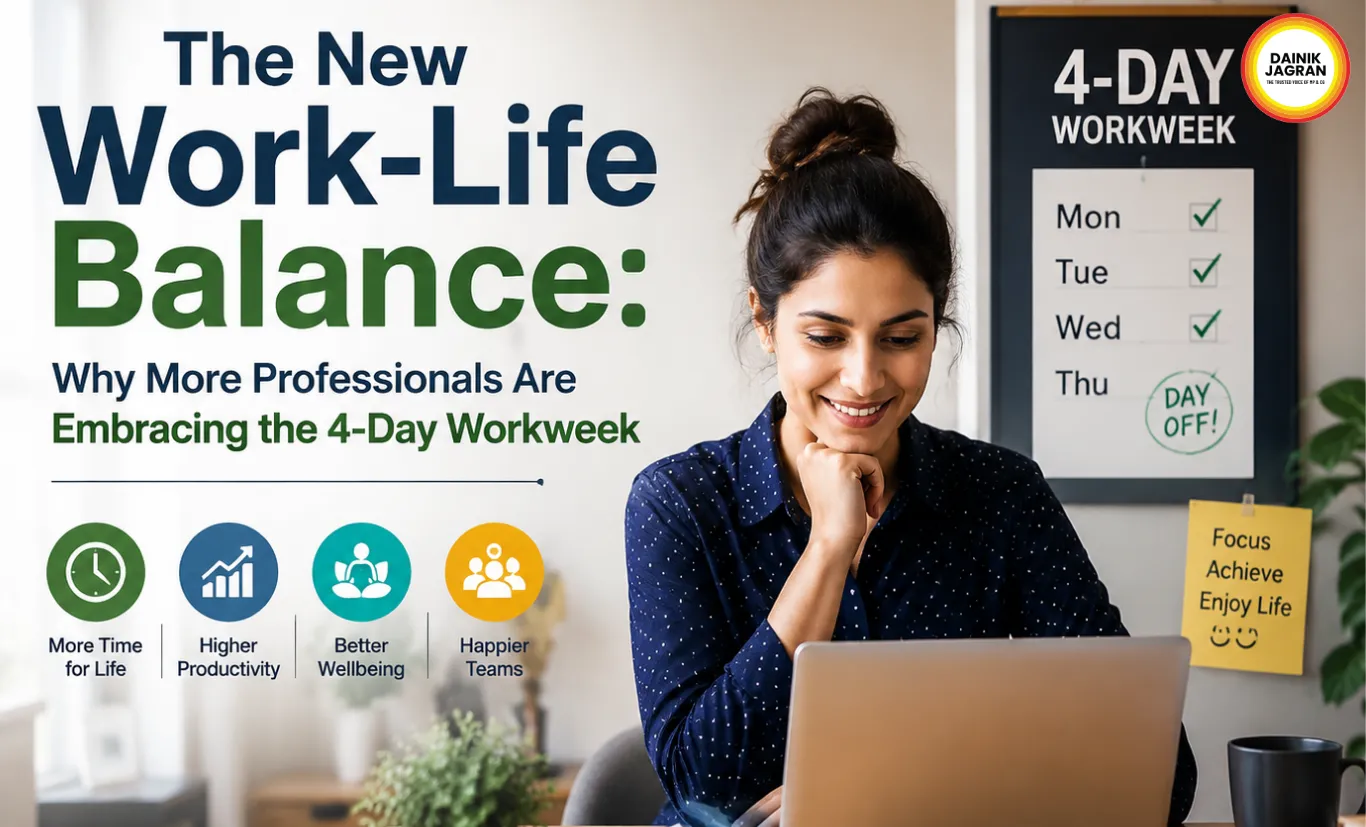
The New Work-Life Balance: Why More Professionals Are Embracing the 4-Day Workweek

Digital Desk

The New Work-Life Balance: Why More Professionals Are Embracing the 4-Day Workweek

A growing number of companies across the world are experimenting with the 4-day workweek, reflecting a broader shift in how employers and employees define productivity, workplace flexibility and overall well-being. Once viewed as an unconventional idea, the shorter workweek is increasingly being adopted by businesses looking to improve employee satisfaction while maintaining operational efficiency.

The trend comes as organisations continue to reassess workplace policies shaped by the pandemic, remote work and changing employee expectations. Human resource experts say professionals today are placing greater value on work-life balance than traditional workplace perks, prompting employers to rethink the standard five-day schedule.

Several businesses in Europe, North America, Asia and parts of Oceania have either completed pilot programmes or permanently introduced four-day work models. While approaches differ, most companies adopting the system expect employees to complete their weekly responsibilities within fewer working days without reducing salaries.

The primary objective is not simply to reduce working hours but to improve efficiency. Organisations participating in pilot programmes have reported that streamlined meetings, fewer workplace distractions and better time management often help employees maintain productivity despite working fewer days. However, results vary depending on the industry and the nature of the work.

The discussion around flexible work has also gained momentum in India, where companies across the technology, startup and creative sectors continue to explore hybrid schedules and employee-friendly workplace policies. Although the traditional five-day workweek remains the norm for most organisations, industry experts believe flexibility has become a key factor in attracting and retaining skilled professionals.

Mental health has emerged as one of the biggest drivers behind the global conversation. Workplace researchers have repeatedly highlighted rising levels of stress, burnout and fatigue among employees balancing demanding jobs with personal responsibilities. A longer weekend, supporters argue, gives workers more time to recover, spend time with family, pursue hobbies and attend to personal commitments without affecting annual leave.

Employers also see potential business benefits. Companies competing for talent increasingly recognise flexible work arrangements as an important recruitment tool, particularly among younger professionals. Millennials and Generation Z workers often rank workplace flexibility alongside salary, career growth and organisational culture when evaluating job opportunities.

The hospitality, healthcare, manufacturing and retail sectors, however, continue to face challenges in adopting shorter workweeks. Businesses that rely on continuous operations often require staggered shifts or additional staffing, making a universal four-day schedule difficult to implement. Industry analysts say any transition requires careful planning to ensure customer service and productivity are not affected.

Technology has played a significant role in making flexible work arrangements more practical. Cloud-based collaboration platforms, digital communication tools and automation have enabled teams to remain connected regardless of location, reducing dependence on conventional office schedules. Many employers now focus more on outcomes and performance than the number of hours employees spend at their desks.

Labour economists caution that a four-day workweek is not a one-size-fits-all solution. The success of such policies depends on organisational culture, workload distribution and employee expectations. In some industries, compressed workweeks may result in longer daily hours, which may not suit every worker.

At the same time, businesses introducing flexible schedules are monitoring their long-term impact on productivity, employee retention and operational costs. Many companies continue to review internal data before deciding whether shorter workweeks should become permanent.

The broader workplace transformation is also influencing public policy discussions in several countries, where governments, labour groups and business organisations are examining the economic implications of reduced working hours. While no universal model has emerged, the conversation signals a wider reassessment of how work is organised in the modern economy.

As organisations compete for talent in an evolving labour market, the emphasis is gradually shifting from measuring time spent at work to measuring results. For many professionals, the four-day workweek represents more than an additional day off—it reflects changing expectations around healthier careers, improved mental well-being and a more sustainable approach to work.


--------

🚨 Beat the News Rush – Join Now!

Get breaking alerts, hot exclusives, and game-changing stories instantly on your phone. No delays, no fluff – just the edge you need. ⚡

Tap to join: 

🟢 WhatsApp Channel: Dainik Jagran MP CG

Crave more?

🅕 Facebook: Dainik Jagran MP CG English

🅧 Twitter (X): Dainik Jagran MP CG

🅘 Instagram: Dainik Jagran MP CG

Share the fire – keep your crew ahead! 🗞️🔥

english.dainikjagranmpcg.com
23 Jul 2026 By Priyanshu.Jha

The New Work-Life Balance: Why More Professionals Are Embracing the 4-Day Workweek

Digital Desk

The trend comes as organisations continue to reassess workplace policies shaped by the pandemic, remote work and changing employee expectations. Human resource experts say professionals today are placing greater value on work-life balance than traditional workplace perks, prompting employers to rethink the standard five-day schedule.

Several businesses in Europe, North America, Asia and parts of Oceania have either completed pilot programmes or permanently introduced four-day work models. While approaches differ, most companies adopting the system expect employees to complete their weekly responsibilities within fewer working days without reducing salaries.

The primary objective is not simply to reduce working hours but to improve efficiency. Organisations participating in pilot programmes have reported that streamlined meetings, fewer workplace distractions and better time management often help employees maintain productivity despite working fewer days. However, results vary depending on the industry and the nature of the work.

The discussion around flexible work has also gained momentum in India, where companies across the technology, startup and creative sectors continue to explore hybrid schedules and employee-friendly workplace policies. Although the traditional five-day workweek remains the norm for most organisations, industry experts believe flexibility has become a key factor in attracting and retaining skilled professionals.

Mental health has emerged as one of the biggest drivers behind the global conversation. Workplace researchers have repeatedly highlighted rising levels of stress, burnout and fatigue among employees balancing demanding jobs with personal responsibilities. A longer weekend, supporters argue, gives workers more time to recover, spend time with family, pursue hobbies and attend to personal commitments without affecting annual leave.

Employers also see potential business benefits. Companies competing for talent increasingly recognise flexible work arrangements as an important recruitment tool, particularly among younger professionals. Millennials and Generation Z workers often rank workplace flexibility alongside salary, career growth and organisational culture when evaluating job opportunities.

The hospitality, healthcare, manufacturing and retail sectors, however, continue to face challenges in adopting shorter workweeks. Businesses that rely on continuous operations often require staggered shifts or additional staffing, making a universal four-day schedule difficult to implement. Industry analysts say any transition requires careful planning to ensure customer service and productivity are not affected.

Technology has played a significant role in making flexible work arrangements more practical. Cloud-based collaboration platforms, digital communication tools and automation have enabled teams to remain connected regardless of location, reducing dependence on conventional office schedules. Many employers now focus more on outcomes and performance than the number of hours employees spend at their desks.

Labour economists caution that a four-day workweek is not a one-size-fits-all solution. The success of such policies depends on organisational culture, workload distribution and employee expectations. In some industries, compressed workweeks may result in longer daily hours, which may not suit every worker.

At the same time, businesses introducing flexible schedules are monitoring their long-term impact on productivity, employee retention and operational costs. Many companies continue to review internal data before deciding whether shorter workweeks should become permanent.

The broader workplace transformation is also influencing public policy discussions in several countries, where governments, labour groups and business organisations are examining the economic implications of reduced working hours. While no universal model has emerged, the conversation signals a wider reassessment of how work is organised in the modern economy.

As organisations compete for talent in an evolving labour market, the emphasis is gradually shifting from measuring time spent at work to measuring results. For many professionals, the four-day workweek represents more than an additional day off—it reflects changing expectations around healthier careers, improved mental well-being and a more sustainable approach to work.

https://english.dainikjagranmpcg.com/life-style/the-new-work-life-balance-why-more-professionals-are-embracing-the/article-23265

Related Posts

Trending News