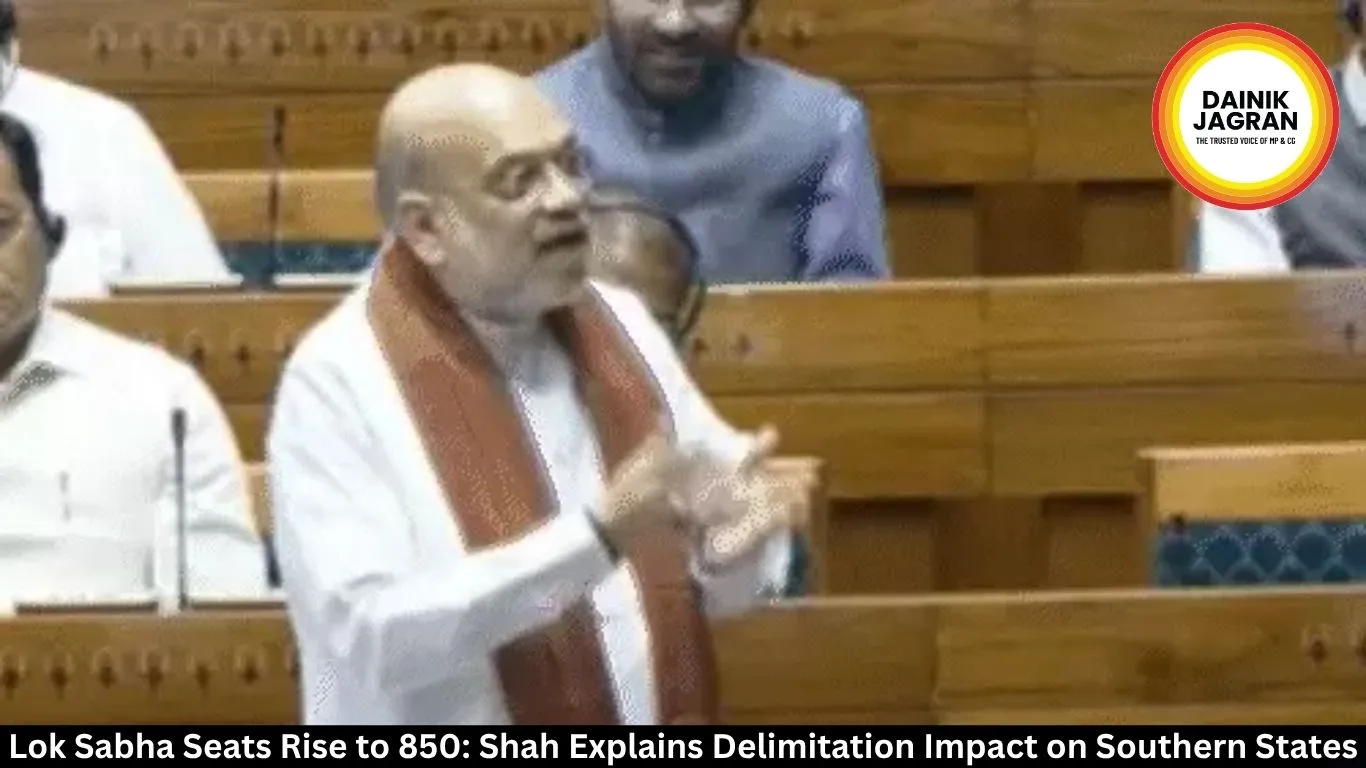
Lok Sabha Seats Rise to 850: Shah Explains Delimitation Impact on Southern States
Digital Desk
Home Minister Amit Shah explains how Lok Sabha seats will increase from 543 to 850 through delimitation. Southern states' representation rises from 129 to 195 seats. Read the detailed parliamentary analysis.
DELIMITATION BILL: HOW LOK SABHA SEATS WILL RISE TO 850, SOUTHERN STATES TO GAIN 66 NEW SEATS
Home Minister Amit Shah clarifies delimitation process; southern states' representation to increase from 129 to 195 seats despite Opposition concerns over fairness
Home Minister Amit Shah on Thursday provided detailed explanations on delimitation and the proposed increase in Lok Sabha seats from 543 to 850 during parliamentary discussion on women's reservation amendment bills. Rejecting Opposition allegations that delimitation would disadvantage southern states, Shah demonstrated mathematically how the 50% seat increase would benefit every state proportionally, including Tamil Nadu, Kerala, Telangana, and Andhra Pradesh. The clarification came as Congress and DMK raised concerns that the constitutional amendment masked a "backdoor delimitation" strategy favouring northern states.
The Mathematics Behind 850 Seats
Shah broke down the delimitation logic during the parliamentary debate. He explained that with 543 current seats and 33% women's reservation, a 50% seat increase would bring the total to approximately 816—rounded to 850 for administrative purposes. The key point Shah emphasised was that applying women's reservation to the increased total would maintain the original seat proportion for existing constituencies.
"Suppose there are 100 seats with 33% reservation for women," Shah said in the Lok Sabha. "If we increase seats by 50% to 150, and then apply 33% reservation, it brings the proportion back roughly to the original 100 seats." This mathematical framework, he argued, ensures no state faces disadvantage under the new delimitation arrangement.
Southern States to Gain 66 Additional Seats
Contrary to Opposition claims, southern states will emerge as significant beneficiaries under the proposed delimitation. The five southern states—Tamil Nadu, Kerala, Telangana, Andhra Pradesh, and Karnataka—will collectively gain 66 new seats, increasing their total representation from 129 to 195 seats in the Lok Sabha.
The seat distribution shows substantial gains: Tamil Nadu will receive 20 additional seats (rising to 59), Kerala 10 seats, Telangana 9 seats, and Andhra Pradesh 13 seats. This increase, Shah pointed out, raises southern states' percentage representation from 23.76% to 23.87%, reflecting their growing population and demographic significance. Contrary to the "punishment" narrative offered by Opposition leaders, the delimitation recognises the South's contribution to India's economy.
Maharashtra, UP See Maximum Expansion
While southern states gain proportionally, Maharashtra and Uttar Pradesh will witness the highest absolute seat increases among all states. Maharashtra, currently the state with the second-highest number of MPs after UP, will receive 24 additional seats. Uttar Pradesh's expected gains were not specified in Thursday's debate but remain the primary beneficiary of population-based delimitation.
The seat distribution pattern reflects the Delimitation Commission's reliance on 2011 census data, which captures significant demographic shifts across Indian states over the preceding decade.
No Changes to Delimitation Law, Says Shah
Shah categorically stated that the Delimitation Commission's framework relies entirely on existing constitutional law with no modifications. "There is no change in the delimitation law. It will have no impact on ongoing elections," he assured the Lok Sabha.
The amendment bills will modify seven constitutional articles—55, 81, 82, 170, 330, 332, and 334(A)—to facilitate the seat increase and women's reservation provisions. The boundaries of constituencies will be redrawn based on the 2011 census data, a framework established under existing constitutional provisions.
Opposition Raises Fairness Concerns
The parliamentary debate revealed sharp disagreement over the delimitation strategy. Congress leader Priyanka Gandhi questioned why women's reservation could not be implemented within the existing 543-seat structure, suggesting the government feared political consequences. "If there is no fear of losing positions, let some people lose their positions so women and OBCs can participate," Gandhi stated.
AIMIM leader Asaduddin Owaisi argued that southern states, despite contributing 30% of GDP and 21% of tax revenue, were being "punished" for good governance. DMK MP T R Balu termed all three amendment bills "sandwich bills" disguising delimitation within women's reservation provisions.
Samajwadi Party's Akhilesh Yadav alleged the government had strategically designed constituency boundaries to benefit itself rather than ensuring backward class women received their rights.
Constitutional Framework and Implementation
The delimitation exercise addresses a long-standing constitutional provision. Article 82 mandates periodic constituency boundary redrawing to reflect population changes, last implemented in 1976. The current exercise, based on 2011 census data, corrects demographic shifts that have significantly altered state-wise population proportions over four decades.
The women's reservation component adds 181 additional seats specifically allocated for women candidates, creating a historic expansion of female representation in India's legislative bodies.
What Comes Next
The amendment bills now face further parliamentary scrutiny before final passage. State assemblies will subsequently undertake similar delimitation exercises reflecting the 2011 census, impacting state legislative boundaries as well. Electoral authorities will need to redraw over 800 new constituency maps, a process expected to take several months before implementation in future general elections.

--------
🚨 Beat the News Rush – Join Now!
Get breaking alerts, hot exclusives, and game-changing stories instantly on your phone. No delays, no fluff – just the edge you need. ⚡
Tap to join:
🟢 WhatsApp Channel: Dainik Jagran MP CG
Crave more?
🅕 Facebook: Dainik Jagran MP CG English
🅧 Twitter (X): Dainik Jagran MP CG
🅘 Instagram: Dainik Jagran MP CG
Share the fire – keep your crew ahead! 🗞️🔥
Lok Sabha Seats Rise to 850: Shah Explains Delimitation Impact on Southern States
Digital Desk
DELIMITATION BILL: HOW LOK SABHA SEATS WILL RISE TO 850, SOUTHERN STATES TO GAIN 66 NEW SEATS
Home Minister Amit Shah clarifies delimitation process; southern states' representation to increase from 129 to 195 seats despite Opposition concerns over fairness
Home Minister Amit Shah on Thursday provided detailed explanations on delimitation and the proposed increase in Lok Sabha seats from 543 to 850 during parliamentary discussion on women's reservation amendment bills. Rejecting Opposition allegations that delimitation would disadvantage southern states, Shah demonstrated mathematically how the 50% seat increase would benefit every state proportionally, including Tamil Nadu, Kerala, Telangana, and Andhra Pradesh. The clarification came as Congress and DMK raised concerns that the constitutional amendment masked a "backdoor delimitation" strategy favouring northern states.
The Mathematics Behind 850 Seats
Shah broke down the delimitation logic during the parliamentary debate. He explained that with 543 current seats and 33% women's reservation, a 50% seat increase would bring the total to approximately 816—rounded to 850 for administrative purposes. The key point Shah emphasised was that applying women's reservation to the increased total would maintain the original seat proportion for existing constituencies.
"Suppose there are 100 seats with 33% reservation for women," Shah said in the Lok Sabha. "If we increase seats by 50% to 150, and then apply 33% reservation, it brings the proportion back roughly to the original 100 seats." This mathematical framework, he argued, ensures no state faces disadvantage under the new delimitation arrangement.
Southern States to Gain 66 Additional Seats
Contrary to Opposition claims, southern states will emerge as significant beneficiaries under the proposed delimitation. The five southern states—Tamil Nadu, Kerala, Telangana, Andhra Pradesh, and Karnataka—will collectively gain 66 new seats, increasing their total representation from 129 to 195 seats in the Lok Sabha.
The seat distribution shows substantial gains: Tamil Nadu will receive 20 additional seats (rising to 59), Kerala 10 seats, Telangana 9 seats, and Andhra Pradesh 13 seats. This increase, Shah pointed out, raises southern states' percentage representation from 23.76% to 23.87%, reflecting their growing population and demographic significance. Contrary to the "punishment" narrative offered by Opposition leaders, the delimitation recognises the South's contribution to India's economy.
Maharashtra, UP See Maximum Expansion
While southern states gain proportionally, Maharashtra and Uttar Pradesh will witness the highest absolute seat increases among all states. Maharashtra, currently the state with the second-highest number of MPs after UP, will receive 24 additional seats. Uttar Pradesh's expected gains were not specified in Thursday's debate but remain the primary beneficiary of population-based delimitation.
The seat distribution pattern reflects the Delimitation Commission's reliance on 2011 census data, which captures significant demographic shifts across Indian states over the preceding decade.
No Changes to Delimitation Law, Says Shah
Shah categorically stated that the Delimitation Commission's framework relies entirely on existing constitutional law with no modifications. "There is no change in the delimitation law. It will have no impact on ongoing elections," he assured the Lok Sabha.
The amendment bills will modify seven constitutional articles—55, 81, 82, 170, 330, 332, and 334(A)—to facilitate the seat increase and women's reservation provisions. The boundaries of constituencies will be redrawn based on the 2011 census data, a framework established under existing constitutional provisions.
Opposition Raises Fairness Concerns
The parliamentary debate revealed sharp disagreement over the delimitation strategy. Congress leader Priyanka Gandhi questioned why women's reservation could not be implemented within the existing 543-seat structure, suggesting the government feared political consequences. "If there is no fear of losing positions, let some people lose their positions so women and OBCs can participate," Gandhi stated.
AIMIM leader Asaduddin Owaisi argued that southern states, despite contributing 30% of GDP and 21% of tax revenue, were being "punished" for good governance. DMK MP T R Balu termed all three amendment bills "sandwich bills" disguising delimitation within women's reservation provisions.
Samajwadi Party's Akhilesh Yadav alleged the government had strategically designed constituency boundaries to benefit itself rather than ensuring backward class women received their rights.
Constitutional Framework and Implementation
The delimitation exercise addresses a long-standing constitutional provision. Article 82 mandates periodic constituency boundary redrawing to reflect population changes, last implemented in 1976. The current exercise, based on 2011 census data, corrects demographic shifts that have significantly altered state-wise population proportions over four decades.
The women's reservation component adds 181 additional seats specifically allocated for women candidates, creating a historic expansion of female representation in India's legislative bodies.
What Comes Next
The amendment bills now face further parliamentary scrutiny before final passage. State assemblies will subsequently undertake similar delimitation exercises reflecting the 2011 census, impacting state legislative boundaries as well. Electoral authorities will need to redraw over 800 new constituency maps, a process expected to take several months before implementation in future general elections.