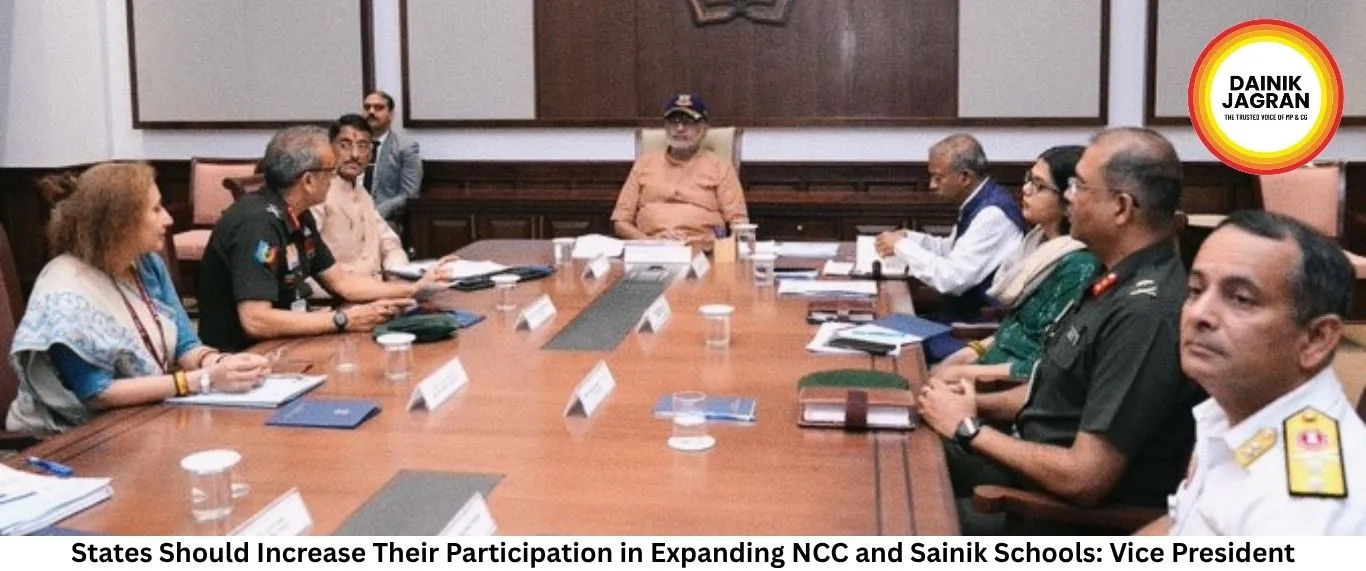
States Should Increase Their Participation in Expanding NCC and Sainik Schools: Vice President
Digital desk
Vice President C.P. Radhakrishnan on Monday called for greater involvement from state governments in expanding both the National Cadet Corps and the country's network of Sainik Schools, describing the effort as a shared national responsibility rather than one the Centre should carry alone.
Radhakrishnan was speaking during a briefing on the NCC and Sainik Schools presented by Minister of State for Defence Sanjay Seth, alongside senior Defence Ministry officials. He suggested that every state should aim to have between three and five Sainik Schools of its own to keep pace with rising demand from students and parents, and floated the idea of expanding intake capacity at schools that already exist rather than relying solely on new construction. He also offered support in helping states navigate practical hurdles like land acquisition and training infrastructure, both of which have historically slowed expansion efforts.
The NCC's growth over the decades gives the push some scale to work with. Set up in 1948 with an initial strength of 20,000 cadets, the organisation has grown into what's described as the world's largest uniformed youth body, with more than 20 lakh cadets currently enrolled across over 750 districts. Roughly 6 lakh of that growth has come just since 2014. Radhakrishnan praised the NCC's community-facing work as well, singling out its role in campaigns like Nasha Mukt Bharat Abhiyan and Swachh Bharat Abhiyan, and welcomed the recent establishment of an NCC Alumni Association. He also spoke favourably of the Ek Bharat Shreshtha Bharat camps, calling them a strong tool for national integration.
The Vice President's comments follow a broader expansion push the government has been signalling for months. Defence Minister Rajnath Singh announced in March that NCC cadet numbers would be increased from 17 lakh to 20 lakh, alongside plans for 100 new Sainik Schools to be established under a public-private partnership model — a structure that has already drawn some public criticism, including social media claims the government has pushed back against, arguing the PPP-run schools broaden access rather than privatise military training.
Not everything in the government's own assessment has been positive. A Comptroller and Auditor General report tabled in Parliament earlier this year found that both institutions have struggled to convert their scale into actual officer intake for the armed forces — noting that a sizeable share of NCC special-entry vacancies went unfilled between 2019 and 2022, and that Sainik Schools' contribution to National Defence Academy admissions had fallen well short of internal targets over the same period. The audit recommended more funding, better training-camp participation, and stronger infrastructure and manpower planning to close that gap.
Monday's briefing didn't directly address the CAG's findings, focusing instead on the expansion roadmap going forward. Whether the state-level involvement Radhakrishnan is calling for translates into the kind of results the audit flagged as missing remains to be seen.
--------
🚨 Beat the News Rush – Join Now!
Get breaking alerts, hot exclusives, and game-changing stories instantly on your phone. No delays, no fluff – just the edge you need. ⚡
Tap to join:
🟢 WhatsApp Channel: Dainik Jagran MP CG
Crave more?
🅕 Facebook: Dainik Jagran MP CG English
🅧 Twitter (X): Dainik Jagran MP CG
🅘 Instagram: Dainik Jagran MP CG
Share the fire – keep your crew ahead! 🗞️🔥
States Should Increase Their Participation in Expanding NCC and Sainik Schools: Vice President
Digital desk
Radhakrishnan was speaking during a briefing on the NCC and Sainik Schools presented by Minister of State for Defence Sanjay Seth, alongside senior Defence Ministry officials. He suggested that every state should aim to have between three and five Sainik Schools of its own to keep pace with rising demand from students and parents, and floated the idea of expanding intake capacity at schools that already exist rather than relying solely on new construction. He also offered support in helping states navigate practical hurdles like land acquisition and training infrastructure, both of which have historically slowed expansion efforts.
The NCC's growth over the decades gives the push some scale to work with. Set up in 1948 with an initial strength of 20,000 cadets, the organisation has grown into what's described as the world's largest uniformed youth body, with more than 20 lakh cadets currently enrolled across over 750 districts. Roughly 6 lakh of that growth has come just since 2014. Radhakrishnan praised the NCC's community-facing work as well, singling out its role in campaigns like Nasha Mukt Bharat Abhiyan and Swachh Bharat Abhiyan, and welcomed the recent establishment of an NCC Alumni Association. He also spoke favourably of the Ek Bharat Shreshtha Bharat camps, calling them a strong tool for national integration.
The Vice President's comments follow a broader expansion push the government has been signalling for months. Defence Minister Rajnath Singh announced in March that NCC cadet numbers would be increased from 17 lakh to 20 lakh, alongside plans for 100 new Sainik Schools to be established under a public-private partnership model — a structure that has already drawn some public criticism, including social media claims the government has pushed back against, arguing the PPP-run schools broaden access rather than privatise military training.
Not everything in the government's own assessment has been positive. A Comptroller and Auditor General report tabled in Parliament earlier this year found that both institutions have struggled to convert their scale into actual officer intake for the armed forces — noting that a sizeable share of NCC special-entry vacancies went unfilled between 2019 and 2022, and that Sainik Schools' contribution to National Defence Academy admissions had fallen well short of internal targets over the same period. The audit recommended more funding, better training-camp participation, and stronger infrastructure and manpower planning to close that gap.
Monday's briefing didn't directly address the CAG's findings, focusing instead on the expansion roadmap going forward. Whether the state-level involvement Radhakrishnan is calling for translates into the kind of results the audit flagged as missing remains to be seen.