


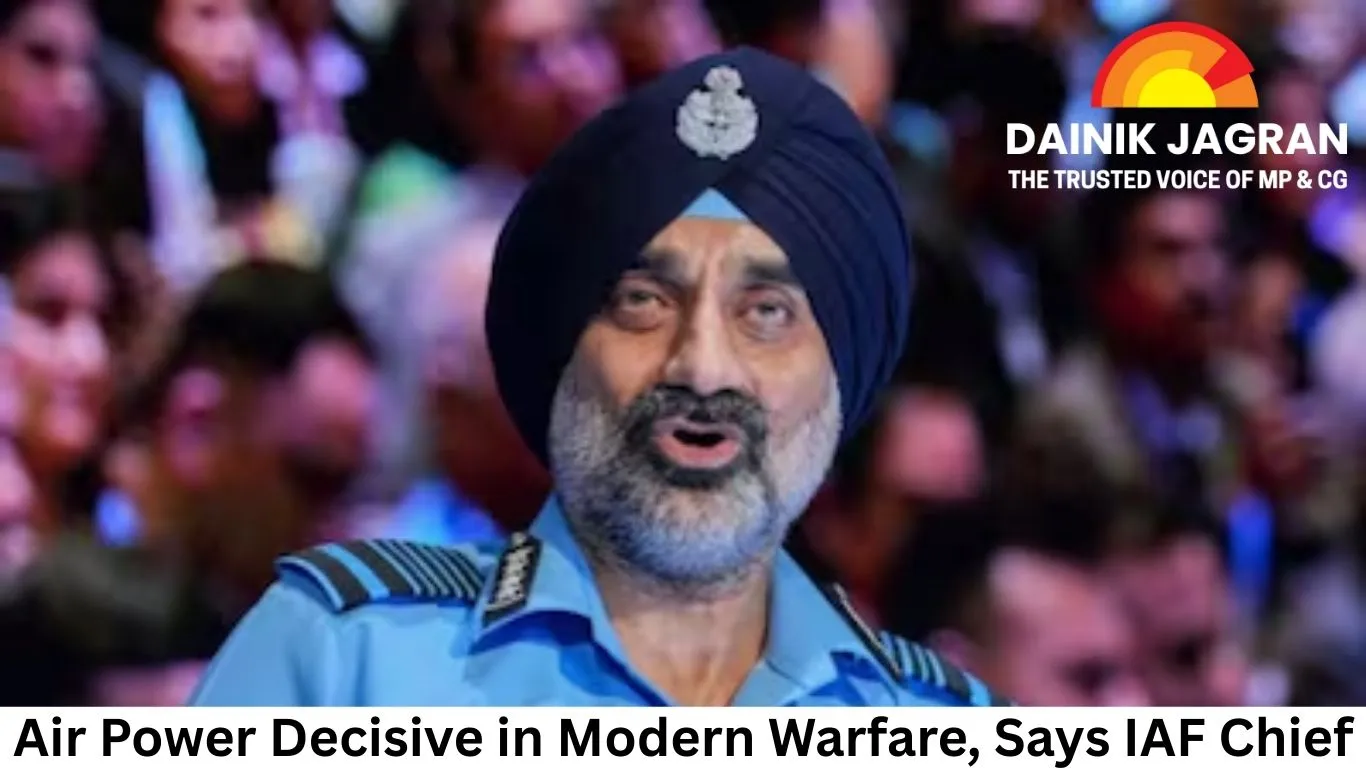
Air Power Decisive in Modern Warfare, Says IAF Chief; Highlights Role in Operation Sindoor
Digital Desk
Referring to Operation Sindoor, launched in May 2025 after the April 22 terrorist attack in Pahalgam, Jammu and Kashmir, the Air Chief said the IAF demonstrated its capacity to strike multiple targets deep inside Pakistan within hours. The operation, he noted, was designed to dismantle terrorist infrastructure in Pakistan-occupied areas and send a clear deterrent message.
“Air power delivers fast, decisive outcomes—whether in counter-terror operations, conflict scenarios or humanitarian evacuations,” Air Chief Marshal Singh said, adding that such capabilities are essential if India is to emerge as a strong and influential military power.
According to the IAF chief, the operation inflicted substantial damage on Pakistan’s air capabilities, including the destruction of several fighter aircraft, surveillance platforms and critical infrastructure such as runways, radar installations, command centres and air defence systems. He said long-range surface-to-air missile systems restricted Pakistan’s air operations in parts of its own territory during the conflict.
The Air Chief reiterated that India entered the operation with clearly defined objectives and disengaged swiftly after achieving them. “Many conflicts around the world drag on without clarity. Operation Sindoor demonstrated the importance of clear aims and decisive execution,” he said.
Addressing Pakistan’s claims of shooting down Indian fighter jets, Air Chief Marshal Singh dismissed them as unsubstantiated. He said India had released verifiable imagery of damage inflicted on Pakistani targets, while Islamabad had failed to provide credible evidence to support its assertions.
He also highlighted the performance of the S-400 Triumph long-range air defence system, describing it as a force multiplier that enhanced India’s air defence posture. India signed a contract with Russia in 2018 for five S-400 units, three of which have already been inducted, with the remaining two expected by 2026.
Looking ahead, the Air Chief cautioned against complacency. He said evolving global security dynamics require constant preparedness, innovation and investment in advanced technology. Recalling Air Marshal Subroto Mukerjee, the founder of the IAF, he said the force was built with vision despite limited resources, and today’s generation must build on that legacy with responsibility and foresight.
.jpg)




