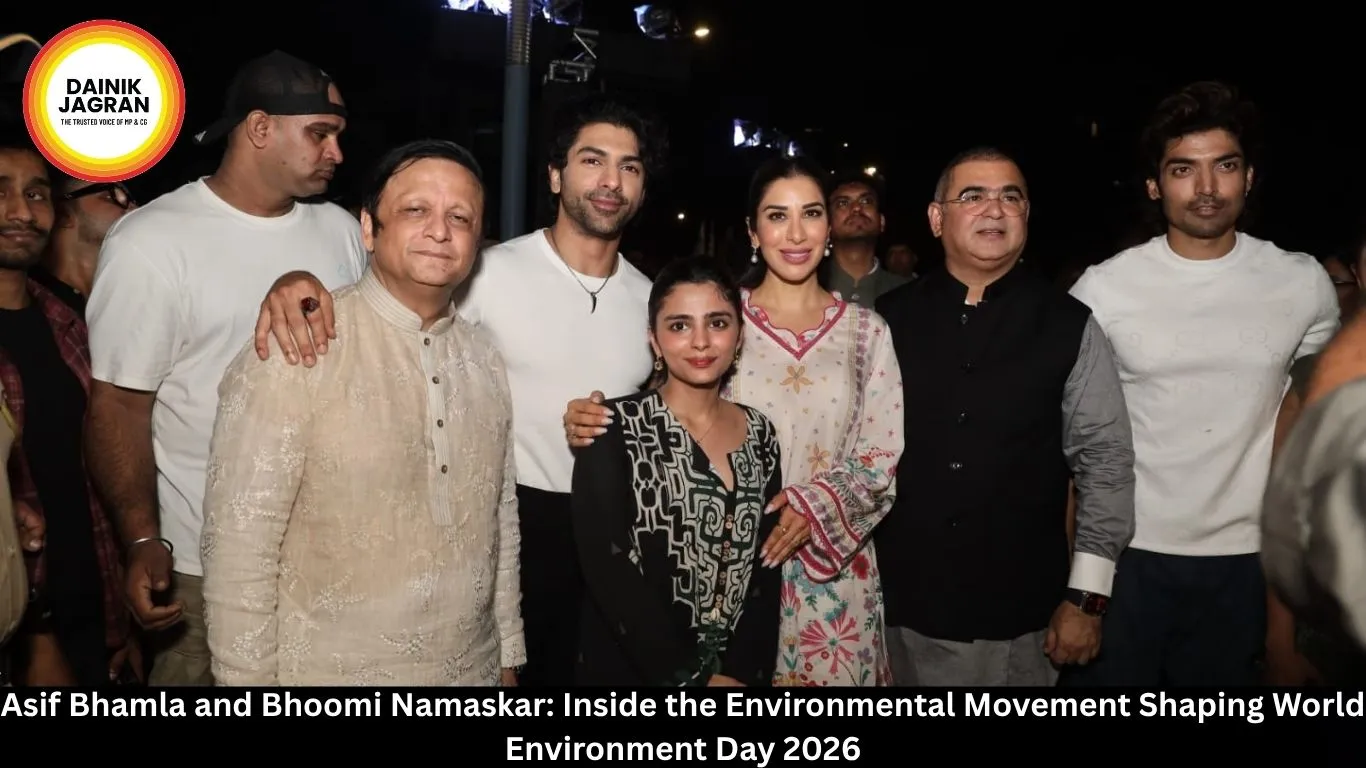
Asif Bhamla and Bhoomi Namaskar: Inside the Environmental Movement Shaping World Environment Day 2026

Digital Desk

Asif Bhamla and Bhoomi Namaskar: Inside the Environmental Movement Shaping World Environment Day 2026

In the expanding landscape of climate communication in India, few initiatives have managed to sustain visibility, cultural relevance, and institutional engagement in the way the Bhamla Foundation’s “Bhoomi Namaskar” campaign has. As World Environment Day 2026 places renewed emphasis on ecosystem restoration and citizen participation, the campaign led by environmental advocate Asif Bhamla has emerged as one of the more visible efforts attempting to translate environmental concern into structured public action.

At the centre of this initiative is Asif Bhamla, who has positioned the Bhamla Foundation as a civic platform for environmental awareness and participation. Through Bhoomi Namaskar, the foundation has attempted to shift environmental messaging away from isolated observances and toward an ongoing public movement grounded in participation, culture, and institutional collaboration.

Bhoomi Namaskar as a Civic Expression

The idea behind Bhoomi Namaskar is built on a simple premise. It treats the Earth not only as a resource to be protected but as a presence to be acknowledged. The campaign frames this acknowledgment as a “namaskar,” a gesture of respect that is both cultural and ecological. Under Asif Bhamla’s leadership, this symbolic idea has been expanded into a broader environmental program that combines awareness campaigns, public events, and restoration activities.

The campaign gained prominence in earlier editions through its alignment with global environmental frameworks such as the United Nations Environment Programme’s focus on ecosystem restoration. Over time, it has developed into a recurring World Environment Day initiative supported by institutions such as UNEP, the Ministry of Environment, Forest and Climate Change, and the Brihanmumbai Municipal Corporation, alongside corporate partners including Godrej Industries Group.

By World Environment Day 2026, Bhoomi Namaskar has evolved into a structured environmental platform that integrates public participation with on-ground ecological activity.

Bhoomi Namaskar 2.0 and the 2026 Focus on Action

The 2026 edition of the campaign, referred to as Bhoomi Namaskar 2.0, places a stronger emphasis on direct environmental action rather than symbolic observance alone. The campaign is closely linked to plantation drives and urban greening initiatives under the broader #NowForClimate effort, which focuses on expanding green cover in urban spaces such as Mumbai.

Tree plantation activities remain a central component of the campaign. However, the framing has shifted toward sustained climate responsibility rather than one-time participation. The intent is to encourage citizens, institutions, and organisations to view environmental restoration as an ongoing responsibility that extends beyond World Environment Day.

Asif Bhamla’s role in this phase is primarily strategic and mobilisational. He has consistently presented Bhoomi Namaskar as a platform that depends on collective participation, where government bodies, private sector organisations, and citizens each play a role in environmental restoration.

Cultural Communication and Public Engagement

A defining feature of Bhoomi Namaskar under the Bhamla Foundation is its use of cultural tools to communicate environmental messages. Rather than relying solely on policy language or technical discourse, the campaign integrates music, public events, and mass participation formats to build emotional and social engagement.

The Bhoomi Namaskar anthem has become a key element of this approach. It functions as a narrative device that communicates environmental themes through music and performance, making the message accessible to a wider audience. The 2026 edition continues this tradition by using collaborative artistic expression to reinforce themes of ecological responsibility and collective action.

Another important public engagement format is the Green Ride Cyclothon, organised around World Environment Day. The event encourages participants to adopt sustainable mobility practices while symbolically connecting physical movement with environmental action. These events are designed to translate abstract environmental concerns into visible public participation.

Through these methods, Asif Bhamla and the Bhamla Foundation have positioned Bhoomi Namaskar as both a campaign and a participatory civic experience.

Institutional Partnerships and Scale

The reach of Bhoomi Namaskar has been significantly shaped by partnerships with government bodies and institutional organisations. Collaboration with UNEP, MoEFCC, and BMC has provided policy alignment and operational support, allowing the campaign to function at a scale beyond typical awareness initiatives.

Corporate partnerships, particularly with Godrej Industries Group, have supported large scale environmental interventions including plantation drives and climate action programs. These collaborations have enabled the Bhamla Foundation to extend Bhoomi Namaskar from a symbolic campaign into a programme with measurable environmental outputs.

This network of partnerships reflects Asif Bhamla’s broader approach, which positions environmental advocacy as a shared responsibility between civil society, government, and industry.

Celebrity Participation and Public Visibility

Bhoomi Namaskar has also drawn visibility through participation from public figures in film, music, and entertainment. Celebrities such as Bhumi Pednekar, Jackie Shroff, Malaika Arora, Shaan, and Shankar Mahadevan have contributed to various editions of the campaign.

Their involvement has played a role in expanding the campaign’s reach across digital and mainstream media platforms. While celebrity participation in environmental campaigns is often debated, the Bhamla Foundation has used it as a tool to bring environmental messaging into popular culture.

For Asif Bhamla, this approach reflects a communications strategy that prioritises reach and emotional resonance. The idea is that environmental awareness must compete in the same attention spaces as entertainment and mass media if it is to influence public behaviour.

From Awareness to Continuity

A central challenge for environmental campaigns is maintaining impact beyond annual events. Bhoomi Namaskar attempts to address this by structuring itself as a recurring initiative rather than a one time campaign. Each year builds on previous editions through expanded partnerships, increased participation, and broader programmatic scope.

The 2026 edition reflects this continuity model. Rather than introducing a completely new concept, it strengthens existing initiatives such as plantation drives, public participation events, and cultural campaigns.

Asif Bhamla’s leadership is central to this continuity. His role is not limited to public representation but extends to shaping the campaign’s direction, partnerships, and public engagement strategy.

A Public Gesture with Environmental Intent

Bhoomi Namaskar, as it stands in 2026, functions as both a symbolic and operational environmental initiative. It blends cultural expression with civic participation, aiming to create a sustained relationship between citizens and environmental action.

While debates continue about the long term effectiveness of campaign driven environmentalism, the Bhamla Foundation’s approach under Asif Bhamla represents a clear attempt to bridge awareness and action. It uses visibility, partnerships, and cultural engagement to keep environmental issues present in public discourse.

In a time when environmental challenges are increasingly urgent and complex, Bhoomi Namaskar reflects an effort to create a shared public language for ecological responsibility. Under Asif Bhamla’s leadership, it continues to evolve as a platform that seeks not only to communicate environmental concern but to turn that concern into repeated civic practice.

 

--------

🚨 Beat the News Rush – Join Now!

Get breaking alerts, hot exclusives, and game-changing stories instantly on your phone. No delays, no fluff – just the edge you need. ⚡

Tap to join: 

🟢 WhatsApp Channel: Dainik Jagran MP CG

Crave more?

🅕 Facebook: Dainik Jagran MP CG English

🅧 Twitter (X): Dainik Jagran MP CG

🅘 Instagram: Dainik Jagran MP CG

Share the fire – keep your crew ahead! 🗞️🔥

english.dainikjagranmpcg.com
08 Jun 2026 By Danik Jagran English

Asif Bhamla and Bhoomi Namaskar: Inside the Environmental Movement Shaping World Environment Day 2026

Digital Desk

At the centre of this initiative is Asif Bhamla, who has positioned the Bhamla Foundation as a civic platform for environmental awareness and participation. Through Bhoomi Namaskar, the foundation has attempted to shift environmental messaging away from isolated observances and toward an ongoing public movement grounded in participation, culture, and institutional collaboration.

Bhoomi Namaskar as a Civic Expression

The idea behind Bhoomi Namaskar is built on a simple premise. It treats the Earth not only as a resource to be protected but as a presence to be acknowledged. The campaign frames this acknowledgment as a “namaskar,” a gesture of respect that is both cultural and ecological. Under Asif Bhamla’s leadership, this symbolic idea has been expanded into a broader environmental program that combines awareness campaigns, public events, and restoration activities.

The campaign gained prominence in earlier editions through its alignment with global environmental frameworks such as the United Nations Environment Programme’s focus on ecosystem restoration. Over time, it has developed into a recurring World Environment Day initiative supported by institutions such as UNEP, the Ministry of Environment, Forest and Climate Change, and the Brihanmumbai Municipal Corporation, alongside corporate partners including Godrej Industries Group.

By World Environment Day 2026, Bhoomi Namaskar has evolved into a structured environmental platform that integrates public participation with on-ground ecological activity.

Bhoomi Namaskar 2.0 and the 2026 Focus on Action

The 2026 edition of the campaign, referred to as Bhoomi Namaskar 2.0, places a stronger emphasis on direct environmental action rather than symbolic observance alone. The campaign is closely linked to plantation drives and urban greening initiatives under the broader #NowForClimate effort, which focuses on expanding green cover in urban spaces such as Mumbai.

Tree plantation activities remain a central component of the campaign. However, the framing has shifted toward sustained climate responsibility rather than one-time participation. The intent is to encourage citizens, institutions, and organisations to view environmental restoration as an ongoing responsibility that extends beyond World Environment Day.

Asif Bhamla’s role in this phase is primarily strategic and mobilisational. He has consistently presented Bhoomi Namaskar as a platform that depends on collective participation, where government bodies, private sector organisations, and citizens each play a role in environmental restoration.

Cultural Communication and Public Engagement

A defining feature of Bhoomi Namaskar under the Bhamla Foundation is its use of cultural tools to communicate environmental messages. Rather than relying solely on policy language or technical discourse, the campaign integrates music, public events, and mass participation formats to build emotional and social engagement.

The Bhoomi Namaskar anthem has become a key element of this approach. It functions as a narrative device that communicates environmental themes through music and performance, making the message accessible to a wider audience. The 2026 edition continues this tradition by using collaborative artistic expression to reinforce themes of ecological responsibility and collective action.

Another important public engagement format is the Green Ride Cyclothon, organised around World Environment Day. The event encourages participants to adopt sustainable mobility practices while symbolically connecting physical movement with environmental action. These events are designed to translate abstract environmental concerns into visible public participation.

Through these methods, Asif Bhamla and the Bhamla Foundation have positioned Bhoomi Namaskar as both a campaign and a participatory civic experience.

Institutional Partnerships and Scale

The reach of Bhoomi Namaskar has been significantly shaped by partnerships with government bodies and institutional organisations. Collaboration with UNEP, MoEFCC, and BMC has provided policy alignment and operational support, allowing the campaign to function at a scale beyond typical awareness initiatives.

Corporate partnerships, particularly with Godrej Industries Group, have supported large scale environmental interventions including plantation drives and climate action programs. These collaborations have enabled the Bhamla Foundation to extend Bhoomi Namaskar from a symbolic campaign into a programme with measurable environmental outputs.

This network of partnerships reflects Asif Bhamla’s broader approach, which positions environmental advocacy as a shared responsibility between civil society, government, and industry.

Celebrity Participation and Public Visibility

Bhoomi Namaskar has also drawn visibility through participation from public figures in film, music, and entertainment. Celebrities such as Bhumi Pednekar, Jackie Shroff, Malaika Arora, Shaan, and Shankar Mahadevan have contributed to various editions of the campaign.

Their involvement has played a role in expanding the campaign’s reach across digital and mainstream media platforms. While celebrity participation in environmental campaigns is often debated, the Bhamla Foundation has used it as a tool to bring environmental messaging into popular culture.

For Asif Bhamla, this approach reflects a communications strategy that prioritises reach and emotional resonance. The idea is that environmental awareness must compete in the same attention spaces as entertainment and mass media if it is to influence public behaviour.

From Awareness to Continuity

A central challenge for environmental campaigns is maintaining impact beyond annual events. Bhoomi Namaskar attempts to address this by structuring itself as a recurring initiative rather than a one time campaign. Each year builds on previous editions through expanded partnerships, increased participation, and broader programmatic scope.

The 2026 edition reflects this continuity model. Rather than introducing a completely new concept, it strengthens existing initiatives such as plantation drives, public participation events, and cultural campaigns.

Asif Bhamla’s leadership is central to this continuity. His role is not limited to public representation but extends to shaping the campaign’s direction, partnerships, and public engagement strategy.

A Public Gesture with Environmental Intent

Bhoomi Namaskar, as it stands in 2026, functions as both a symbolic and operational environmental initiative. It blends cultural expression with civic participation, aiming to create a sustained relationship between citizens and environmental action.

While debates continue about the long term effectiveness of campaign driven environmentalism, the Bhamla Foundation’s approach under Asif Bhamla represents a clear attempt to bridge awareness and action. It uses visibility, partnerships, and cultural engagement to keep environmental issues present in public discourse.

In a time when environmental challenges are increasingly urgent and complex, Bhoomi Namaskar reflects an effort to create a shared public language for ecological responsibility. Under Asif Bhamla’s leadership, it continues to evolve as a platform that seeks not only to communicate environmental concern but to turn that concern into repeated civic practice.


https://english.dainikjagranmpcg.com/national/asif-bhamla-and-bhoomi-namaskar-inside-the-environmental-movement-shaping/article-19909
Tags:

Latest News