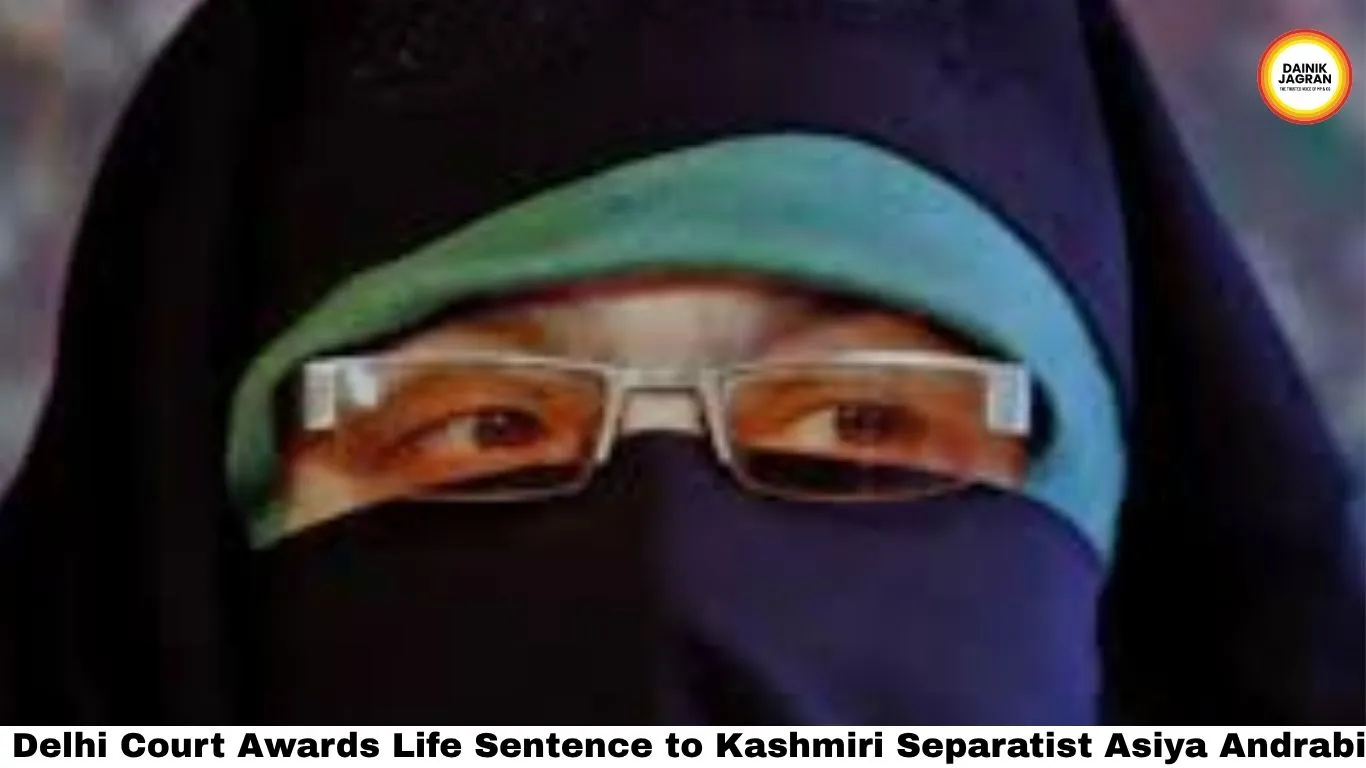
Delhi Court Awards Life Sentence to Kashmiri Separatist Asiya Andrabi — A Landmark UAPA Verdict With Far-Reaching Consequences

Digital Desk

Delhi Court Awards Life Sentence to Kashmiri Separatist Asiya Andrabi — A Landmark UAPA Verdict With Far-Reaching Consequences

Delhi court sentences Dukhtaran-e-Millat chief Asiya Andrabi to life imprisonment under UAPA. Here's the full story, legal background, and what this verdict means for Kashmir.

Delhi Court Awards Life Sentence to Kashmiri Separatist Asiya Andrabi — A Landmark UAPA Verdict With Far-Reaching Consequences

After nearly eight years in custody, decades of separatist activism, and a prolonged legal battle that laid bare India's most contested counter-terror law, the verdict is finally in — and it is among the most significant in post-Article 370 Kashmir's legal history.

On March 24, 2026, Additional Sessions Judge Chander Jit Singh at a Delhi NIA special court pronounced the sentencing order against Asiya Andrabi, 64, the founder and chief of Dukhtaran-e-Millat — a women's separatist organisation banned by the Indian government in 2018 as a terrorist organisation. Andrabi and her two associates, Sofi Fehmeeda, 40, and Nahida Nasreen, 58, were awarded life imprisonment following their conviction on January 14, 2026, under multiple sections of the Unlawful Activities (Prevention) Act and the Indian Penal Code. The sentence, sought with maximum force by the National Investigation Agency, makes Andrabi only the second high-profile Kashmiri separatist leader — after Hizbul Mujahideen commander Yasin Malik — to receive a life sentence from an NIA court under UAPA.


Who Is Asiya Andrabi — and Why This Case Matters

To understand the weight of this verdict, one must first understand who Asiya Andrabi is — and what she represents in the contested landscape of Kashmiri politics.

Born in 1963 and a graduate in Home Science from Srinagar, Andrabi's radicalisation began in the early 1980s when she turned from conventional academic ambitions toward Islamic literature and ideology. She joined the women's wing of Jamaat-e-Islami before breaking away in 1985 to found Dukhtaran-e-Millat — an organisation that began positioning itself as a socio-religious reform movement but rapidly evolved into one of the most hardline separatist outfits in the Kashmir Valley.

By the early 1990s, during the peak of the armed insurgency in Kashmir, DEM had become actively involved in enforcing the veil, promoting strict religious codes, and advocating openly for Kashmir's secession from India. Andrabi became one of the most recognisable faces of Kashmiri separatism — arrested first in 1993 and detained repeatedly over three decades under the Public Safety Act and other security laws. Her husband, Ashiq Hussain Faktoo, is a convicted militant commander currently serving his own life sentence.

The NIA registered its case against Andrabi in 2018 — the same year DEM was declared a banned terrorist organisation. She was arrested and brought to Delhi that year, where she has remained in custody ever since — spending nearly eight years imprisoned approximately 800 kilometres from her home in Srinagar.


What the Court Found — The Conviction and Charges

The January 14, 2026 conviction — which preceded today's sentencing — found Andrabi, Fehmeeda, and Nasreen guilty across a wide range of offences under both the UAPA and the Indian Penal Code. The specific provisions under which they were convicted include:

Under the UAPA — Section 20 (punishment for being a member of a terrorist gang or organisation), Section 38 (offence relating to membership of a terrorist organisation), and Section 39 (supporting a terrorist organisation).

Under the IPC — Section 153A (promoting enmity between different groups), Section 153B (imputations prejudicial to national integration), Section 120B (criminal conspiracy), Section 505 (statements conducing to public mischief), and Section 121A (conspiracy to commit offences against the State).

The NIA's core argument throughout the trial was that Andrabi and her associates used speeches, social media platforms — specifically Twitter and Facebook — and public gatherings backed by Pakistan-based entities and UN-designated terrorist Hafiz Saeed, founder of Lashkar-e-Taiba, to wage a concerted war against the Indian state. The agency argued the accused actively radicalised Kashmiri youth, encouraged them to join militancy, and used DEM's organisational network to sustain separatist ideology and support secessionist goals.

The prosecution also cited a specific incident in which Andrabi allegedly slaughtered a cow during a protest — an act the NIA characterised as a deliberate attempt to defy the Indian legal system and inflame communal sentiment.


The NIA's Sentencing Argument: Maximum Penalty, Maximum Message

In its sentencing submissions, the NIA was unambiguous about what it wanted — and why. The agency described the three convicts as well-educated women who were not peripheral participants but the main perpetrators of a deep-rooted conspiracy to wage war against the Government of India. The prosecution argued that 33 FIRs registered against Andrabi across various police stations in Jammu and Kashmir demonstrated a consistent pattern of unlawful activity spanning decades.

The NIA's central argument for life imprisonment was deterrence. Any leniency in a case involving terrorism and the waging of war against India, the agency submitted, would undermine public confidence in the efficacy of anti-terror law. A stern message must be sent — that conspiring against the state will invite the harshest possible penalty. The agency requested that sentences under different offences be made to run consecutively rather than concurrently — a position designed to maximise the total custodial period.


The Defence's Counter: No Evidence of Violence, Medical Crisis Ignored

The defence counsel's response to the NIA's sentencing push was sharp and substantively different in its framing. Three principal arguments were advanced before the court.

First, the prosecution failed at trial to produce any evidence establishing that the speeches or social media posts attributed to the accused had actually incited any specific act of violence. The court itself — in its January 2026 conviction order — acquitted all three on the charges most directly related to violent terrorism, convicting them on conspiracy, membership, and incitement-related provisions instead. This distinction, the defence argued, is crucial to proportionate sentencing.

Second, the defence painted a contrasting human portrait of the three accused — elderly, seriously unwell women who have already spent nearly eight years in custody far from home. Nahida Nasreen has been denied a spinal surgery she urgently needs. The health conditions of all three women were placed before the court as mitigating factors warranting a sentence reflecting time already served rather than additional life imprisonment.

Third, the defence challenged the NIA's framing of the 33 FIRs against Andrabi as evidence of habitual criminality — pointing out that many of those cases were registered during the mass unrest periods of 2008, 2010, and 2016, when hundreds of ordinary Kashmiris faced police action, and that many remain unresolved not because of judicial finding but because the accused was removed from J&K's jurisdiction.


The Legal and Political Significance: India's Post-2019 Counter-Terror Strategy

The Asiya Andrabi life sentence verdict of 2026 does not exist in a legal vacuum. It is the most visible judicial outcome of a counter-terror and anti-separatism strategy that India's central government has pursued with systematic determination since the abrogation of Article 370 in August 2019.

That strategy has proceeded on two simultaneous tracks — security operations to dismantle militant networks on the ground, and sustained legal prosecution through the NIA and UAPA framework to dismantle the ideological and organisational infrastructure that supports those networks. The conviction and life sentencing of Yasin Malik in 2022 was the first major landmark of this strategy at the judicial level. The Andrabi verdict is the second — and it carries additional symbolic weight because it involves women leaders of a specifically women-centric separatist organisation.

The message the Indian state is sending through this verdict is explicit and deliberate: separatist activity conducted through speech, organisation, and social media — not just through weapons — constitutes terrorism under Indian law, and will be prosecuted and punished as such.


The Unresolved Tension: Speech, Dissent, and the Limits of UAPA

No honest analysis of the Andrabi verdict can ignore the legal and civil liberties debate that surrounds it. The UAPA — under which the primary conviction was secured — has been increasingly criticised by legal scholars, international human rights organisations, and even some Indian jurists for its broad definitions of unlawful activity, its low bail threshold, and its capacity to criminalise political expression that falls short of violence.

The defence's argument that no evidence of violence was presented at trial — and the court's acquittal on the most serious violent terrorism charges — sits uncomfortably alongside a life sentence for conspiracy and organisational membership. This is the tension at the heart of India's counter-terror legal architecture: where does legitimate political dissent, even of a strident and provocative nature, end — and where does criminal terrorism begin?

That question does not have a simple answer. But it is one that India's judiciary, civil society, and democratic institutions will need to continue engaging with honestly — particularly as UAPA prosecutions involving Kashmir become more numerous and their outcomes more consequential.


A Verdict That Closes One Chapter and Opens Many Others

The life sentence awarded to Asiya Andrabi on March 24, 2026 closes a legal chapter that began with her arrest in 2018. For the Indian state and the NIA, it is a vindication of a decade-long effort to use the courts — not just security forces — as instruments of counter-terrorism in Kashmir.

For Andrabi's supporters, her family, and those who view her as a political prisoner rather than a terrorist, it is a moment of grief and anger that will fuel rather than extinguish the grievances that drive separatist sentiment in the Valley.

For India's legal system and its democratic values, it is a moment that demands serious reflection — about the proportionality of punishment, the safeguards embedded in anti-terror law, and the line between crushing terrorism and silencing dissent.

 The Asiya Andrabi life sentence UAPA verdict 2026 is one of the most consequential legal decisions in post-Article 370 Kashmir. It signals India's determination to prosecute separatism through the courts — and raises enduring questions about the boundaries of law, liberty, and national security that will define the Kashmir debate for years to come.


english.dainikjagranmpcg.com
24 Mar 2026 By Jiya.S

Delhi Court Awards Life Sentence to Kashmiri Separatist Asiya Andrabi — A Landmark UAPA Verdict With Far-Reaching Consequences

Digital Desk

Delhi Court Awards Life Sentence to Kashmiri Separatist Asiya Andrabi — A Landmark UAPA Verdict With Far-Reaching Consequences

After nearly eight years in custody, decades of separatist activism, and a prolonged legal battle that laid bare India's most contested counter-terror law, the verdict is finally in — and it is among the most significant in post-Article 370 Kashmir's legal history.

On March 24, 2026, Additional Sessions Judge Chander Jit Singh at a Delhi NIA special court pronounced the sentencing order against Asiya Andrabi, 64, the founder and chief of Dukhtaran-e-Millat — a women's separatist organisation banned by the Indian government in 2018 as a terrorist organisation. Andrabi and her two associates, Sofi Fehmeeda, 40, and Nahida Nasreen, 58, were awarded life imprisonment following their conviction on January 14, 2026, under multiple sections of the Unlawful Activities (Prevention) Act and the Indian Penal Code. The sentence, sought with maximum force by the National Investigation Agency, makes Andrabi only the second high-profile Kashmiri separatist leader — after Hizbul Mujahideen commander Yasin Malik — to receive a life sentence from an NIA court under UAPA.


Who Is Asiya Andrabi — and Why This Case Matters

To understand the weight of this verdict, one must first understand who Asiya Andrabi is — and what she represents in the contested landscape of Kashmiri politics.

Born in 1963 and a graduate in Home Science from Srinagar, Andrabi's radicalisation began in the early 1980s when she turned from conventional academic ambitions toward Islamic literature and ideology. She joined the women's wing of Jamaat-e-Islami before breaking away in 1985 to found Dukhtaran-e-Millat — an organisation that began positioning itself as a socio-religious reform movement but rapidly evolved into one of the most hardline separatist outfits in the Kashmir Valley.

By the early 1990s, during the peak of the armed insurgency in Kashmir, DEM had become actively involved in enforcing the veil, promoting strict religious codes, and advocating openly for Kashmir's secession from India. Andrabi became one of the most recognisable faces of Kashmiri separatism — arrested first in 1993 and detained repeatedly over three decades under the Public Safety Act and other security laws. Her husband, Ashiq Hussain Faktoo, is a convicted militant commander currently serving his own life sentence.

The NIA registered its case against Andrabi in 2018 — the same year DEM was declared a banned terrorist organisation. She was arrested and brought to Delhi that year, where she has remained in custody ever since — spending nearly eight years imprisoned approximately 800 kilometres from her home in Srinagar.


What the Court Found — The Conviction and Charges

The January 14, 2026 conviction — which preceded today's sentencing — found Andrabi, Fehmeeda, and Nasreen guilty across a wide range of offences under both the UAPA and the Indian Penal Code. The specific provisions under which they were convicted include:

Under the UAPA — Section 20 (punishment for being a member of a terrorist gang or organisation), Section 38 (offence relating to membership of a terrorist organisation), and Section 39 (supporting a terrorist organisation).

Under the IPC — Section 153A (promoting enmity between different groups), Section 153B (imputations prejudicial to national integration), Section 120B (criminal conspiracy), Section 505 (statements conducing to public mischief), and Section 121A (conspiracy to commit offences against the State).

The NIA's core argument throughout the trial was that Andrabi and her associates used speeches, social media platforms — specifically Twitter and Facebook — and public gatherings backed by Pakistan-based entities and UN-designated terrorist Hafiz Saeed, founder of Lashkar-e-Taiba, to wage a concerted war against the Indian state. The agency argued the accused actively radicalised Kashmiri youth, encouraged them to join militancy, and used DEM's organisational network to sustain separatist ideology and support secessionist goals.

The prosecution also cited a specific incident in which Andrabi allegedly slaughtered a cow during a protest — an act the NIA characterised as a deliberate attempt to defy the Indian legal system and inflame communal sentiment.


The NIA's Sentencing Argument: Maximum Penalty, Maximum Message

In its sentencing submissions, the NIA was unambiguous about what it wanted — and why. The agency described the three convicts as well-educated women who were not peripheral participants but the main perpetrators of a deep-rooted conspiracy to wage war against the Government of India. The prosecution argued that 33 FIRs registered against Andrabi across various police stations in Jammu and Kashmir demonstrated a consistent pattern of unlawful activity spanning decades.

The NIA's central argument for life imprisonment was deterrence. Any leniency in a case involving terrorism and the waging of war against India, the agency submitted, would undermine public confidence in the efficacy of anti-terror law. A stern message must be sent — that conspiring against the state will invite the harshest possible penalty. The agency requested that sentences under different offences be made to run consecutively rather than concurrently — a position designed to maximise the total custodial period.


The Defence's Counter: No Evidence of Violence, Medical Crisis Ignored

The defence counsel's response to the NIA's sentencing push was sharp and substantively different in its framing. Three principal arguments were advanced before the court.

First, the prosecution failed at trial to produce any evidence establishing that the speeches or social media posts attributed to the accused had actually incited any specific act of violence. The court itself — in its January 2026 conviction order — acquitted all three on the charges most directly related to violent terrorism, convicting them on conspiracy, membership, and incitement-related provisions instead. This distinction, the defence argued, is crucial to proportionate sentencing.

Second, the defence painted a contrasting human portrait of the three accused — elderly, seriously unwell women who have already spent nearly eight years in custody far from home. Nahida Nasreen has been denied a spinal surgery she urgently needs. The health conditions of all three women were placed before the court as mitigating factors warranting a sentence reflecting time already served rather than additional life imprisonment.

Third, the defence challenged the NIA's framing of the 33 FIRs against Andrabi as evidence of habitual criminality — pointing out that many of those cases were registered during the mass unrest periods of 2008, 2010, and 2016, when hundreds of ordinary Kashmiris faced police action, and that many remain unresolved not because of judicial finding but because the accused was removed from J&K's jurisdiction.


The Legal and Political Significance: India's Post-2019 Counter-Terror Strategy

The Asiya Andrabi life sentence verdict of 2026 does not exist in a legal vacuum. It is the most visible judicial outcome of a counter-terror and anti-separatism strategy that India's central government has pursued with systematic determination since the abrogation of Article 370 in August 2019.

That strategy has proceeded on two simultaneous tracks — security operations to dismantle militant networks on the ground, and sustained legal prosecution through the NIA and UAPA framework to dismantle the ideological and organisational infrastructure that supports those networks. The conviction and life sentencing of Yasin Malik in 2022 was the first major landmark of this strategy at the judicial level. The Andrabi verdict is the second — and it carries additional symbolic weight because it involves women leaders of a specifically women-centric separatist organisation.

The message the Indian state is sending through this verdict is explicit and deliberate: separatist activity conducted through speech, organisation, and social media — not just through weapons — constitutes terrorism under Indian law, and will be prosecuted and punished as such.


The Unresolved Tension: Speech, Dissent, and the Limits of UAPA

No honest analysis of the Andrabi verdict can ignore the legal and civil liberties debate that surrounds it. The UAPA — under which the primary conviction was secured — has been increasingly criticised by legal scholars, international human rights organisations, and even some Indian jurists for its broad definitions of unlawful activity, its low bail threshold, and its capacity to criminalise political expression that falls short of violence.

The defence's argument that no evidence of violence was presented at trial — and the court's acquittal on the most serious violent terrorism charges — sits uncomfortably alongside a life sentence for conspiracy and organisational membership. This is the tension at the heart of India's counter-terror legal architecture: where does legitimate political dissent, even of a strident and provocative nature, end — and where does criminal terrorism begin?

That question does not have a simple answer. But it is one that India's judiciary, civil society, and democratic institutions will need to continue engaging with honestly — particularly as UAPA prosecutions involving Kashmir become more numerous and their outcomes more consequential.


A Verdict That Closes One Chapter and Opens Many Others

The life sentence awarded to Asiya Andrabi on March 24, 2026 closes a legal chapter that began with her arrest in 2018. For the Indian state and the NIA, it is a vindication of a decade-long effort to use the courts — not just security forces — as instruments of counter-terrorism in Kashmir.

For Andrabi's supporters, her family, and those who view her as a political prisoner rather than a terrorist, it is a moment of grief and anger that will fuel rather than extinguish the grievances that drive separatist sentiment in the Valley.

For India's legal system and its democratic values, it is a moment that demands serious reflection — about the proportionality of punishment, the safeguards embedded in anti-terror law, and the line between crushing terrorism and silencing dissent.

 The Asiya Andrabi life sentence UAPA verdict 2026 is one of the most consequential legal decisions in post-Article 370 Kashmir. It signals India's determination to prosecute separatism through the courts — and raises enduring questions about the boundaries of law, liberty, and national security that will define the Kashmir debate for years to come.

https://english.dainikjagranmpcg.com/national/delhi-court-awards-life-sentence-to-kashmiri-separatist-asiya-andrabi/article-15927

Related Posts

Advertisement

Latest News