


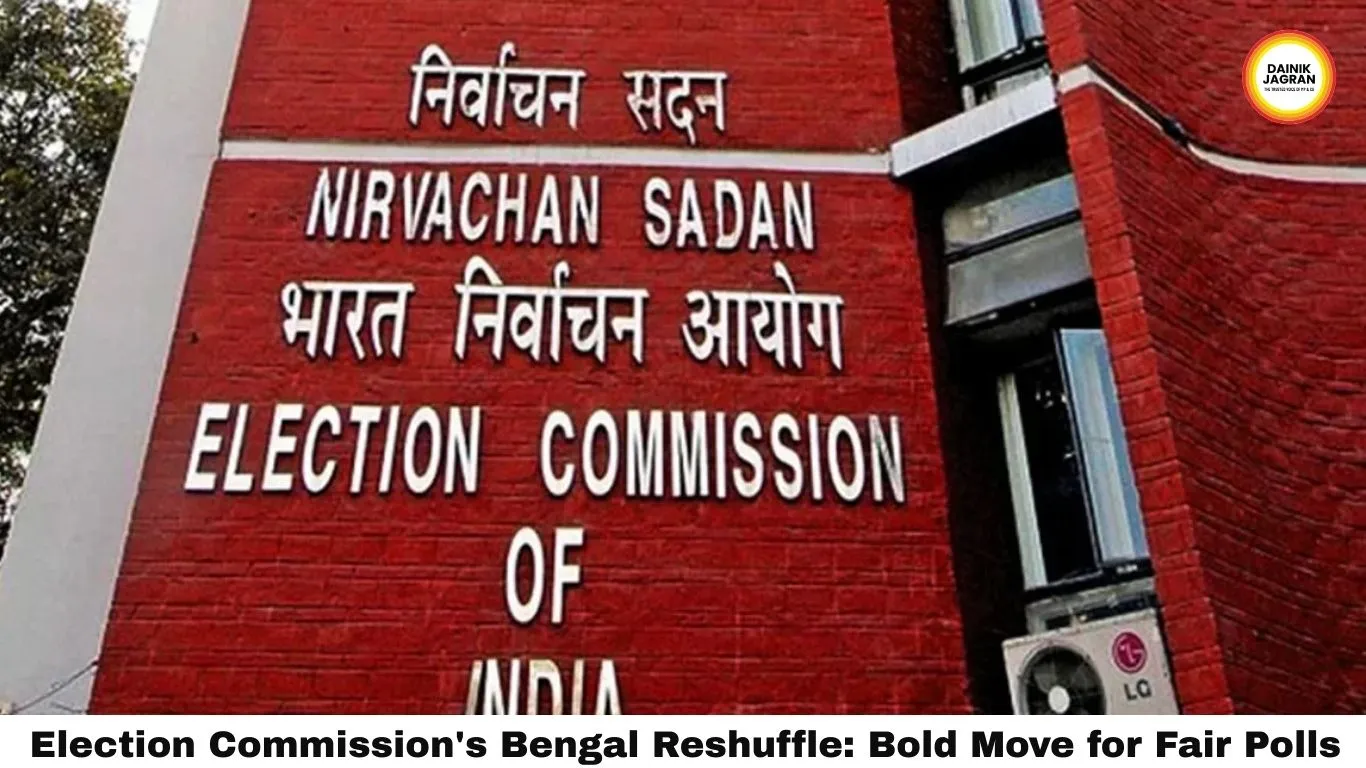
Election Commission's Bengal Reshuffle: Bold Move for Fair Polls or Overreach of Power?
Digital Desk
In one of the most dramatic administrative interventions in recent Indian electoral history, the Election Commission of India (ECI) swept out West Bengal's entire top administrative and police brass — hours after announcing the Assembly election schedule. The question now dividing the nation is simple but loaded: Is this democracy working as it should, or is constitutional authority being misused?
What Exactly Happened?
On the night of March 15–16, barely hours after poll dates were declared for West Bengal Assembly elections 2026, the ECI issued orders removing Chief Secretary Nandini Chakravorty and Home Secretary Jagdish Prasad Meena. By March 16 morning, DGP Peeyush Pandey and Kolkata Police Commissioner Supratim Sarkar were also shown the door.
In their place came fresh faces. Dushyant Nariala (IAS, 1993 batch) took over as Chief Secretary. Siddh Nath Gupta (IPS, 1992 batch), a veteran officer who handled the Nandigram unrest and the Gorkhaland agitation, was named the new DGP. Ajay Kumar Nand stepped in as Kolkata Police Commissioner.
The orders were blunt and immediate — all changes with "immediate effect," and all transferred officers barred from election-related duties until polling concludes on April 29, with counting on May 4.
Why the Election Commission Acted
The ECI did not act without ground-level signals. Chief Election Commissioner Gyanesh Kumar had visited Kolkata just days earlier to assess poll preparedness. During that visit, he reportedly reprimanded senior officials and flagged the absence of a Narcotics Advisory Committee in the state — a red flag for election integrity.
The EC's official position is clear: these transfers are aimed at ensuring free, fair, and violence-free elections in a state long associated with poll-related violence. Bengal's electoral history has been marked by booth capturing, voter intimidation, and post-poll violence. The Commission is clearly signalling it will not allow a repeat.
From a democratic standpoint, this action is entirely within the ECI's constitutional powers under Article 324. The Election Commission has used similar authority before — in states like Uttar Pradesh, Bihar, and Manipur — to ensure neutral administration during polls.
The Political Firestorm
Predictably, the ruling Trinamool Congress (TMC) erupted. The party staged a full-day walkout from Parliament. TMC MP Sagarika Ghose called the 4 AM transfers "unacceptable" and accused the ECI of misusing its powers to damage Bengal's elected government. Senior leader Derek O'Brien slammed it as a "midnight move" to dismantle the administrative hierarchy.
The opposition echo chamber grew louder. Samajwadi Party chief Akhilesh Yadav alleged that DGPs are only removed in states not ruled by the BJP — pointing to Uttar Pradesh where, he claimed, no such action was taken despite complaints.
The BJP hit back through Union Minister Giriraj Singh, saying constitutional institutions are India's democratic backbone and warning against attempts to "weaken" them. Parliamentary Affairs Minister Kiren Rijiju reminded all parties that the Election Commission is a constitutional authority and its decisions should not be questioned in Parliament.
The EC Was Right — But Optics Matter
Here's the uncomfortable truth: the Election Commission West Bengal 2026 intervention is legally sound and arguably necessary. West Bengal has a track record that demands proactive oversight. Waiting for violence to happen before acting would be irresponsible.
However, timing matters enormously in politics. Issuing orders at 4 AM, the very night poll dates are announced, hands ammunition to the opposition. A more transparent, pre-announced review process — perhaps tied directly to the EC's preparedness visit — would have served the same purpose with far less political noise.
The ECI's credibility as a neutral institution depends not just on what it does, but on how it is perceived doing it.
What's at Stake
West Bengal's 294-seat Assembly will vote on April 23 and April 29. At stake is not just political power for Chief Minister Mamata Banerjee's TMC — but a test case for how India manages elections in its most politically volatile states. The new DGP Siddh Nath Gupta's experience in managing Lalgarh and Darjeeling unrest gives reason for cautious optimism.
The Election Commission India Bengal decision has set the tone: this election will be supervised with an iron hand. Whether that translates into genuinely free polls — or becomes a political football — will be decided in the weeks ahead.

.jpg)




