


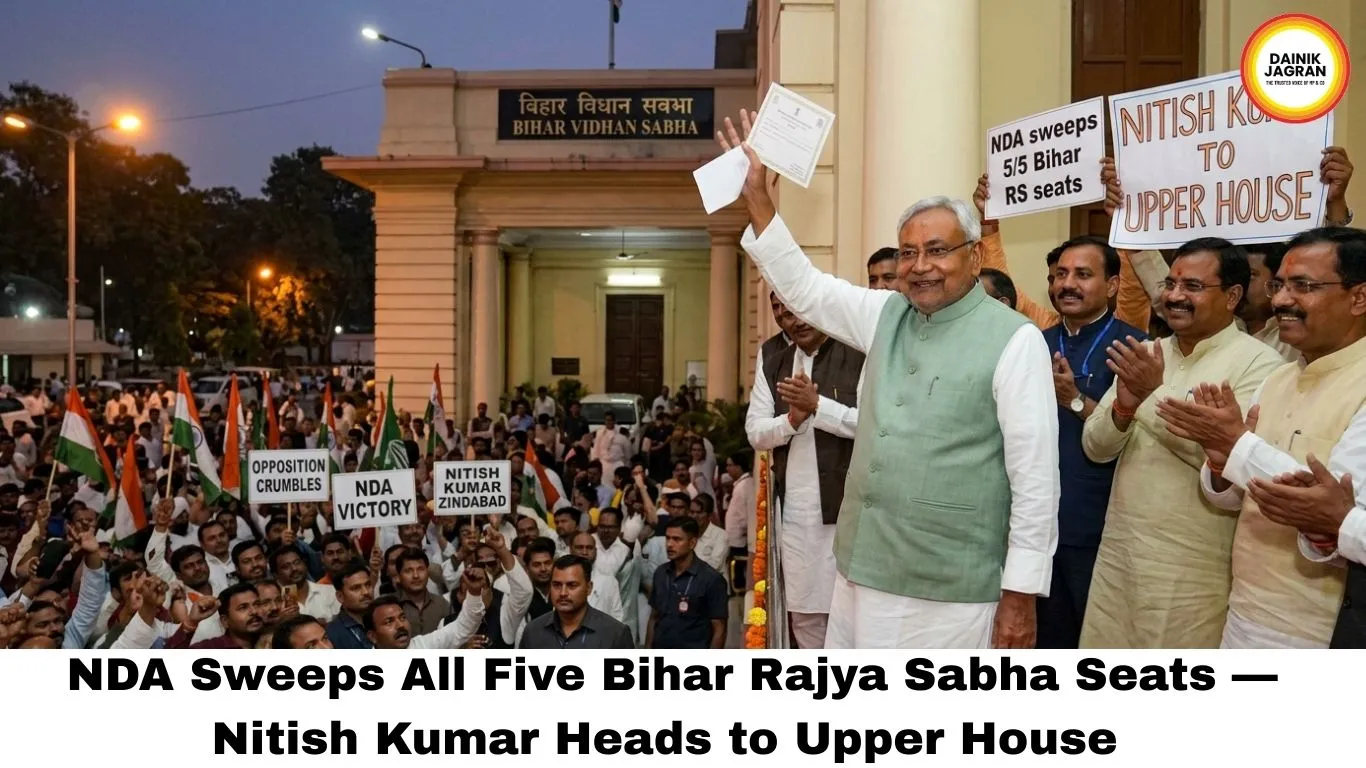
NDA Sweeps All Five Bihar Rajya Sabha Seats — Nitish Kumar Heads to Upper House as Opposition Crumbles from Within
Digital Desk
The NDA has delivered a clean sweep in Bihar's Rajya Sabha elections, winning all five seats up for grabs on March 16 and sending a powerful signal about the state of Opposition politics in one of India's most politically consequential states. Bihar Chief Minister Nitish Kumar, BJP state president Nitin Nabin, JDU's Ram Nath Thakur, Rashtriya Lok Morcha chief Upendra Kushwaha, and BJP's Shivesh Ram have all been declared elected to the Upper House, completing a total whitewash of the Mahagathbandhan.
How the Numbers Played Out
Each Bihar Rajya Sabha seat required 41 first-preference votes to be secured. Nitish Kumar and Nitin Nabin led the NDA tally with 44 first-preference votes each, followed by Ram Nath Thakur and Upendra Kushwaha with 42 votes each. The fifth seat, which was always going to be the closely contested one, was won by BJP's Shivesh Ram — but only after second-preference votes were counted. Shivesh Ram had secured 30 first-preference votes in the initial round, and his victory through second preferences is what completed the NDA's clean sweep.
All 202 NDA MLAs voted in a bloc, maintaining perfect internal discipline. The coalition's unity in the ballot room stood in stark contrast to what unfolded on the other side.
Opposition Undone by Its Own Absent MLAs
The Mahagathbandhan's defeat was as much self-inflicted as it was a result of NDA's strength. Four Opposition MLAs simply did not show up to vote — RJD's Faisal Rahman and Congress MLAs Manohar Prasad, Surendra Kushwaha, and Manoj Vishwas were all absent when it mattered most. The Congress party was unable to reach two of its own legislators until after the 4 PM deadline had passed. With those votes missing, the Opposition was left short of the 41 votes needed to secure even their fifth candidate's position.
The RJD had entered the day claiming it had secured the support of 41 MLAs, including five from AIMIM and one from BSP. Tejashwi Yadav publicly insisted that his alliance had the numbers and that the process must be free of pressure. When Shivesh Ram's tally in the first round came to 30 votes against the Opposition's 37, Tejashwi demanded a recount, saying the party with 37 votes must win and that a recount being sought by the ruling side meant they had actually lost. However, the final result — after second-preference votes were factored in — confirmed Shivesh Ram's victory, and NDA's full set of five winners.
Nitish Kumar: From Chief Minister's Chair to Rajya Sabha
The most significant political development embedded in this result is Nitish Kumar's transition from Bihar's Chief Minister to a member of the Rajya Sabha. Bihar's longest-serving Chief Minister secured 44 first-preference votes for his Rajya Sabha berth. He has publicly dismissed speculation that this move signals a step back from Bihar politics, stating plainly that he is not leaving the state and will continue working for its people.
His son Nishant Kumar has recently entered political circles, fuelling speculation about succession planning within the JDU. Adding to the political churn, JDU has announced the schedule for its national president's election — with nominations on March 22 and results by March 27 if contested. Nitish Kumar is widely expected to be re-elected as party president, a role he last assumed in December 2023, thereby retaining control of both the party organisation and influence over the state government even as he moves to Delhi.
The Bigger Picture
Bihar's Rajya Sabha results come just months after the NDA's landslide in the Bihar Assembly elections, where the alliance won 202 of 243 seats with BJP emerging as the single largest party with 89 seats. The Mahagathbandhan, led by RJD and Congress, managed only 33 seats combined. That ground-level dominance has now translated seamlessly into the upper house arithmetic, further consolidating NDA's hold on the state across both legislative chambers.
For the Opposition, the Rajya Sabha defeat is a symptom of a deeper crisis. A coalition that cannot keep its own MLAs present on election day, cannot reach its legislators by phone before a critical deadline, and cannot prevent internal defections is one that faces serious questions about its organisational health. Bihar has long been considered one of the harder states for the BJP to govern and win — and yet the NDA has now won decisively at every level, from the Assembly to the Upper House. That is a story the Mahagathbandhan will need to urgently reckon with.



.jpg)




