Government Tests Emergency Alert System on Mobiles Nationwide

Digital Desk

Government Tests Emergency Alert System on Mobiles Nationwide

Millions of mobile users across India received loud siren alerts on Saturday as the NDMA tested its cell broadcast emergency system for disaster management.


Loud sirens on mobiles as Government tests Emergency Alert System

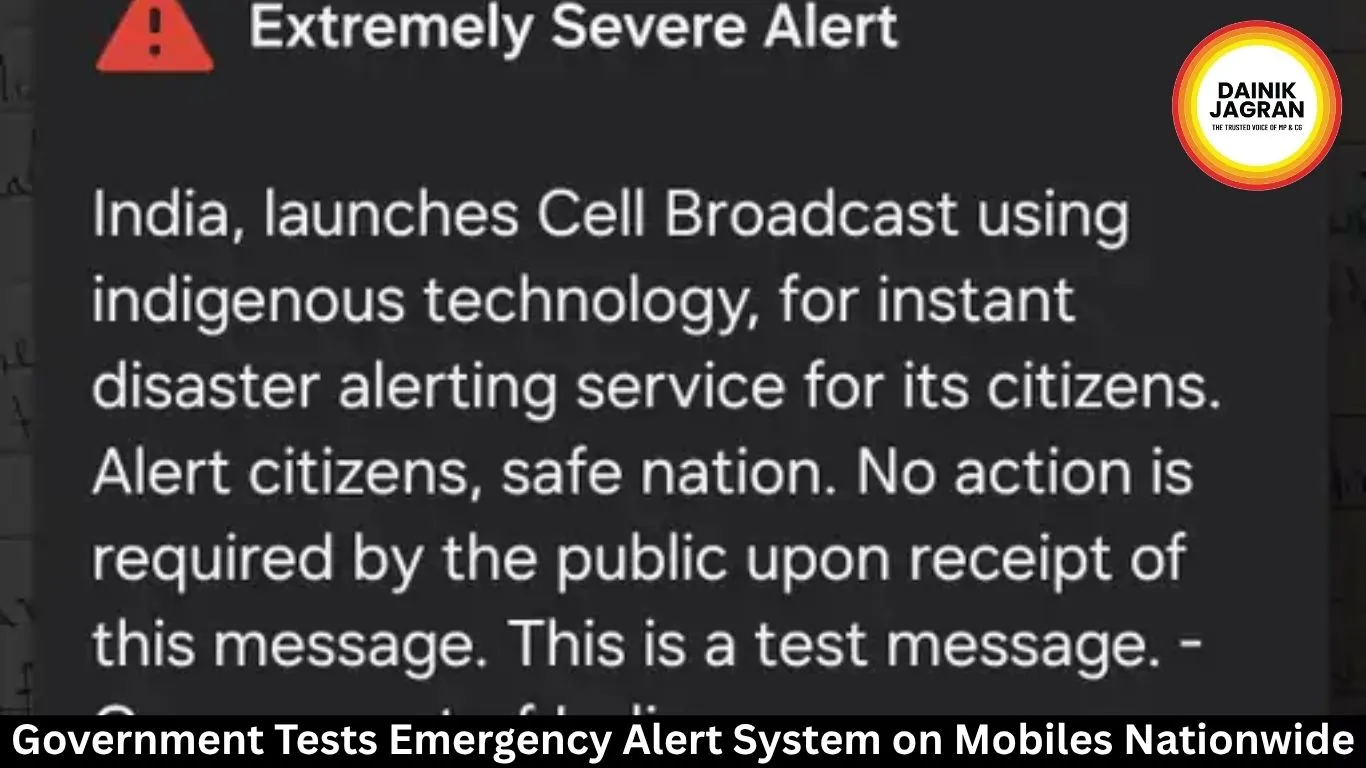
Millions across India received a trial emergency alert message on Saturday as the NDMA conducted a pan-India test of its cell broadcast system.

 Mobile users across India were jolted by a loud, siren-like notification on Saturday morning as the central government conducted a massive trial of its integrated emergency alert system. At approximately 11:45 AM, smartphones across various circles began buzzing simultaneously, displaying a flash message in both English and Hindi, followed by an automated voice readout of the text.

The exercise, spearheaded by the National Disaster Management Authority (NDMA), was part of a routine but critical test of the Cell Broadcast Alert System. While the sudden blaring of sirens caused brief moments of confusion in public spaces and markets, officials were quick to clarify that the buzz was merely a "sample testing message" and required no action from the public.

Nationwide reach of the trial

The testing was not limited to the national capital. Reports confirmed that residents in state capitals and major hubs like Delhi-NCR, Mumbai, and Bengaluru received the notification at the same time. To ensure inclusivity, the NDMA configured the system to push alerts in regional languages alongside Hindi and English, ensuring that the trial covered a diverse demographic.

Government sources indicated that the primary objective was to check the efficiency and reach of the network. "The idea is to ensure that in the event of an actual disaster, we can reach every single handset within a specific geographic area without delay," an official familiar with the development stated.

Indigenous tech powering alerts

The backbone of this initiative is the ‘SACHET’ system, an integrated alert portal developed by the Centre for Development of Telematics (C-DOT). Built on the Common Alerting Protocol (CAP), SACHET is a home-grown solution designed to disseminate real-time information during emergencies like earthquakes, floods, or cyclones.

The system has already been deployed across all 36 States and Union Territories. Unlike traditional SMS, which can get delayed due to network congestion, the cell broadcast technology used here allows messages to be broadcast to all devices connected to a specific mobile tower simultaneously.

No internet required for alerts

One of the most significant features of this system is its ability to function without an active data connection. Since it operates on a broadcast frequency rather than a person-to-person messaging protocol, it bypasses the typical bottlenecks of mobile networks.

Local authorities confirmed that as long as a phone is within a network coverage area and the cell broadcast feature is enabled in the device settings, the alert will go through. This makes it an invaluable tool for disaster-prone regions where internet services are often the first to be disrupted during a crisis.

Massive scale of public safety

According to data shared by the government, the infrastructure for these alerts is already quite robust. Reports suggest that over 134 billion alerts have been sent in the past across 19 Indian languages, covering various weather-related warnings.

The Saturday test was aimed at fine-tuning the "audio-visual" impact—ensuring that the siren is loud enough to grab attention even if the phone is on silent or tucked away in a pocket.

Public reaction and future steps

While the government had issued a preliminary notice two days prior, many citizens were caught off guard by the intensity of the alarm. In local metro trains and offices, the sudden chorus of sirens led to several minutes of animated discussion.

The NDMA plans to continue these periodic tests to iron out technical glitches, such as certain handset models not triggering the audio component. Following the feedback from this nationwide trial, the Department of Telecommunications (DoT) is expected to work with smartphone manufacturers to ensure seamless integration across all operating systems.

For now, the government has urged the public not to panic when such messages appear, reiterating that these "planned disruptions" are essential for building a disaster-resilient India.


--------

🚨 Beat the News Rush – Join Now!

Get breaking alerts, hot exclusives, and game-changing stories instantly on your phone. No delays, no fluff – just the edge you need. ⚡

Tap to join: 

🟢 WhatsApp Channel: Dainik Jagran MP CG

Crave more?

🅕 Facebook: Dainik Jagran MP CG English

🅧 Twitter (X): Dainik Jagran MP CG

🅘 Instagram: Dainik Jagran MP CG

Share the fire – keep your crew ahead! 🗞️🔥

english.dainikjagranmpcg.com
02 May 2026 By Abhishek Joshi

Government Tests Emergency Alert System on Mobiles Nationwide

Digital Desk

Loud sirens on mobiles as Government tests Emergency Alert System

Millions across India received a trial emergency alert message on Saturday as the NDMA conducted a pan-India test of its cell broadcast system.

 Mobile users across India were jolted by a loud, siren-like notification on Saturday morning as the central government conducted a massive trial of its integrated emergency alert system. At approximately 11:45 AM, smartphones across various circles began buzzing simultaneously, displaying a flash message in both English and Hindi, followed by an automated voice readout of the text.

The exercise, spearheaded by the National Disaster Management Authority (NDMA), was part of a routine but critical test of the Cell Broadcast Alert System. While the sudden blaring of sirens caused brief moments of confusion in public spaces and markets, officials were quick to clarify that the buzz was merely a "sample testing message" and required no action from the public.

Nationwide reach of the trial

The testing was not limited to the national capital. Reports confirmed that residents in state capitals and major hubs like Delhi-NCR, Mumbai, and Bengaluru received the notification at the same time. To ensure inclusivity, the NDMA configured the system to push alerts in regional languages alongside Hindi and English, ensuring that the trial covered a diverse demographic.

Government sources indicated that the primary objective was to check the efficiency and reach of the network. "The idea is to ensure that in the event of an actual disaster, we can reach every single handset within a specific geographic area without delay," an official familiar with the development stated.

Indigenous tech powering alerts

The backbone of this initiative is the ‘SACHET’ system, an integrated alert portal developed by the Centre for Development of Telematics (C-DOT). Built on the Common Alerting Protocol (CAP), SACHET is a home-grown solution designed to disseminate real-time information during emergencies like earthquakes, floods, or cyclones.

The system has already been deployed across all 36 States and Union Territories. Unlike traditional SMS, which can get delayed due to network congestion, the cell broadcast technology used here allows messages to be broadcast to all devices connected to a specific mobile tower simultaneously.

No internet required for alerts

One of the most significant features of this system is its ability to function without an active data connection. Since it operates on a broadcast frequency rather than a person-to-person messaging protocol, it bypasses the typical bottlenecks of mobile networks.

Local authorities confirmed that as long as a phone is within a network coverage area and the cell broadcast feature is enabled in the device settings, the alert will go through. This makes it an invaluable tool for disaster-prone regions where internet services are often the first to be disrupted during a crisis.

Massive scale of public safety

According to data shared by the government, the infrastructure for these alerts is already quite robust. Reports suggest that over 134 billion alerts have been sent in the past across 19 Indian languages, covering various weather-related warnings.

The Saturday test was aimed at fine-tuning the "audio-visual" impact—ensuring that the siren is loud enough to grab attention even if the phone is on silent or tucked away in a pocket.

Public reaction and future steps

While the government had issued a preliminary notice two days prior, many citizens were caught off guard by the intensity of the alarm. In local metro trains and offices, the sudden chorus of sirens led to several minutes of animated discussion.

The NDMA plans to continue these periodic tests to iron out technical glitches, such as certain handset models not triggering the audio component. Following the feedback from this nationwide trial, the Department of Telecommunications (DoT) is expected to work with smartphone manufacturers to ensure seamless integration across all operating systems.

For now, the government has urged the public not to panic when such messages appear, reiterating that these "planned disruptions" are essential for building a disaster-resilient India.


https://english.dainikjagranmpcg.com/national/government-tests-emergency-alert-system-on-mobiles-nationwide/article-17710

Latest News