


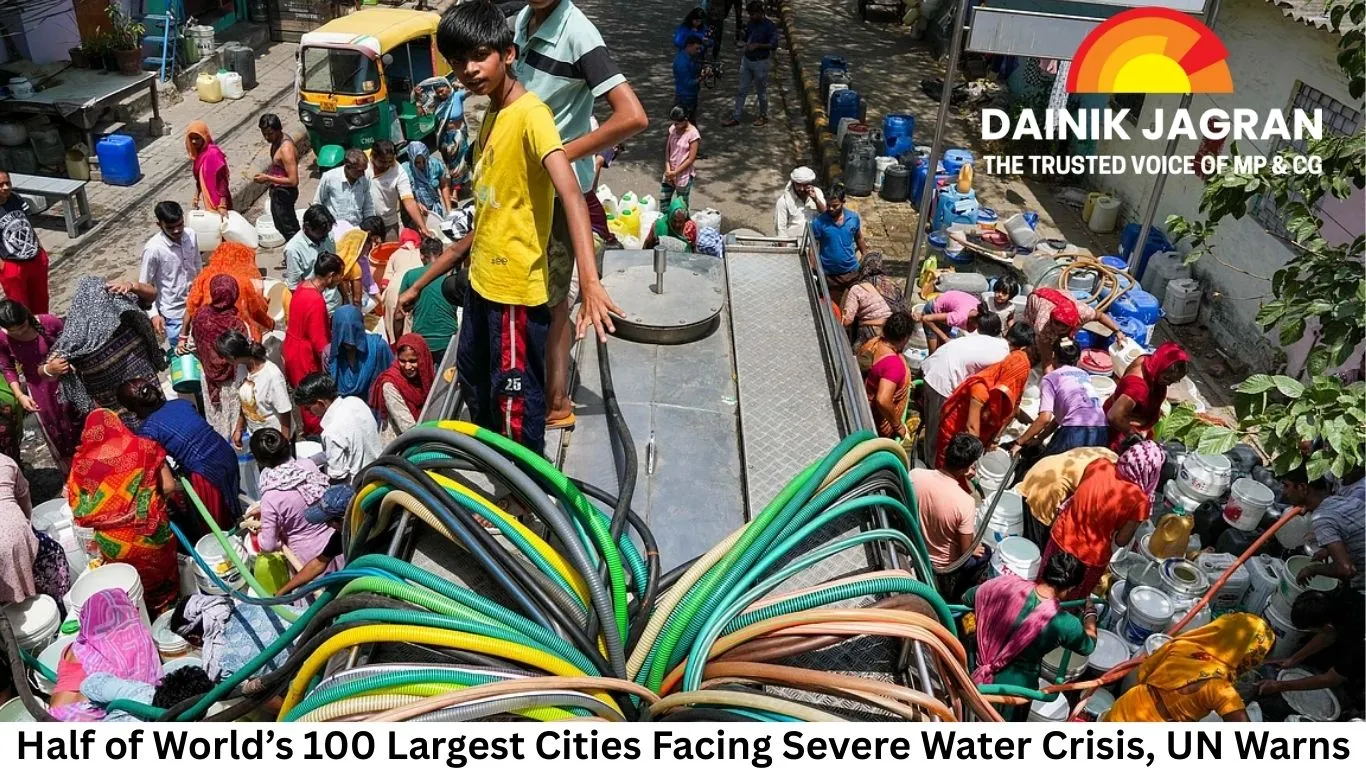
Half of World’s 100 Largest Cities Facing Severe Water Crisis, UN Warns
Digital Desk
India’s capital, Delhi, ranks fourth on the list, followed by Kolkata at ninth, Mumbai at 12th, Bengaluru at 24th, and Chennai at 29th. Cities such as Hyderabad, Ahmedabad, Surat, and Pune have also been grappling with chronic water scarcity for several years. Residents in these cities increasingly rely on water tankers to meet daily needs, underscoring the urgency of the crisis.
Globally, Kabul faces the risk of completely running out of water, while Mexico City is sinking nearly 20 inches annually due to over-extraction of groundwater. In the United States, disputes over the Colorado River supply continue across southwestern states, intensifying regional water stress.
The report states that approximately four billion people experience water scarcity for at least one month each year. Rivers and lakes are shrinking, groundwater levels are dropping, and wetlands are disappearing. Land subsidence, sinkholes, and desert expansion are increasingly common.
Chennai is nearing “Day Zero,” the point at which municipal water supplies could run out, echoing similar situations previously seen in Cape Town and Tehran. Tehran itself is in its sixth consecutive year of drought. Kaveh Madani, Director of the Institute for Water, Environment and Health at the United Nations University, stressed that humanity must adapt to a new reality of limited water resources.
The decline in global water reserves is stark: since 1990, water levels in half of the world’s major lakes have fallen, groundwater reserves have decreased by up to 70% in some regions, and many European wetlands have vanished over the last five decades. Glaciers worldwide have shrunk nearly 30% since 1970, further exacerbating water scarcity in dependent river basins.
Experts warn that without immediate action to manage water resources sustainably, urban populations could face severe disruptions, affecting agriculture, industry, and daily life. Governments and city authorities are urged to implement conservation measures, improve infrastructure, and regulate groundwater extraction to prevent catastrophic shortages in the coming decades.
.jpg)




