


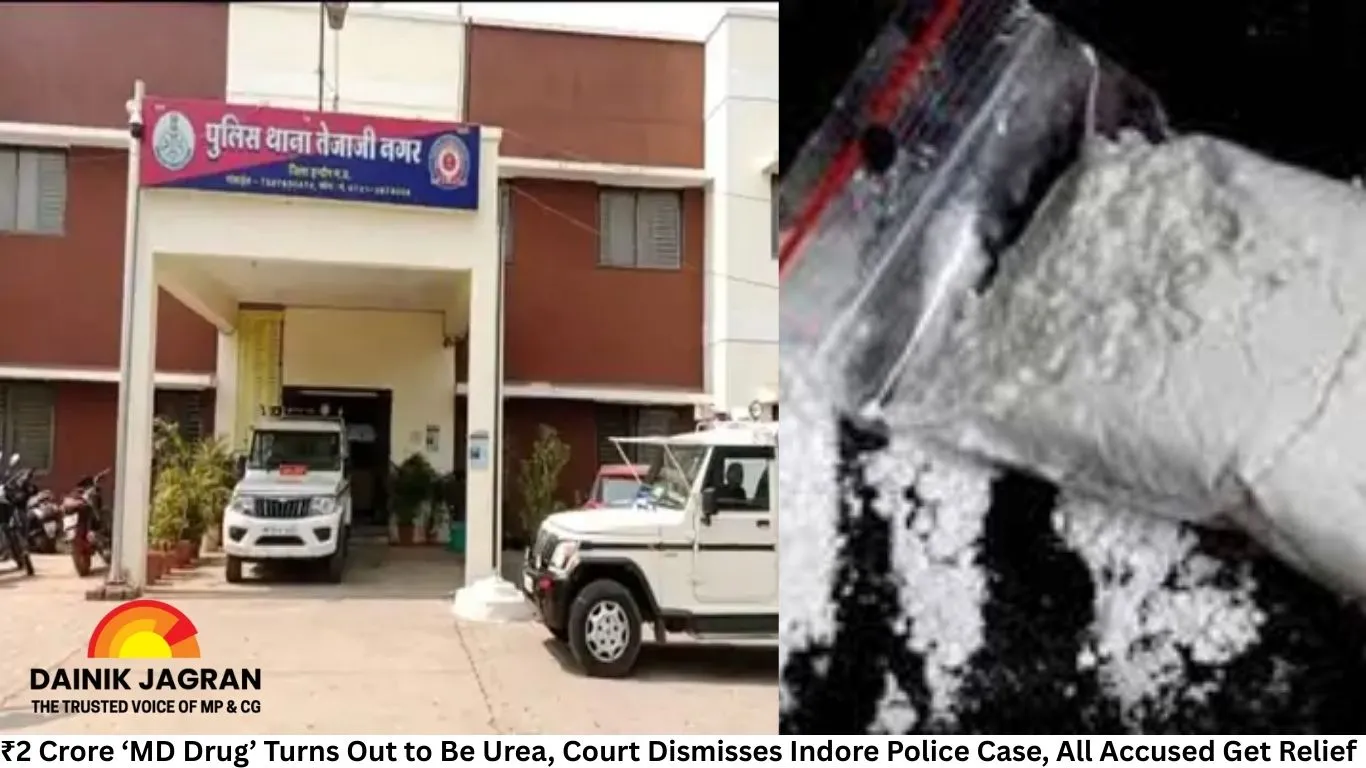
₹2 Crore ‘MD Drug’ Turns Out to Be Urea, Court Dismisses Indore Police Case, All Accused Get Relief
Digital Desk
The case dates back to February 26, 2025, when Tejaji Nagar police intercepted two bike-borne youths on the AB Road bypass near Kasturba Gram. The accused were identified as Vijay Patidar of Mandsaur and Mohammad Shahnawaz of Azad Nagar. Police had claimed to recover 198 grams of MD (mephedrone) from Shahnawaz’s pocket and estimated its international market value at ₹2 crore. Both were arrested under Sections 8 and 22 of the Narcotic Drugs and Psychotropic Substances (NDPS) Act.
Based on Shahnawaz’s memorandum statement, police also named Lakhan Gupta, a court munshi posted at Azad Nagar police station, as an accused, alleging his involvement in the case. Another accused, Raja alias Raja Babu, was later added during the investigation.
However, the prosecution’s case weakened after a forensic report from the Bhopal-based Forensic Science Laboratory (FSL) revealed that the seized substance was not MD or any other banned narcotic. The analysis identified it as potassium nitrate, a compound commonly used in fertilizers, fireworks and toothpaste.
Despite the findings, police sought a re-examination from the Central FSL in Hyderabad. The second report, submitted on December 9, 2025, reaffirmed that the substance was urea and ruled out the presence of any narcotic drug. With both forensic reports contradicting the initial claim, the NDPS charges could not be sustained.
Following the forensic conclusions, Tejaji Nagar police submitted a closure report before the district court, admitting that the case registered against Vijay Patidar, Mohammad Shahnawaz, Raja alias Raja Babu and constable Lakhan Gupta was incorrect. On Tuesday, the special NDPS court accepted the report, formally dismissing the case and ordering the return of seized mobile phones and other personal belongings. All accused are currently on bail.
Legal experts say the case highlights the growing importance of forensic scrutiny in NDPS investigations. High Court advocate Krishna Kumar Kunhare stated that individuals wrongfully implicated can seek compensation from the state under constitutional provisions and demand action against erring officers. Advocate and doctor Roopali Rathore noted that Section 58 of the NDPS Act provides safeguards against misuse of power, including false search, arrest and harassment.
The case has raised serious questions about investigative diligence and accountability in narcotics enforcement.
.jpg)




