


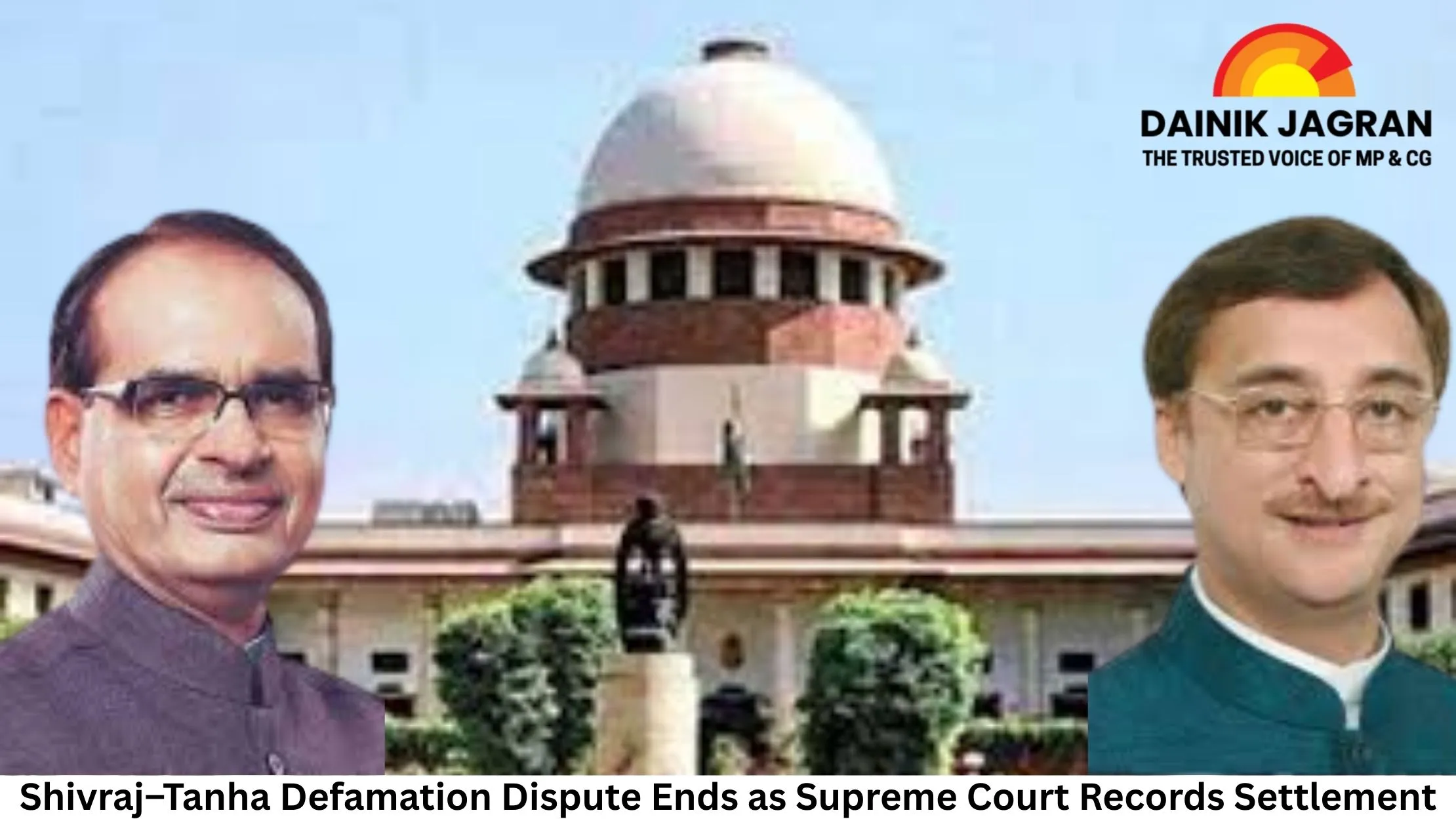
Shivraj–Tanha Defamation Dispute Ends as Supreme Court Records Settlement
Digital Desk
The dispute stemmed from events during the 2021 panchayat elections in Madhya Pradesh, when political controversy erupted over the issue of OBC reservation. At the time, hearings on OBC reservation were underway in the Supreme Court. During the political debate, statements were made by BJP leaders alleging that Tanha was opposing OBC reservation. Tanha later claimed that these statements had caused serious damage to his public image and reputation.
Following the remarks, Tanha filed both civil and criminal defamation cases against Shivraj Singh Chouhan. The civil suit sought damages of ₹10 crore, while the criminal complaint invoked Section 500 of the Indian Penal Code, which deals with criminal defamation. The matter was initially heard by a lower court, later moved to the High Court, and eventually reached the Supreme Court.
On Tuesday, senior advocate Mahesh Jethmalani, appearing on behalf of Vivek Krishna Tanha, informed a bench comprising Justice M.M. Sundresh and Justice N.K. Singh that the dispute had been resolved amicably. He told the court that Tanha had decided to withdraw both the civil and criminal defamation cases against Chouhan after discussions between the two leaders.
According to submissions made before the court, Shivraj Singh Chouhan and Vivek Krishna Tanha met in Parliament and mutually agreed to put an end to the legal battle. Following the settlement, Tanha formally withdrew the allegations and sought closure of the proceedings.
Taking note of the development, the Supreme Court observed that once the complainant had withdrawn the allegations, there was no justification for continuing the criminal proceedings. The court accordingly dismissed both the civil and criminal cases, bringing the matter to a close.
The resolution marks the end of a politically sensitive dispute that had drawn attention during debates on reservation policy and electoral politics in Madhya Pradesh. Legal experts note that the court’s decision reinforces the principle that criminal defamation proceedings cannot continue in the absence of a complainant pursuing the charges.
The settlement is also seen as a rare instance of cross-party consensus, with both leaders choosing reconciliation over prolonged litigation. With the Supreme Court’s order, all legal proceedings arising from the controversy now stand concluded.
.jpg)




