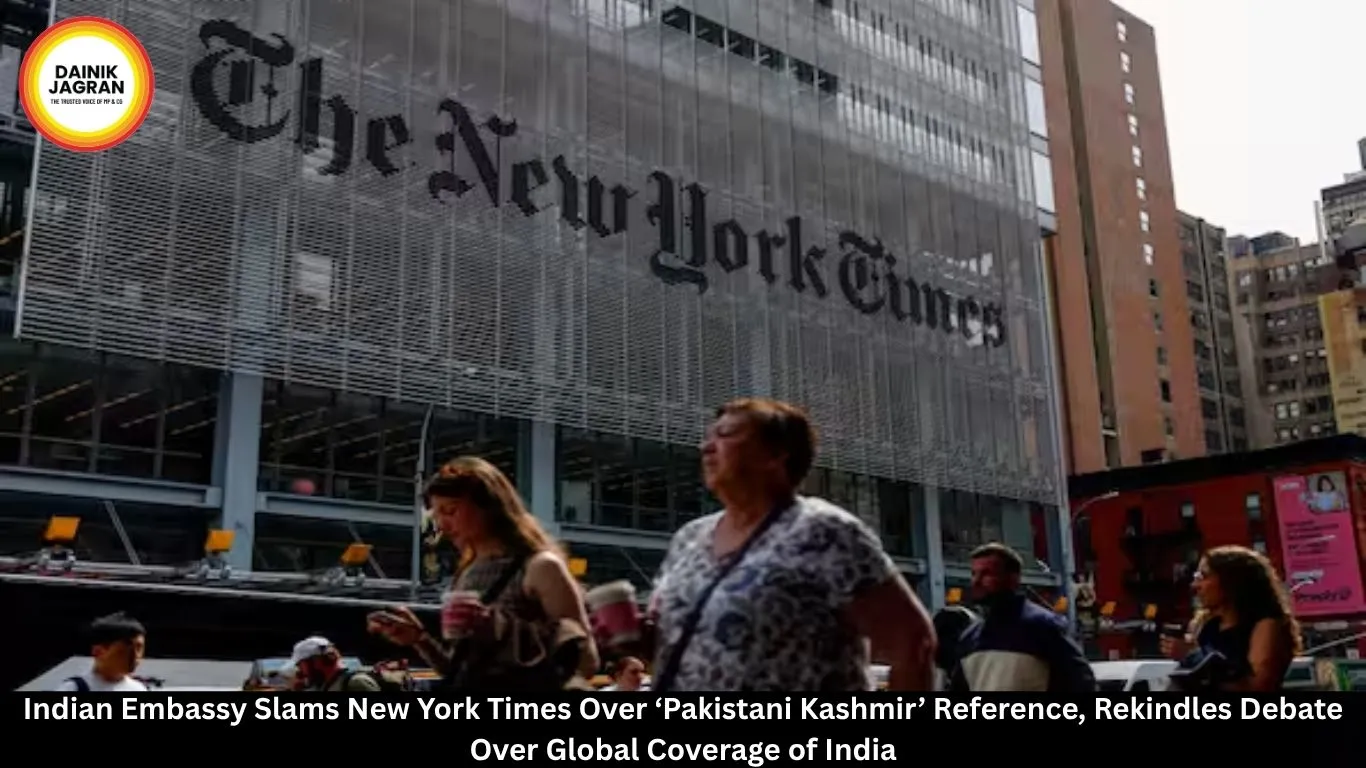
Indian Embassy Objects to New York Times' 'Pakistani Kashmir' Reference

Digital Desk

Indian Embassy Objects to New York Times' 'Pakistani Kashmir' Reference

The Indian Embassy in the US has criticised The New York Times for referring to Pakistan-occupied Kashmir as "Pakistani Kashmir," calling the terminology misleading and reaffirming India's position on the region.

 The Indian Embassy in the United States has strongly objected to The New York Times for referring to Pakistan-occupied Kashmir (PoK) as "Pakistani Kashmir" in a recent report, calling the description "misleading and incorrect." The diplomatic response has once again brought international media coverage of India's territorial issues under scrutiny.

The controversy arose after the US-based newspaper published a report on protests and violence during local body elections in Pakistan-occupied Kashmir. In its headline and report, the publication referred to the region as "Pakistani Kashmir" or "Pakistan-administered Kashmir," terminology that drew immediate objections from Indian officials.

Embassy Rejects Terminology

Responding through an official post on X, the Indian Embassy stated that the description used by the newspaper did not accurately reflect India's position on the territory.

"There is no Pakistani Kashmir, only Pakistan-occupied Kashmir," the embassy said, adding that the Union Territories of Jammu & Kashmir and Ladakh "have been, are, and will always remain an integral and inalienable part of India."

The embassy further alleged that Pakistan continues to illegally occupy parts of Indian territory and accused Islamabad of using force against civilians in the region.

Report Focused on PoK Protests

The New York Times report highlighted violent clashes in Pakistan-occupied Kashmir during local elections, where protesters and security forces reportedly confronted each other in several areas.

According to the report, demonstrations were led by the Joint Awami Action Committee (JAAC), which has been demanding political and economic reforms in the region. Media reports indicated that the unrest resulted in casualties and injuries, while security forces launched operations to control the situation.

The newspaper described the region using terminology commonly adopted by several international media organisations, which often refer to the territory based on its current administrative control while acknowledging that it remains disputed.

Fresh Debate Over International Coverage

The embassy's response has revived a broader discussion on how international media outlets describe Jammu & Kashmir and Pakistan-occupied Kashmir.

Indian officials have consistently maintained that the entire erstwhile princely state of Jammu & Kashmir, including territories under Pakistan's control, forms an integral part of India. Consequently, the Government of India officially uses the term "Pakistan-occupied Kashmir" or "PoK."

Several international publications, however, use expressions such as "Pakistan-administered Kashmir" or "Pakistan-controlled Kashmir" to describe the territory while reporting on developments there.

Previous Controversies

The latest disagreement also renewed attention on earlier instances in which The New York Times faced criticism from sections of Indian policymakers, commentators and readers over its reporting on India-related issues.

Over the years, the publication has attracted criticism over the terminology used in reports on Kashmir, editorial cartoons, and coverage of Indian domestic and foreign policy. Supporters of the newspaper argue that its editorial decisions follow international journalistic conventions, while critics contend that certain descriptions fail to adequately reflect India's official position.

Diplomatic Sensitivity

The disagreement underscores the continuing diplomatic sensitivity surrounding Kashmir, which remains one of the most contentious issues between India and Pakistan.

India maintains that Pakistan occupies parts of Jammu & Kashmir illegally, while Pakistan disputes India's claim over the territory. International media organisations often adopt terminology that differs from the official position of either country, occasionally leading to diplomatic objections.

The latest response from the Indian Embassy highlights New Delhi's continued emphasis on ensuring that references to Jammu & Kashmir align with India's constitutional and territorial position.

As the debate over terminology continues, the incident also illustrates the broader challenges international news organisations face while reporting on long-standing geopolitical disputes where competing national narratives remain deeply entrenched.

 

--------

🚨 Beat the News Rush – Join Now!

Get breaking alerts, hot exclusives, and game-changing stories instantly on your phone. No delays, no fluff – just the edge you need. ⚡

Tap to join: 

🟢 WhatsApp Channel: Dainik Jagran MP CG

Crave more?

🅕 Facebook: Dainik Jagran MP CG English

🅧 Twitter (X): Dainik Jagran MP CG

🅘 Instagram: Dainik Jagran MP CG

Share the fire – keep your crew ahead! 🗞️🔥

english.dainikjagranmpcg.com
30 Jul 2026 By Abhishek Joshi

Indian Embassy Objects to New York Times' 'Pakistani Kashmir' Reference

Digital Desk

 The Indian Embassy in the United States has strongly objected to The New York Times for referring to Pakistan-occupied Kashmir (PoK) as "Pakistani Kashmir" in a recent report, calling the description "misleading and incorrect." The diplomatic response has once again brought international media coverage of India's territorial issues under scrutiny.

The controversy arose after the US-based newspaper published a report on protests and violence during local body elections in Pakistan-occupied Kashmir. In its headline and report, the publication referred to the region as "Pakistani Kashmir" or "Pakistan-administered Kashmir," terminology that drew immediate objections from Indian officials.

Embassy Rejects Terminology

Responding through an official post on X, the Indian Embassy stated that the description used by the newspaper did not accurately reflect India's position on the territory.

"There is no Pakistani Kashmir, only Pakistan-occupied Kashmir," the embassy said, adding that the Union Territories of Jammu & Kashmir and Ladakh "have been, are, and will always remain an integral and inalienable part of India."

The embassy further alleged that Pakistan continues to illegally occupy parts of Indian territory and accused Islamabad of using force against civilians in the region.

Report Focused on PoK Protests

The New York Times report highlighted violent clashes in Pakistan-occupied Kashmir during local elections, where protesters and security forces reportedly confronted each other in several areas.

According to the report, demonstrations were led by the Joint Awami Action Committee (JAAC), which has been demanding political and economic reforms in the region. Media reports indicated that the unrest resulted in casualties and injuries, while security forces launched operations to control the situation.

The newspaper described the region using terminology commonly adopted by several international media organisations, which often refer to the territory based on its current administrative control while acknowledging that it remains disputed.

Fresh Debate Over International Coverage

The embassy's response has revived a broader discussion on how international media outlets describe Jammu & Kashmir and Pakistan-occupied Kashmir.

Indian officials have consistently maintained that the entire erstwhile princely state of Jammu & Kashmir, including territories under Pakistan's control, forms an integral part of India. Consequently, the Government of India officially uses the term "Pakistan-occupied Kashmir" or "PoK."

Several international publications, however, use expressions such as "Pakistan-administered Kashmir" or "Pakistan-controlled Kashmir" to describe the territory while reporting on developments there.

Previous Controversies

The latest disagreement also renewed attention on earlier instances in which The New York Times faced criticism from sections of Indian policymakers, commentators and readers over its reporting on India-related issues.

Over the years, the publication has attracted criticism over the terminology used in reports on Kashmir, editorial cartoons, and coverage of Indian domestic and foreign policy. Supporters of the newspaper argue that its editorial decisions follow international journalistic conventions, while critics contend that certain descriptions fail to adequately reflect India's official position.

Diplomatic Sensitivity

The disagreement underscores the continuing diplomatic sensitivity surrounding Kashmir, which remains one of the most contentious issues between India and Pakistan.

India maintains that Pakistan occupies parts of Jammu & Kashmir illegally, while Pakistan disputes India's claim over the territory. International media organisations often adopt terminology that differs from the official position of either country, occasionally leading to diplomatic objections.

The latest response from the Indian Embassy highlights New Delhi's continued emphasis on ensuring that references to Jammu & Kashmir align with India's constitutional and territorial position.

As the debate over terminology continues, the incident also illustrates the broader challenges international news organisations face while reporting on long-standing geopolitical disputes where competing national narratives remain deeply entrenched.


https://english.dainikjagranmpcg.com/national/indian-embassy-objects-to-new-york-times-pakistani-kashmir-reference/article-24302

Trending News